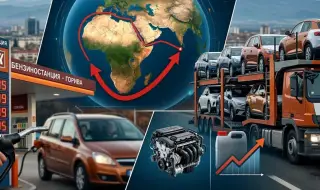
The geopolitical tension in the Middle East in early 2026 is not just a distant conflict - it is an economic domino that is already knocking down the first tiles, but we are interested in what can happen to the Bulgarian automotive market. From the price of the gas station to the delivery time of your new car, the effects are starting to become visible and measurable.
The dance of prices: Fuels under pressure
If you felt a slight “pinching“ in your wallet when you last filled up, you are not imagining it. The escalation of the conflict led to a sharp jump in crude oil prices, with Brent crossing the psychological threshold of $100 per barrel.
For the Bulgarian consumer, this means only one thing - an increase in price. Experts predict that in the short term, gasoline and diesel prices in our country may increase by 15 to 20 cents per liter. Economists even warn that if the crisis deepens, the price of the pump may reach levels of 1.80 euros per liter. The good news is that a physical shortage of fuel is not expected in Bulgaria, since our country does not directly depend on supplies through the Strait of Hormuz.
Logistical labyrinth: Your new car will be late
Bypassing the dangerous areas in the Red Sea has become the “new normal” for transport companies. Instead of the Suez Canal, ships carrying cars and components from Asia (China, South Korea, Japan) are now en masse bypassing Africa via the Cape of Good Hope.
What does this mean for you? Extended delivery times: The journey is extended by 10 to 14 days. Higher costs: Transport costs have jumped by 10% to 30% due to longer routes and twice as high insurance premiums. Parts shortages: The logistical chaos is also affecting the supply of spare parts, which can prolong the time cars spend in workshops.
The artificial increase in the price of cars
It's not just logistics and fuel. A modern car contains between 150 and 200 kg of plastic and synthetic materials, the cost of which is directly linked to the price of oil. The projected 15% to 25% increase in petrochemical raw material prices will put additional pressure on final vehicle prices until the summer of 2026.
Is there light at the end of the tunnel?
Despite the dark clouds, the Bulgarian market is showing resilience. Retailers are adapting through larger inventory and flexible logistics schemes. However, market analysts advise: if you are planning to purchase a new car, now is the time to act before the full effect of the accumulated costs is reflected in price lists in the second quarter.