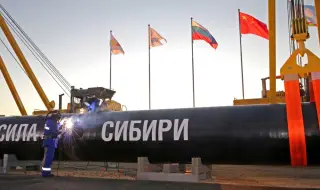
Russia and China are preparing a new stage in their gas partnership. „Gazprom“ and the Chinese CNPC are working on the start of supplies of Russian gas via the Far Eastern route.
This became clear after a meeting in Beijing between the chairman of „Gazprom“ Alexei Miller and the head of CNPC Dai Houlian.
According to „Gazprom“, preparations are on schedule. Equipment is currently being installed at the „Dalnorechensk“ gas metering station. The planned start of supplies is January 2027. The expected maximum volume is up to 12 billion cubic meters of gas per year.
The key technical element of The “preparation” stage is the metering infrastructure. It is needed to record quantities and control gas parameters. “Gazprom” indicates that this is where equipment is currently being installed.
The planned capacity of 12 billion cubic meters per year does not replace current supplies. It adds a new line to the already operating flows to China. Thus, Russia receives another export channel to the east. China gains additional pipeline resources.
“Gazprom” emphasizes the reliability of the operating eastern route. This is the “Power of Siberia” gas pipeline, which connects Russian fields with the Chinese market. The company claims that scheduled maintenance was carried out without interrupting supplies. This happened this spring. The same approach was applied the previous year.
Supplies on the “Power of Siberia” began in 2019. The first source was the Chayandinskoye field in Yakutia. Three years later, gas from the Kovikta field in the Irkutsk region was added to the flow.
According to Gazprom, deliveries have already reached the contractual level of 38 billion cubic meters per year. For 2025, the company forecasts 38.8 billion cubic meters. This is above the contractual obligations.
In addition to current deliveries and the Far Eastern route, the parties are also talking about expansion. According to the announcement, an agreement has been reached to increase deliveries to 44 billion cubic meters per year.
In parallel, a legally binding memorandum was signed for the construction of the “Power of Siberia 2“. The package also includes the “Soyuz-Vostok“ transit gas pipeline through Mongolia. This route should allow the delivery of another 50 billion cubic meters of gas per year from Russia through Mongolian territory.
If these projects are realized, the Moscow-Beijing energy axis will become even more structured. This would consolidate China's role as a major market for Russian pipeline gas. For the region, this means stronger competition for long-term contracts and infrastructure corridors.