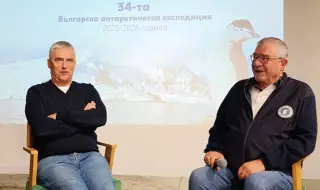
The 34th Bulgarian Antarctic Expedition and the 4th on the ship "St. Cyril and Methodius" begin. The first group of scientists - 9 logisticians and 2 scientists, depart on November 6 early in the morning, and a day later the Bulgarian ship will also sail from the port of Varna. This year it will be 150 days outside Bulgaria. It is expected to reach the Bulgarian base in about 45 days. The total stay on the Scheldt Islands will be between 45 and 50 days. “During this time, over 10 projects related to cinematographic research will be implemented. We have never had such a busy program before. A huge logistical activity will also be carried out with the ship. In addition to the transfer and transportation of materials, food and everything necessary as equipment, the ship will transport over 80 tons of various cargo“, said Lyubomir Mateev, the logistics manager of the Bulgarian Antarctic base and deputy director of the National Center for Polar Research at a press conference on the occasion of the start of this year's expedition.
There is a large interesting project related to sea currents. It is being implemented jointly with the Institute of Geology in Hamburg. A large radar has already been installed on the ship, which will help study currents and waves.
“The colleagues from Montenegro will also work from the ship on oceanographic projects. In terms of logistics, the base will be open from November 15 to March 6. And in total, over 60 people are expected to work on it, including logisticians, scientists, builders and people who will equip the new laboratory“, Mateev specified.
This year, women predominate in the expedition. “They will work for species diversity in the Southern Ocean. Measures must be identified to protect Antarctica“, said Prof. Hristo Pimpirev, Chairman of the Bulgarian Antarctic Institute and head of the 34th Bulgarian Antarctic Expedition. “This is the fourth expedition of the ship NIK421. With this fourth expedition, we proved that we are a maritime nation“, he said.
Antarctica occupies one tenth of the Earth's surface — it is a common human treasure, but also part of Bulgarian scientific pride. “Today we are equal to the nations that once discovered new worlds, while we "we were under Ottoman rule. Now we stand shoulder to shoulder with them in the scientific exploration of new territories," the professor explained.