The new stricter sanctions and fines, which came into force on September 7 this year, did not reduce the number of victims on the road, but paradoxically - they increased. This is shown by the black statistics of the Ministry of Interior for the period from September 7 to October 31, 2025. Six more Bulgarians lost their lives compared to the same period last year, despite the repressive measures against drivers.
At the same time, the official data of the Ministry of Interior paint a picture in which the state and municipalities are practically faultless in terms of road infrastructure. According to the written acts, in 99.9% of cases the citizens - drivers and pedestrians - are to blame for the accidents. Only 0.1% of accidents are attributed to poor road conditions.
The number one cause of accidents in our country in 2025 is not speeding, but the so-called "improper speed". This is the legal term that allows the Traffic Police to sanction drivers even when they are driving within the law, but end up in unsafe areas.
"The traffic policeman comes and asks for his documents. Sir, have you been driving at an inappropriate speed? A person has a comprehensive insurance policy on his car and wants to get it from the insurer. The insurer says - I need a traffic accident report. The easiest thing is for the traffic policeman to write that he was driving at an inappropriate speed. Nobody says that there is a problem on the road," said the former director of the "Traffic Police" Tencho Tenev, quoted by bTV.
According to the expert, it is administratively easiest for the police to draw up a driver's report, instead of entering into complex procedures for describing infrastructure deficiencies, which would involve the responsibility of the municipality or the Road Infrastructure Agency (API).
A victim of this practice is Miroslav Ivanov. The incident with him occurred on the Chelopeshko Shose Boulevard in Sofia, just a day after the new legal changes came into force.
"It was 4:00 p.m., I was driving at 60 km/h at a reasonable speed. And as I was driving, suddenly he took me off the lane, straight onto the shoulder. The tires squealed. I got out, saw the front tire, I saw the rear tire, they were flat. "The rims are very bent," the victim told bTV.
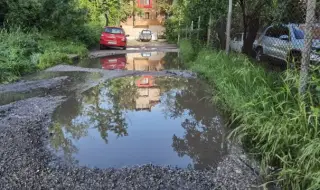
Although he did not break the rules, Miroslav chose not to call the police, knowing that he would probably be sanctioned for "inappropriate speed". The cause of the accident was untrimmed bushes that pushed the cars to the right lane, where a 50-centimeter hole gaped.
Two months after the accident and the report, the hole has still not been filled, and the bushes have not been cut. The Sofia Municipality told bTV that repairs are planned for next year.
While drivers are subject to constant checks and sanctions, the responsibility of the institutions remains in the background. The RIA road budget for 2025 is over 1.6 billion leva, but the condition of the road network in many regions remains critical.
Eurostat data confirms the link between poor infrastructure and mortality. The northwestern region of Bulgaria has the highest number of deaths per capita in the entire European Union.
"A week ago we wrote to the Minister of Regional Development. The roads, especially Lom – Brusartsi – Dinkovo, are in a deplorable condition. I specifically wrote to the Minister asking for attention, because in our village of Vasilovtsi we have terrible open potholes. They are already pits that are a constant prerequisite for road accidents," commented Alexander Borisov, mayor of the village of Vasilovtsi.
The statistics are categorical – from September 7 to October 31, 987 serious accidents occurred on Bulgarian roads. The death toll is 74, six more than before the lockdown.