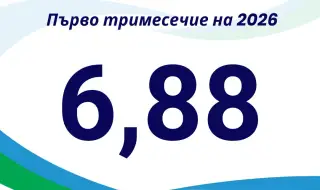
Public tension in Bulgarian society remains high. For the first quarter of the year, the index, measured jointly by the Center for Analysis and Crisis Communications and the agency “Myara“, is worth 6.88.
This is a slight increase compared to the previous period, when it was 6.76. Thus, the indicator in question continues to be in the column “high index, difficult to control risks“.
Despite the close values for the last two quarters, the internal dynamics are quite interesting. The political tension, typical of the last months of 2025, has decreased, but as factors for increasing anxiety, the real and perceived increase in prices and the “Petrokhan” tragedy, which received quite a serious public resonance, come to the fore.
General characteristics, statehood and environment
According to the general indicators included in the calculation of the public tension index, there is a slight increase in inflation. At the same time, however, the perception of the increase in prices, which is reported in the section on well-being and trust, has the potential to generate more anxiety.
The corruption index according to data and information from international organizations remains high, which has an impact on the tension. The number and scale of cataclysms and disasters for the reported period is not large, and this in turn maintains the values of the index at the indicated levels. General crimes per capita – in number, not in significance – also do not show much dynamics.
Well-being and trust
The main factor for the increase in public tension is obviously price growth. It is the indicator related to the expectation of a price increase that continues to grow against the background of the previous quarters.
Of course, the traditional pre-election public tension also has an influence, which is characterized by low levels of positive attitude in most institutions. During part of the period under review, our country is in a campaign and in these conditions, trust in the government slightly increases, while trust in the other institutions under review does not show almost any change.
Publicity
A serious increase in the share of negative publications compared to positive ones in the media and on social networks is observed, and an increased use of these channels is also seen during the period under review. The main reason for the first, established by keywords, is the tragedy “Petrohan“, which has clearly had a significant impact on the anxiety of the population. Moreover, regardless of the attitude towards the case, which divided our society in two, the tension is high in both groups.
The reasons for the larger number of audience reached are both the case in question, and the topic of prices, the election campaign and the emergence of a new political player. The number of registered protests for the period is smaller, the number of participants in them is also smaller, but the coverage and sharing are quite serious in number and intensity,
––––––––––––––––––––––––––––––––––-
About the values of the Social Tension Index
The index takes values from 0 to 10, with the scale being following:
From 0 to 3.99 – low index, fully controlled risks
From 4 to 5.99 – medium index, well controlled risks
From 6 to 7.99 – high index, difficult to control risks
From 8 to 10 – very high index, almost unmanageable situation
About the Center for Analysis and Crisis Communications
The Center for Analysis and Crisis Communications was established in September 2018 by Assoc. Prof. Dr. Alexander Hristov, Lyubomir Alamanov and Daniel Kiryakov. The organization works on consultations, creating analyses and forecasts for communication crises, assessing potential communication risks, recommendations for creating procedures for prevention and response in case of crisis.