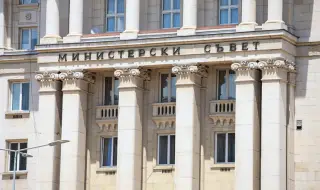
With a legislative package, the government is reforming the mechanism for investigating the Prosecutor General and a new way to form the Commission for Counteracting Corruption, Dariknews.bg reports.
At their last meeting before the elections, the caretaker ministers adopted a package of legislative changes aimed at an effective and working mechanism for investigating the Prosecutor General. It also introduces mandatory judicial control over the termination or suspension of criminal proceedings for a number of corruption crimes committed by persons in high public positions.
The changes are dictated by the urgent need to take action to implement the provisions of the National Recovery and Resilience Plan in Pillar “Fair Bulgaria“, Component “Business Environment“, letter “d“ Reforms and Investments, Reform 2: “Countering Corruption“, which provides for amendments to the legal framework related to ensuring the effectiveness of the criminal process.
The purpose of the proposed amendments is to introduce effective institutional control over the actions of the ad hoc prosecutor who investigates the Prosecutor General or his deputies, which has been practically absent to date.
The draft law does not create a new mechanism, but makes the existing one applicable, by eliminating legislative loopholes and introducing real guarantees for control.
The explanatory memorandum explicitly states that there is an “unacceptable situation of emptiness in the Criminal Procedure Code (CPC)“, including due to a reference to a non-existent provision, which practically blocks the functioning of the mechanism. Amendments to the Judiciary Act provide that the control will be carried out by a judge from the criminal chamber of the Supreme Court of Cassation (controlling prosecutor), who is randomly selected from a list approved by the General Assembly of the criminal chamber. The list should include judges with the highest rank and experience in criminal justice.
The powers of the supervising prosecutor include reviewing the actions and acts of the investigating prosecutor, issuing mandatory instructions, assessing the legality and justification of the procedural actions, and possibly resuming the proceedings in the presence of new circumstances.
The supervising prosecutor will be appointed at the time the proceedings are initiated, thus preventing a period in which the actions of the investigating prosecutor remain unsupervised.
Mandatory judicial control is also provided for over rulings to terminate criminal proceedings for a crime committed by the Prosecutor General.
Mandatory judicial control is also introduced over the termination or suspension of criminal proceedings for a number of corruption crimes committed by persons in high public positions.
The new regulation proposes that the court be notified, as The control will cover both legality and justification. The dependence on the filing of a complaint by an interested person to initiate judicial control is eliminated.
The explanatory memorandum emphasizes that in the current legislation, in the absence of an interested person to initiate judicial control over the prosecutor's decrees, the further development of the process is practically hindered.
The President, the supreme courts, the bar and the National Assembly will elect the members of the new anti-corruption commission
As for the formation of the Commission for Combating Corruption, a draft of a new Law on Combating Corruption among Persons Holding Public Offices was approved. This creates a new way of forming it, focusing its activities on the actual anti-corruption activity and other innovations, the press service of the Council of Ministers reports.
The goal is to create an effective body to combat corruption, whose independence is legally guaranteed in the protection of the public interest.
The creation of the new law is also in implementation of the National Recovery and Resilience Plan (NRRP), as well as the recommendations of the European Commission with a view to the comprehensive reporting and payment of funds within the framework of the second and third payments under the NRP. So far, due to unsatisfactory implementation of the anti-corruption reform, the EC has suspended the payment of a total of 258,228,948 euros.
The new law provides for the establishment of a five-member Commission for Combating Corruption, with one of its members to be elected by the National Assembly, one to be appointed by the President of the Republic, one each to be elected by the general assemblies of the Supreme Court of Cassation and the Supreme Administrative Court, and one to be elected by the Supreme Bar Council. The mandate of the commission will be five years, without the right to re-election, and its chairman will be changed every year on a rotational basis by drawing lots. Every six months, the commission will report to the National Assembly and will also submit an annual report on its activities.
The law defines 52 categories of persons holding public positions who fall within its scope. Among them are the president and vice-president, deputies, members of the Council of Ministers, constitutional judges, those holding leading positions in the judiciary, members of the European Parliament from the Republic of Bulgaria, Bulgarian European Commissioners and a number of others.
The work of the commission will be in several areas - prevention of corruption (through collection and analysis of information, development and proposal of anti-corruption measures), detection and investigation of so-called corruption crimes, including embezzlement, intentional mismanagement, conclusion of an unprofitable deal, individual crimes in office, bribery, trading in influence, money laundering, etc. Next, the commission will check the declarations of assets and interests of persons holding public positions, as well as establish conflicts of interest of the same.
The bodies of the Commission will have operational-search and investigative powers. The operational-search activity will be carried out by specially appointed officers upon receipt of information about a corruption crime committed by persons holding public positions, upon ascertaining discrepancies between declared and actual property, etc. The investigation will be carried out by investigating inspectors, whose status is analogous to the investigating police officers and investigating customs inspectors. Their investigative activity will be carried out under the terms and conditions of the Criminal Procedure Code.
The Anti-Corruption Commission will be able to appeal to the court the prosecutor's refusals to initiate pre-trial proceedings. Mandatory judicial control is introduced over the termination and suspension of pre-trial proceedings investigated by employees of the Commission.
The law also regulates the consequences that occurred after the establishment of the Commission and the transfer of anti-corruption functions from the Court of Auditors to the Commission.