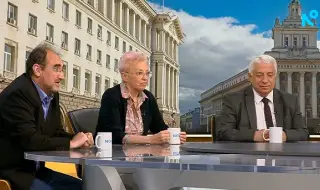
Expectations for the future government of Rumen Radev and Iliyana Yotova will be huge, and the first months of the cabinet will probably be marked by difficult economic decisions, the need for serious explanations to the public and a complex balance between promises and reality. Media expert Diana Damyanova, journalist Valery Todorov and his colleague from the newspaper “Sega“ Petyo Tsekov united around this opinion in the studio of “Hello, Bulgaria“ and commented on what signals the silence around the ministers gives, what risks the future government hides and what the role of the opposition will be.
According to Diana Damyanova, the most interesting thing about the new cabinet is the lack of leaks and public “burning“ of candidacies even before their official announcement. According to her, this is a different approach from the familiar Bulgarian practice, in which the names of future ministers often appear in advance in order to be subjected to attacks and discrediting.
She noted that around Radev's team there is a desire to present the cabinet in a complete form, without long internal bargaining and public disputes. According to her, this resembles a European model of political behavior.
However, Petyo Tsekov commented that the lack of party structure and internal party dynamics around the future government creates the feeling that decisions are made by a narrow circle around the president. According to him, this is precisely why society is paying close attention to whether the names that have been unofficially discussed in recent weeks will appear.
The journalist emphasized that for him, the most important issue is not the specific ministers, but what strategy the new government will outline in the first months of its mandate. According to him, society expects clear priorities and direction, not just personal appointments.
Valeriy Todorov also believes that the key figures around the cabinet are largely already recognized through the president's close circle. According to him, in the past, the public "releasing" of names has often served both to test public reactions and to concentrate political attacks on certain candidates.
He described the silence around the ministers as a good tactic in the short term, but warned that the real test will come with the specific policies and decisions of the future government. According to him, the foreign policy and culture departments will be particularly important, where public and international pressure is traditionally stronger.
The studio also commented on the reaction of Dimitar Stoyanov, who is close to Radev, who sharply criticized the PP-DB's request to vote against the cabinet. Diana Damyanova described such messages to the opposition as worrying and undemocratic.
Petyo Tsekov was also categorical that it is not normal for the ruling party to dictate to the opposition how it should vote. According to him, it is the opposition between the government and the opposition that is the basis of the democratic model, and any expectation of unconditional support undermines this balance.
Valeriy Todorov pointed out that the big question will still be how the different political forces will position themselves in relation to the new government. According to him, the opposition's behavior will affect not only the parliamentary dynamics, but also public attitudes towards the cabinet.
Regarding the economic challenges facing the future government, the guests commented that if the country's budget situation turns out to be difficult, the new government may be forced to take unpopular measures, including limiting spending and freezing income.
According to analysts, it is then that it will become clear whether the high public trust in Radev will be maintained and whether citizens will accept difficult decisions as a necessary price for stability.
According to Valery Todorov, the state has been moving by inertia towards increasing spending and debt for years. He recalled that a number of social concessions have been made in recent administrations, while at the same time the state debt continues to grow. In his words, if this trend continues, governing the country will become increasingly difficult.
Todorov also drew attention to the discrepancy between public expectations and the real financial situation. According to him, some voters supported Radev in the hope that he would control prices and improve the standard of living, but it is possible that the new government will face the need to limit and freeze spending.
Diana Damyanova drew a parallel with the government of Ivan Kostov, which, according to her, carried out severe economic changes, but lost public trust due to the perception of corruption. She warned that the future cabinet faces not only the question of whether it will have the courage to make reforms, but also whether it will be able to explain them to the people.
In her words, communication will be crucial. If the government undertakes serious reforms, it will have to constantly explain its actions and convince the public of the need for them. However, if it continues the current model of distributing funds without real changes, then, according to her, the reformist image will quickly run out.
Petyo Tsekov commented that it is still not clear what kind of cabinet is ahead. According to him, if the government is center-left, it will probably continue the policy of redistribution through the state in order to reduce inequalities. However, the journalist raised the question of where the necessary funds will come from, given that the financial resources are not infinite.
He defined the state administration as an overly bloated system and pointed out that it is there that there is a reserve for cuts and optimization. Valery Todorov, however, warned that such actions risk affecting the few remaining experts in the institutions, as many administrations are built on a political principle.
Diana Damyanova believes that Radev will probably rely on a more distant and “royal“ style of communication, in which the main messages will be conveyed through spokespeople and representatives of the government. According to her, however, everything will depend on whether the cabinet will actually implement reforms or simply continue the current model.
Petyo Tsekov noted that contradictions are already noticeable in the public positions of people around the future government, including on topics such as the Ministry of Internal Affairs and the role of the caretaker cabinet. According to him, this shows that the political adjustment within the new government is still to come.