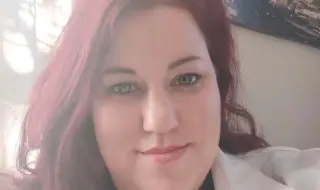
"When I was in that relationship, in that place, I didn't hear my children's laughter. That trembling, the emotion in their voices - I didn't hear them. I was there just long enough to survive and exist." This is one of Martina Lazarević's terrible memories of her relationship with an abusive partner. Looking back, she realizes that there were warning signs from the very beginning. "But no one saw them."
Martina meets her ex-partner on a dating app. She is captivated by his eyes and his desire for the settled life she had always dreamed of. Their relationship develops very quickly. On one of their first dates, the man introduces her to his mother, soon after Martina moves into his home, they get engaged, she becomes pregnant. "Love and affection are quiet, calm, they don't rush. Every spurt of things is a little red flag", the young woman says today from the distance of time and accumulated experience. But Martina has seen things differently in the past, or at least she wanted them to be different from what they actually were. That's why when at the beginning of their relationship her partner insists on taking her everywhere and picking her up, she admires his attitude and concern. "But actually he did it to make sure I would come home, that I wouldn't talk to anyone."
"Violence is every single day you feel like you can't move forward"
Martina realizes that there is a problem after giving birth to her child. She is subjected to constant mental harassment, and everything becomes an excuse - from whether she seasoned dinner well and whether she did the housework, to how she takes care of her child. "He starts to get annoyed and finds a reason to take it out on you. Not because you are to blame, just because he needs to explode."
The outbursts of mental violence in Martina's home are becoming increasingly brutal. "I have been threatened that I will be buried on Vitosha, and more than once. But a little voice inside me said "he's just talking to himself, calm down, he won't do anything to you, he loves you". But the truth is that when he goes into that other state where he becomes uncontrollable, he doesn't realize what he's doing. And then he hardly thinks that he loves you and that he can hurt you", she admits. This is precisely the invisible crisis in the home that is often belittled. "Society does not tolerate when a person is cut 400 times with a knife. But that's not the only violence - when they stuff you into a suitcase and you're done with. Violence is also every single day when you feel like you can't move forward", Martina is categorical. For her, violence is any restriction of human freedom - not being able to see your friends, being placed in financial dependence, being forced to think in a certain way. The list is painfully long. But the symptom is one - the inner feeling that something is wrong. And it is very important to listen to it.
Martina gets pregnant again. She hopes that maybe this is the way to sort everything out and her partner will become the loving and caring man she thought she met at the beginning. But the reality turns out to be crueler. The mental abuse of the young mother results in suicidal thoughts. "I wanted this hell to end. I didn't want it anymore, I couldn't stand it, I couldn't", says Martina. The only thing stopping her is the thought that she will leave her children to be raised in a family of an abuser. When brutal femicides in 2019 spark a public discussion about domestic violence, Martina begins to think about how the family relationships she considers normal are actually not. And she decides to seek help. She shares her story in an online group for mothers, who are helping her organize her escape. "Ultimately, the positive thing about this situation is that not with one, but two children, without an apartment, I left, I continued my life, and I don't exist, I live", says Martina.
But the battle doesn't end there. According to the young woman, one of the biggest misconceptions is that by leaving an abusive relationship, everything will automatically get better. Processing trauma is a long process. It happens that a person falls into a hole again, but it is important to keep moving forward. "As time passed, as I calmed down and started working with myself and my traumas, at one point I realized that I could already hear the children playing, how happy they were, how cheerful they were. And this gave rise to a new feeling in me that I had not experienced before," admits Martina. She remembers how, while she was placed in a crisis center with her children, she observed social workers and promised herself that one day, when she got back on her feet, she would help women and children.
Today, Martina helps women who have experienced domestic violence
Six and a half years after that fateful oath, Martina Lazarević is now a lecturer and mentor for women who have experienced domestic violence. For over four years, she has been part of the Survivors community of the Emprove Foundation - a community created by women who have managed to free themselves from domestic violence, for women who have embarked on a change and a new life. "This is one of the few places where things are handled in a constructive and positive way, so that you don't feel bad, you don't feel like a victim... In this community, we are absolutely safe and there is no judgment, no criticism, there is only mutual assistance", says Martina. Emprove strives to support victims of domestic violence by offering them various projects with which to process the topic - through art, creativity and reflection. For example, the "Meetings under the sign of love" campaign, part of the global campaign "Abuse is Not Love", in which "decode" The 9 First Signs of Toxic Relationships.
Martina's former pain is now healing. She observes that one of the biggest problems of victims of domestic violence is self-blame, that they allowed it to get to that point; that they didn't set boundaries; that they didn't protect themselves. As a mentor, she talks to them and shows them that they are not alone, that their feelings are normal. And she always reminds them that they have the right to happiness. "Every single person on this earth deserves to be happy. Everyone can think for themselves what makes them happy and pursue that happiness. You are not alone. Don't be afraid to seek help."
Author: Stea-Maria Miteva