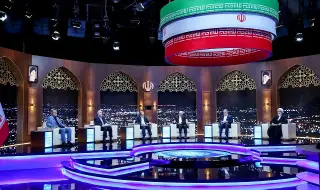
Iran is one of the countries richest in natural resources in the world, and is also a key player in the Middle East and a close ally of China and Russia. The country's future is important for both the region and the world.
Because of its geopolitical position at one of the most important nodes in the world's energy trade - the Strait of Hormuz in the Persian Gulf, as well as its vast oil and gas reserves, its political ambitions and its nuclear program, Iran is considered one of the key players in the Middle East.
For two weeks, the country of 93 million inhabitants, in which the Shiite population predominates, has been torn apart by national protests, initially triggered by the economic crisis, but which have now escalated into an open uprising against the regime in Tehran. The authoritarian leadership of the Islamic Republic officially blames the protests on its external enemies - especially the United States and Israel.
The United States and Iran - sworn enemies
However, it seems easier for the leadership to negotiate with the United States than to engage in dialogue with its own population. On January 11, US President Donald Trump announced that Iran was ready to enter into negotiations with the United States.
Since the Islamic Revolution in 1979 and the subsequent occupation of the US embassy in Tehran, Iran and the United States have not maintained diplomatic relations. Since then, relations between them have been marked by hostility, sanctions, security tensions and disputes related to Iran's nuclear program.
The United States demands that Iran completely stop enriching uranium for its nuclear program. The West accuses Tehran of seeking to create an atomic bomb. Iran denies this, but it has already enriched uranium to 60 percent. The nuclear program remains a major sticking point in relations with the West.
How big is the threat of war in Iran?
In recent days, Trump has repeatedly threatened Iran with military intervention if security forces use violence against protesters.
But the brutal approach to them has remained hidden from the world due to the shutdown of the internet and almost all forms of communication since January 9. Since Sunday, Iranian television has been constantly showing footage of morgues filled with the bodies of protesters killed by security forces. At the same time, families are warned not to allow their children to participate in the demonstrations, which were led by "terrorists".
The Iranian Foreign Ministry stated that the Islamic Republic does not seek war, but is prepared for it.
Iran and Middle East expert Fatema Aman commented on this occasion to DW: "The debate about Donald Trump's possible decisions or Israel's military actions against Iran is dedicated less to officially announced intentions than to the real impact of such steps on the power structure in the country." She added: "Experience shows that external pressure, especially if it does not lead to a quick fall of the government, will not necessarily have a weakening effect and may even have the opposite effect. In the case of Iran, this risk is particularly high."
The external threat could be used as a pretext to tighten security measures, to more strongly suppress protesters and to marginalize internal conflicts within the power apparatus. "President Trump has repeatedly shown that he puts American interests above all else", emphasizes Aman, who works at the Middle East Institute and the Atlantic Council. She believes that his main goal may be to change the behavior of the Islamic Republic, and not necessarily the regime itself. This goal could be achieved through pressure, sanctions and threats, but not through all-out war.
A large-scale war between the United States and Iran may not lead to regime change, but it would have immediate impacts on neighboring countries. "It could lead to instability in energy supplies, growing insecurity, significant economic pressure, as well as the threat of expanding related conflicts. Therefore, widespread support for a large-scale war in the region cannot be expected at this time."
Concerns about stability in the Persian Gulf
The neighboring Arab states in the Persian Gulf are not considered allies of Iran, but they have a strong interest in regional stability and avoiding military escalation. An attack on Iran carries the risk that Tehran will respond with attacks on American military bases in the region, of which there are dozens in neighboring countries.
As political scientist Farzan Sabet told DW, before the current events, the Gulf Cooperation Council countries had decided to recognize Iran as a political reality that they had to reckon with. "Later, after the events of 2019, they began to build up their own military forces and deepen their strategic ties with allies. At the same time, they wanted to emphasize diplomacy and limit tensions with Iran."
The regional feud between the Shiite rulers in Iran and the Sunni royal family in Saudi Arabia for dominance in the Middle East escalated in 2019 after refineries in Saudi Arabia were attacked with drones and missiles, temporarily cutting oil production by half. The attacks were blamed on the Houthis in Yemen, who are backed by Iran, although Tehran has denied direct involvement.
New sanctions against Iran do not please Russia and China
For Beijing, which has been steadily expanding its influence in the Middle East and continues to import cheap oil from Iran despite US sanctions, the protests and new US sanctions are not good news.
As allies of the Islamic Republic, China and Russia have criticized the sanctions imposed on Iran in September 2025 over its nuclear program, rejecting them as legally unacceptable. President Donald Trump, for his part, announced on January 12 that a 25 percent tariff would immediately take effect for countries doing business with Iran. Iran's most important trading partners are China, Turkey, the UAE and Iraq.
China criticized the decision and said it would resolutely defend its rights and interests.
Putin's Russia supports the Islamic Republic
However, Russia under Vladimir Putin's rule could have the most concerns about a free and democratic Iran, energy expert Umud Shokri suggests. He told DW: "Russia has great influence over the current leadership of the Islamic Republic. If a government comes to power that threatens Russia's interests in the region or in foreign policy, it would not be desirable for Moscow."
Iran is among the three countries with the largest oil reserves in the world, and also has the second largest reserves of natural gas. "If Iran manages to attract the necessary capital and technology and regain its share of the energy market after the lifting of sanctions, the share of other exporters will gradually decrease."
However, Shokri believes that a democratically elected and stable government in Tehran could be in the interest of all other countries in the region. This would put an end to Iran's interventionist foreign policy, which affects all countries in the region - whether they want it or not.