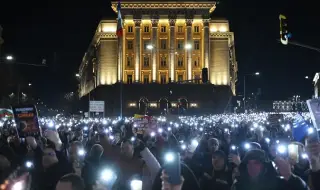
If civil discontent does not grow into a civil vote, the model against which it is directed will still survive, predicts Georgi Lozanov.
What risks does the state of the media environment in Bulgaria carry after the removal of Maria Tsantsarova and on the eve of the early parliamentary elections, caused by the most massive civil protests of the transition? The main risk is that civil discontent will demoralize and not reach the ballot boxes, and how and when Tsantsarova's removal was carried out is indicative of this. Among the reasons, the fact that she allowed herself a gesture of civil solidarity on air was specifically highlighted as an unacceptable transgression. And the moment of saying goodbye to her was chosen in such a way as to turn it into a message to the protesters: do not imagine that anything depends on you - the model of government remains stable!
And indeed, if the civil discontent does not grow into a civil vote, the model against which it is directed will still survive. Because it feeds and itself feeds the corporate, controlled, bought and manipulated vote, which it always counts on to predetermine the governance of the country. And after the electoral spiral turns in the familiar game of "stay where you are", to once again arrive at a regular government, which, assembled or not, reproduces the same model. It is enough for the citizens, who insist on its end and on a Western European future for their homeland, to stay at home. And this is achieved by convincing them, in Baiganievsky style, that everyone is a sham in favor only of those who really are such. The rest are at most "impotent" because they can do nothing to the maskers, the "made-up", according to the Arabic etymology of the word, i.e. to those who present themselves as those they are not. Generation Z took to the streets precisely against the great shaming in politics and at first the rulers felt obliged to support the right to protest, the government resigned to satisfy the demands. But this also turned out to be shaming, because they subsequently accused the protesters of all sorts of things, even that they were financed by smugglers.
The government is trying to hide its outrages
The "everyone is a masker" strategy is being implemented in the tried and tested way - by changing the roles and topics in the media coverage of politics. For a whole year, the democratic practice of the opposition criticizing the government, which should respond to its criticism, was reversed, and instead, it directed them even more loudly back at the opposition. And not even at the whole, but primarily at the PP-DB, actively attacked by other opposition parties. The impression is created that entities like "Mech" are in parliament only to raise the decibels of the scandal, so that the audience completely loses orientation who is wrong, who is right. The point is not that the PP-DB is infallible, but that using political factors outside the government as a "punch bag" gives it the opportunity to hide its own scandals from public attention, so that pointing them out sounds like just one opinion in a debate without an ending.
If this were not the desired result, the party leaders from the ruling majority would not be running around giving interviews in the media, where journalism could at least exercise its critical function on them. And the dismissal of Tsantsarova should be another warning that such professional ambitions are punished. By the way, President Radev has also limited himself publicly to briefings and statements, which is another sign that he is preparing to be a party leader of the type in question.
The critical whatabautism - whatever you accuse me of, I accuse you of - also helps the second replacement. The petty squabbles that flow into each other with their inherent threats, sarcasm and boasting set the tone of public discourse and lead the media agenda, so that the big problems of society sound like commonplace talk and remain in the background. There are two of them and the less we deal with them, the more dramatic they become: corruption, which drastically reduces the quality of life (infrastructure, healthcare, investments, social care, etc.) and Putin, who wants to return Bulgaria to the zone of old Soviet influence. I can already hear the reactions of annoyance: enough with this corruption, enough with this Putin! Those who call themselves fighters against corruption, are they not corrupt? Why are you scaring us with Putin, when we are in the EU and NATO?
Corruption and Russia - a national destiny?
Corruption is also thrown around like a hot potato from word of mouth, as if it were a matter of personal bargaining, mastery in releasing compromising material and folk psychological studies on the topic of "Who hasn't given 20 leva to a katajija". As if it is not about endemic corruption, which has become systemic, determining the functioning of power and the distribution of public resources - it is precisely this model that citizens rose up against. And as if for the Bulgarian 21st century the fight against it is not the central one, which "as a rule" picks up speed before elections and subsides after them. Without the third brother from the fairy tale having appeared to protect the golden apple. But the important lesson here is "Hristo Ivanov" - whatever legal and constitutional reform you make, it loses its meaning if Peevski's people, who have become a byword for the problem, remain in the institutions and even you yourself will be labeled as one of them, sitting on a greasy coffee in the lap of the new beginning.
Through an even more opaque public fog, we are shown the image of Putin, who from a war criminal, on whose conscience over two million human lives already weigh, was repackaged as a partner with whom a deal must be made. And they gently rock us in a propaganda cradle so that we do not feel that we will also be part of the deal. Meanwhile, the casting for the Bulgarian Orban is underway on the local political scene, with contenders not only the outspoken Kremlin proxy Kostadinov and the more timid Radev, but also Peevski, who has embarked on a new battle with the "Sorosoids" and withdrew his support for financial aid to Ukraine. So even Boyko Borisov tried on the role of his friend Viktor and after all the requests for devotion to the EU decided to give an interview to Yavor Dachkov. When a politician appears before a sworn Eurosceptic and an outspoken admirer of Putin, even if he emphasizes his contribution to European integration with every second word, his main message is to whom he appeared. The context tells his voters: today we may still be for the EU, but tomorrow we will have to be for Putin. And from the Bulgarian Orban to the Bulgarian Putin (Kim Jong-un's ally) there is only one step, because of the innate closeness to Russia that is instilled in us by the first class, which they do not have in Hungary.
The election campaign is going on, and with it the "boiling of frogs", until you come to terms with the fact that both corruption and Russia are national destiny and there is no moving forward. Then you evaluate politicians according to what they are ready to do for the people - for example, a "people's store", and not whether they hear the voice of the citizens in the squares. In order for them to be forced to hear it, you have to put it in the ballot box. And the test for whom has now become quite simple: for the one who is more capable of governing according to the rule of law, and not according to the law of force.
This text expresses the opinion of the author and may not coincide with the positions of the Bulgarian editorial office and the State Gazette as a whole.