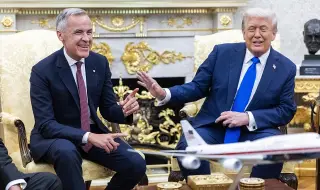
After Canadian Prime Minister Mark Carney spoke in Davos last week, an entire continent felt envy of his leadership. Calling the rules-based order — which Washington preached for decades before trampling it — a mirage, Carney gave a rhetorical middle finger to his country’s hegemonic neighbor, and Europeans were immediately impressed, writes "Politico".
Before politicians in the bloc rush to emulate him, however, it might be worth cooling off the Carney fever.
Looking both steely and smooth in his Davos speech, Carney warned middle powers that "when we only negotiate bilaterally with a hegemon, we negotiate out of weakness." Perhaps this was a reference to the brutal daily coercion that Canada suffers from the US administration. But he may have been talking about the more subtle asymmetry he experienced just days earlier in Beijing.
In contrast to his defiance in Switzerland, Carney was flattering during his visit to China. He signed an agreement on behalf of Canada for a “new strategic partnership” in preparation for an emerging “new world order” and praised Chinese leader Xi Jinping as a champion of multilateralism.
The visit also led to the “cars for rapeseed” deal, under which Canada will cut tariffs on Chinese electric vehicles from 100% to 6.1% and raise the import limit to 49,000 vehicles per year. In return, China will reduce tariffs on Canadian canola seeds from 84% to 15%.
Ottawa expects Beijing to also reduce tariffs on Canadian lobsters, crabs and peas later this year and to buy more Canadian oil and perhaps gas. The agreement to start energy ministerial-level dialogue is sure to pave the way for potential deals.
These productive talks ultimately led Carney to declare Beijing a "more predictable" trading partner than Washington. And who can blame him? He was simply stating the obvious - after all, China is not threatening Canada with annexation. But one is tempted to wonder whether he would have flattered China so much if his country still possessed some of the world's leading technology.
The truth is, Canada's oil and gas industry probably shouldn't have gotten its hopes up so high. Chinese officials usually offer serious consideration, not outright polite rejection—just ask Russia, which has spent decades in dialogue with Beijing over a pipeline designed to replace Europe as a natural gas market.
The “cars for rapeseed” deal also carries a certain irony: Canada is importing the very technology that is making fossil fuels obsolete. China is electrifying at a dizzying pace, with the International Energy Agency predicting that its oil consumption will peak as early as next year thanks to “extraordinary” sales of electric vehicles. That means Beijing is probably not in desperate need of new foreign suppliers of hydrocarbons, and the ministerial-level dialogue is likely to drag on inconclusively—if politely—well into the future.
This state of Sino-Canadian trade can be seen as a classic comparative advantage in action: China is good at making things, and Canada has an abundance of raw materials. But in the not-so-distant past, it was Canadian companies that sold nuclear reactors, telecommunications equipment, airplanes and high-speed trains to China. Yet today, many of these once world-famous Canadian high-tech manufacturers have either left the scene or are living a much reduced existence.
Somewhere in this trade story lies a cautionary tale for Europe. Deindustrialization can have its own self-reinforcing momentum. As a country’s economic composition changes, so does its political economy. When the producers of goods disappear, so does their political influence. And the center of lobbying shifts to downstream consumers and consumers who prefer readily available imports.
Europe already has its own version of this story: its domestic solar power producers have been driven almost to extinction by much cheaper Chinese products for two decades. The solar industry is currently dominated by installers and operators who prefer cheap imports and oppose trade protectionism.
Simply put, Carney's "canola cars" deal is a salve for Canadian consumers and goods producers, but it's also reverse industrial policy. In other words, industrial policy is about encouraging exports of finished goods rather than raw materials and discouraging the opposite in order to build domestic capacity for value-added and productivity.
But while Canada can probably do without industry - as Carney said in Davos, his ambition is to run an "energy superpower" - Europe does not have that option. The food and mining sectors are not enough to sustain the continent's economy - even with added goods like tourism and luxury goods.
China currently exports more than twice as much to the EU as it imports. In container terms, the imbalance widens to 4 to 1. Meanwhile, Goldman Sachs estimates that Chinese exports will shave 0.2 percentage points or more off GDP growth in Germany, Spain and Italy each year through 2029. And according to the European Central Bank, automobiles, chemicals, electrical equipment and machinery – sectors that form Europe’s industrial backbone – face the most serious job losses from the trade shock with China.
Europe shares Canada’s plight in its relations with the United States, which is now not only an unreliable trading partner but also an ally turned imperialist. That’s why Carney’s speech resonates. But American protectionism has only made China’s mercantilism a more acute challenge to Europe, as the US resists EU exports and Chinese goods continue to pour into Europe in greater quantities at lower prices.
European leaders would be wrong to seek trade relief from China, as Carney does, and in the process bargain away the continent’s industrial capacity. Whether it is to resist an expansionist Russia or an imperial US, Europe still needs to hold on to its manufacturing base.