The information on the "Petrohan" case is so contradictory that the initial versions have begun to be dropped or changed, which makes the rapid institutional reaction to the detriment of the victims strange. By Daniel Smilov:
Three important things have happened in Bulgaria in the last seven days. Rumen Radev gave his first party interview, in which he was enigmatic enough not to repel a single potential voter. PR experts defined this behavior as a strategic triumph, and the entire electorate was left pleasantly wondering what Radev's new party would actually be, which mafia and how it would fight, with whom it would form a coalition and whose Crimea would ultimately be.
Boiko Borisov, in order not to be left behind, also gave an extensive interview on a major television station, which made even the experienced journalist Tsvetanka Rizova startle at times. In addition to the edifying and scolding pathos at who knows who (but mostly at the PP-DB), Borisov's interview turned out to be just as enigmatic as Radev's. While Radev creates strategic ambiguity with a lack of meaningful answers, Borisov achieves the same effect with contradictions and a lack of logic. For example: Donald Trump's Peace Council is a good thing and that's why Bulgaria signed it, but it will not ratify it because Peevski was the first to demand ratification. Or GERB voted to limit the sections abroad because - for absolutely unclear reasons - they had promised "Vazrazhdane" to vote like that. (And in fact, they most likely promised to vote like that on "Novoto nachlas".) In the meanderings of these thoughts, the voter, the viewer, and the host in the studio often flattered each other - some with satisfaction from the performance, others with genuine surprise. To top it off, Borisov also brought clarity on another issue that no one had any doubt about: that in his opinion Borislav Sarafov is legitimate. This position of his is well-known, because if Borisov-Peevski did not think so, Sarafov would have long since left his post (where he has been illegally for half a year).
Political-criminal mystery
The third important thing of the week was the sinister triple murder in "Petrohan". The aforementioned Sarafov came out of his peculiar illegality, threw accusations of pedophilia and paramilitarism at the victims in front of the cameras and suggested that things in their cabin were more terrible than in David Lynch's series "Twin Peaks". In a sense, this is probably true, because in this series at least the main investigator was completely legitimate from a legal point of view, and with us it is not quite so. But it is not only the main owl in this case that is not what it is. The information on the case is currently so contradictory that the initial versions have begun to be dropped or modified, which still makes the quick and categorical institutional reaction towards creating a strongly negative image of the victims strange.
The three events of the week have mixed up a political-criminal mystery that puts the electorate in the position of Hercule Poirot: many versions on many questions and only the smartest will arrive at the correct answer. That's why the television studios resembled the final scenes of Agatha Christie novels and far overshadowed the otherwise laudable efforts of the local film industry to create the first Bulgarian mystical horror film.
Political observers don't have much to do in this situation, except to join in the speculation. And indeed, many do it according to the formula "this is how things seem to me at the moment". This is actually insurance, because in every good crime film, what seems at one moment is different from the next and completely different from the final result.
That's why it's good to talk about the facts, and not about who sees things the way they do. And the political facts are as follows.
Non-aggression pact
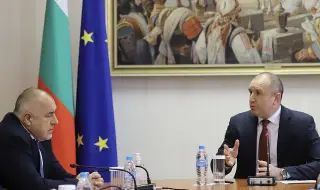
On the one hand, Rumen Radev and Boyko Borisov concluded a public non-aggression pact during the campaign. Peevski is also included in every Borisov pact by default. The non-aggression pact consists of Radev not personalizing his attacks on the "oligarchy" and the "mafia", but claiming that everyone knows their names. Borisov, on the other hand, will not directly attack Radev, but will continue his traditional (convenient) line that others, and especially the PP-DB, are to blame for everything. For now, the non-aggression pact does not include attacking a third country (Poland or the PP-DB), but appetite comes with eating, and every pact has both explicit and hidden clauses.
On the other hand, Radev and Borisov will also nobly compete to see who is more of a Trump and Orban man in Bulgaria, while both competitors remain "European" in some sense. For now, the competition is 0:0. Radev received an invitation to the Trump Peace Council and refused it, while Borisov accepted it and Zhelyazkov signed the statute of the new organization, but the goal does not count because the treaty will not be ratified. Meanwhile, Borisov goes to an EPP meeting, where everyone raved about him (as usual), and Radev said something to the effect that we are "Europeans" and we will stay in Europe (there is a catch). A game that emotionally engages the audience without anything significant happening in it
While all this is going on, Bulgaria is simply wasting time and collecting small and medium damages, such as the reduction of voting sections abroad, for example. The above-described political maneuvers do not actually answer any significant question for the country. They are not even important in terms of future coalitions, because the non-aggression pact is not a commitment to joint governance. On the contrary, in this way both parties (rightly or wrongly) simply calculate that they will collect the most votes in the elections.
Meanwhile, Sarafov remains in office without a broad political front for his removal. Radev's entry was expected to lead to such a front, but, alas, the non-aggression and non-personalization pact clearly also covers the acting prosecutor general.
Betrayal of the agenda outlined by the thousands in the squares
Even more important is that Bulgaria is not discussing the solution of two major problems facing its future. One is that the external stabilizers - the EU and NATO, on which we have relied so far, are themselves in crisis and at a crossroads. To survive, the EU must be far more integrated and have greater fiscal, foreign policy and military capacity. Bulgaria's national interest in an era of the return of aggressive empires is to be together with other European nations and to be powerful enough to preserve our nations, our sovereignty and our place in the world. Mao Zedong had already said that Italy does not matter and may not survive new conflicts. What did he think of Bulgaria? But the duty of Italians, Germans, French, Bulgarians and other Europeans is to show the rest that together we can not only survive, but also have the potential to be a great power. After all, the EU is the second or at most the third largest world economy, comparable to those of the USA and China. The EU is the largest trading union and the place with the most incredible accumulation of multi-layered and multi-faceted culture and history. And the EU is the instrument for guaranteeing the prosperity and security of its constituent states, each of which would be in the position of Italy (or worse) in relation to the ambitions of imperial centers such as China, Russia, Turkey, and recently the USA.
In this big picture, it is extremely irresponsible to try to position ourselves like Orban or Hungary in the EU - the cunning one who looks to China, Russia and the USA, but wants to take funds from the EU as well. Even if it gains something in the short term, such a strategy is counterproductive for Bulgaria and cuts off the branch on which we are sitting in the global jungle.
Finally: the thing that hinders Bulgaria both economically and politically and does not allow it to realize its full potential is the bad reputation as a corrupt country. The protests of late 2025 gave a clear diagnosis and named the names that should not govern a European Bulgaria. The election "Twin Peaks" that is currently being played out, as well as the non-aggression pacts, are actually a betrayal of the agenda that hundreds of thousands in the squares outlined. It would be a great pity if the elections overshadowed this agenda and replaced it with some mysterious semi-competition between archetypal Balkan machos.
This text expresses the opinion of the author and may not coincide with the positions of the Bulgarian editorial office and the DG as a whole.