"The gangsters from the Mexican drug cartel who are fighting the government in Mexico have Ukrainian flags on their jeeps” - this claim was circulating on social networks shortly after the drug lord "El Mencho" was killed. Photos show jeeps marked with blue and yellow, which is presented as proof that these are actually Ukrainian military vehicles. There is no real data for this, but the plot fits perfectly into Russian propaganda.
Many of the channels spreading the claim have published pro-Russian disinformation before, ARD reports. The publications are now trying to suggest that Ukraine is simply reselling the weapons supplied to it by its Western allies. This is a narrative that has been repeated frequently since the beginning of the full-scale war that Russia is waging against the country. As early as 2023, pro-Russian social media accounts were spreading claims that drug cartels and criminal organizations were buying weapons from Ukraine.
Ukraine as a "corrupt and neo-Nazi state"
In connection with the war in the Middle East, pro-Russian propagandists have repeatedly claimed that Ukraine is supplying weapons to Hamas, ARD recalls, including by imitating reputable publications that had allegedly reported this.
Discrediting Ukraine is one of the most important goals of Russian propaganda, says Yulia Smirnova, a senior researcher at the Center for Monitoring, Analysis and Strategies. "For years, they have been trying to portray Ukraine as a corrupt and neo-Nazi state", she told ARD.
There have been real corruption scandals in Ukraine - for example, the one involving Zelensky's right-hand man, Andriy Yermak, who is currently under investigation on suspicion of corruption practices. However, many of the claims spread by Russian propaganda are false. For example, an image showing Ukrainian President Zelensky wearing a football kit with a swastika painted on it. It is completely manipulated - the jersey actually has the number 95 written on it.
Volodymyr Zelensky is a target of propaganda
The Ukrainian president is often the subject of disinformation anyway, says expert Smirnova. In recent weeks, digitally manipulated images have emerged that supposedly prove a connection between Zelensky and convicted sex offender Jeffrey Epstein. Claims that Zelensky is no longer a legitimate president are also spreading. All of these narratives are untrue.
Another target of disinformation and propaganda are Ukrainian refugees. For example, in Germany, the false claim is being spread that Ukrainian refugees have a special status in the German pension system, which allows them to retire earlier than Germans. A number of checks have proven this to be a fabrication.
The US is no longer enemy number one
Russian propaganda has followed a line relatively precisely in recent years, says Smirnova. However, some things have changed. "At the beginning of the aggressive war, the US was presented as the biggest enemy, along with Ukraine. Since Trump became president, Russian state media has stopped talking like that and focused on Britain and the EU.
False claims about European leaders are also constantly being spread - for example, a video that allegedly showed German Chancellor Friedrich Merz, French President Emmanuel Macron and British Prime Minister Keir Starmer using cocaine. This turned out to be a lie. "In recent years, Russian propaganda has targeted not only the West's support for Ukraine, but also the democratic systems themselves in European countries - through interference in elections and attempts at destabilization," Smirnova told ARD. "Four years after the start of the full-scale invasion, one thing is clear - Europe is perceived as an enemy by Russia and an information war is being waged against it".
Russian media circumvents sanctions
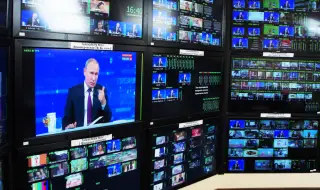
Russian propaganda is spread through various channels - first through state media such as Russia Today, which, according to research by the German investigative journalism platform "Korektiv", continues to be watched by millions of people despite the sanctions. However, since the introduction of these sanctions, Russian propaganda has relied on covert influence, for example through its campaign with lookalike sites that copy reputable media outlets, or using influencers who formally have no connection to the state but spread Moscow's theses in their native languages.
Russian propaganda targets different audiences in different countries, expert Smirnova explains to ARD. "For the political left, Russia is presented as a force of resistance to colonial powers and a bearer of peace. For the political right, Russia is a defender of traditional values," the analyst says.
People who do not trust traditional media and seek information elsewhere are usually the most vulnerable to Russian propaganda. While it is important to note that Russia does not achieve success with every disinformation campaign, Moscow "invests enormous resources in it," says Smirnova. "Therefore, the response must go beyond simply refuting a particular campaign - it must be strategic".
Author: Pascal Zigelkov ARD