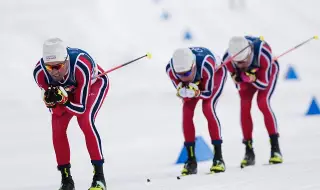
Norway once again topped the Olympic Games standings with a total of 41 medals, 18 of which were gold. And this is no coincidence. We can learn from the Norwegians about public relations, and even about politics.
It sounds like a fiction, but it is not - a country with a population of 5.5 million categorically overtook another country with a population of nearly 350 million in medals. This is exactly what happened at the just-concluded Winter Olympic Games in Milan and Cortina. Norway once again topped the standings with a total of 41 medals, 18 of which were gold, while the United States remained second with 33 medals, 12 of which were gold.
The 18 medals are also an all-time record in Olympic history, and as many as 6 of them were won by the extraterrestrial skier Johannes Høsflot Klebo, with which he personally overtook most other nations in gold - only 7 have more. And now two fair questions arise again: 1. How do the Norwegians do it, so that the USA, China, and Canada are left behind them? and 2. What can we learn from their overall sports strategy?
"Physical socialism" of the Norwegians
You will say, but they are almost born with "pencils" on their feet, and they are one of the richest countries in the world. It is true, but this does not exhaust the reasons, because first of all we are talking about a unique approach and national organization in sports. Note - the Norwegians have dizzying successes not only in winter disciplines, but also in a number of others. The country enjoys world stars in football - in men - Erling Haaland, Martin Odegaard, Alexander Sørlot, in women - Ada Hegerberg, in golf - Viktor Hovland, in tennis - Kasper Ruud, in middle and long-distance running - Jakob Ingebrigsten, even in women's weightlifting - Solfrid Coanda, who became the Olympic champion in Paris in 2024.
Let's imagine it as a pyramid: in its widest part is mass sport, which is a purposeful state policy, as well as a carefully cultivated cult of physical activity from an early age. Up the pyramid it is clear - quantity gradually leads to the top, where world-class quality is, but what is far more important is something else: it is a system based on equal access to sport, with the necessary spirit of joint efforts, strategic thinking and comprehensive care for the person. The latter is not naive. The Norwegians have built a kind of "physical socialism", which without the state coercion of totalitarian societies leads to amazing results. Can we not learn from there about public relations, and even politics?
What can we learn from the Norwegians?
There are other interesting moments. The Norwegians do not emphasize competition and early profiling in children's and youth sports - up to the age of 12, no one even takes into account the result, and the point is in participation and inclusiveness, especially in team games. This is also part of their mental strategy for coping and mass participation - they are convinced that such a system encourages the majority, and therefore children and young people do not give up due to a lack of confidence in their own strength and talent. The key word here is "interaction", not "competition" or results at any cost.
Of course, the mentality also helps a lot - there is no mention of the widespread, well-known practice in our country of parents paying coaches "under the table", which distorts both the idea of sports and the very natural selection of the most talented. Inclusivity also means joining immigrant communities in sports from an early age - that is why we are talking precisely about equal access and an approach from which we can seriously learn.
We also come to financing, because I already hear in absentia the remark "but the state there, it is rich, pours into high sports achievements" - mostly from nostalgics of the communist regime here, when the state was god, what appeals and residual reflexes there are to this day, including in Bulgarian politics. And yes, and no - the Norwegian state mainly takes care of mass sports and the associated infrastructure, with world heroes like Klebo the contribution is on average 20-25%, the rest is mainly private sponsorship. That is, we again come to something painful - public funding must provide the conditions for the majority, so that we can enjoy the star minority.
Let's start with sports
In this sense, Bulgaria's two bronze medals in biathlon - of the wonderful Lora Hristova and Milena Todorova, plus the achievements of Tervel and Malena Zamfirova in snowboarding - are pure personal heroism, which raises questions about both the state strategy for sports, but also the culture of private sponsorship. Another important question, in addition to the one about mass participation, is related to prioritization - why and what disciplines to emphasize. The Norwegians, unlike the Germans, for example, do not deliberately develop bobsleigh and sledding, simply because they are an expensive pleasure, and the idea is to direct the funds towards universal inclusion. Tom Tvedt, the head of their Olympic Committee, where there is no practice of strong political figures being neck-to-neck through their proxies, summed it up most accurately: the Norwegians do not pour state millions in exchange for a short national "orgasm" from some medal and photos of politicians with the champion, but they have seen the direct connection between support for mass sports and local small clubs. On the other hand - and serious achievements in the elite.
In other words, the formula is "egalitarianism, egalitarianism, egalitarianism", no matter how shocking it may sound to someone in power here, the lame concept of "we fixed everything, so we resorted to mass sports" is unknown in Norway. At least because it is obviously short-sighted - a whole separate treatise could be written about the connection between the mass sports in question and overall public health. By the way, the appointment of Dimitar Berbatov as sports advisor to the new Prime Minister Andrey Gyurov is an obvious step in the right direction.
Well, how are we going to reach the Norwegians? Well, no, but we can at least think about goal setting, broad access and strategic thinking. At least in sports. I don't dare to dream about politics.
This text expresses the opinion of the author and may not coincide with the positions of the Bulgarian editorial office and the State Gazette as a whole.