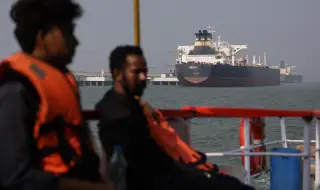
Last week, 32 countries decided to use their strategic oil reserves to stabilize sharply rising oil prices, but this measure was quickly overshadowed by Iran's escalating attacks in the Strait of Hormuz. Members of the International Energy Agency (IEA), the association of the largest energy-consuming countries, had agreed to release hundreds of millions of barrels of oil from their strategic reserves.
At the same time, however, Iran has stepped up its attacks near or directly in the Strait of Hormuz: several commercial ships, including oil tankers and cargo ships, have been attacked with missiles, drones and explosives. Since the war began on February 28, Tehran has effectively blocked the narrow strait through which the Persian Gulf states transport about a fifth of the world's crude oil and natural gas exports, mostly to Asia. As a result, tanker traffic has been almost completely blocked.
At the same time, major oil producers in the region, including Saudi Arabia, Iraq, Kuwait and the United Arab Emirates, have reduced their production because they have no free storage capacity for the raw material. This further increases concerns about the stability of the energy market.
What is the Strategic Petroleum Reserve?
The Strategic Petroleum Reserve is a state-controlled stockpile of crude oil that can be used in the event of supply disruptions or market crises. The first modern strategic reserve was created by the United States in 1975. The reason for this was the oil crisis – the Arab oil embargo, which exposed the vulnerability of global energy supplies.
The shock caused oil prices to quadruple, causing fuel shortages in the West and highlighting how vulnerable economies are to sudden supply disruptions. Today, dozens of countries, mostly IEA members, maintain their own strategic reserves as part of a coordinated system to ensure energy security. In total, IEA members have more than 1.2 billion barrels of government emergency reserves. This is in addition to about 600 million barrels held by industry.
China is believed to have the world's largest emergency reserve, followed by the United States. Beijing keeps the exact figures secret, but the analyst firm Vortexa estimates China's total reserves at about 1.3 billion barrels. That would be enough to power the Chinese economy for three to four months. The US Strategic Petroleum Reserve holds 415 million barrels. Together with 439 million barrels in private storage, this corresponds to a supply of more than 40 days.
How much oil do IEA members intend to release to the market?
According to the IEA, member states want to release a total of 400 million barrels of oil from their emergency stocks. For comparison: since the beginning of the Russian attack on Ukraine in 2022, the largest coordinated release so far amounted to 182 million barrels. The energy agency explained that the stocks will be released in stages, taking into account the specific situation in each individual country. The United States wants to take the lead and release 172 million barrels from its Strategic Petroleum Reserve (SPR) starting this week.
Japan has announced that it will release about 80 million barrels – an amount that is enough to cover about 45 days of domestic consumption. Both private and government stocks will be used for this purpose. Additional quantities are also coming from Germany, Australia, France, South Korea and the United Kingdom. IEA members are required to maintain an emergency reserve containing quantities equal to those they import for a period of about 90 days.
The US Strategic Petroleum Reserve consists entirely of crude oil, which is stored in underground salt caverns along the Gulf Coast. However, other countries, including in Europe, maintain a wider range of products in their strategic storages - including gasoline, diesel and jet fuel. China, which is not a full IEA member, has not yet announced such an exemption. Instead, the government is prioritizing domestic supply security and has halted the export of refined fuels.
Will all of this lead to lower oil prices?
Oil industry analysts say the release of strategic reserves could ease immediate market pressure but is unlikely to lead to a sharp or long-term drop in prices. Such measures do signal that there are reserves for additional supply and that governments can intervene in the event of an emergency.
However, the IEA estimates that the planned release could replace supplies from the Persian Gulf for only three to four weeks. Even if it lowers oil prices by a few dollars, the effect is likely to be limited. The quantities released are relatively small compared to the global oil market, which covers about 100 million barrels per day.
Analyst David Morrison of the British brokerage Trade Nation told Agence France-Presse that the simultaneous measures by dozens of countries “have failed miserably if their aim was to put a price ceiling“. According to him, the market may even interpret this measure as “panic”, given the de facto blockade of the strategically important Strait of Hormuz by Iran. London-based analyst house Capital Economics also expects prices to rise if the strait remains blocked for a longer period of time.
Author: Nicholas Martin