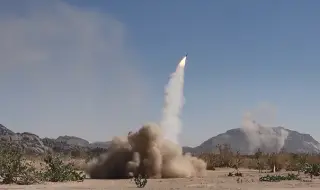
Over the weekend, Iran fired missiles towards Diego Garcia, an island located 4,000 kilometers from Iran. This raises questions about the range of Iranian weapons. Is there a danger to Europe?
On Saturday, Iran fired two ballistic missiles at a joint British-US military base on the island of Diego Garcia, Iranian state television reported. According to senior US officials quoted by CNN and the Wall Street Journal, neither of the two missiles hit their targets - one was damaged in flight and the other was intercepted, the German public broadcaster ARD reported. A British government official later confirmed the media reports to Agence France-Presse.
However, analysts say Tehran has now proven that the range of Iranian weapons is clearly much greater than previously thought.
Iranian missiles: are they dangerous for Europe?
The island of Diego Garcia is located in the Chagos archipelago in the Indian Ocean - about 4,000 kilometers southeast of Iran. Until now, it was believed that Iranian missiles had a range of up to 2,000 kilometers. The Iranian Fars news agency, which is close to the Revolutionary Guard, even claims that Iran can reach Europe with these missiles.
According to German military expert Fabian Hoffman, the attack on the island of Diego Garcia is a "clear signal from Iran". In an interview with public broadcaster ZDF, he said that the aim is to show the Americans and Europeans that the country can escalate this conflict even further. And also to encourage the Europeans to put pressure on the US to end this war.
What are the dangers of a longer range?
Hoffmann sees no reason to worry about the range of the missiles. "A range of around 3,000 to 4,000 kilometers is not particularly surprising," he says. The fact that Tehran had this technology was "relatively clear" even before the attack. "We know that Iran is quite good at producing ballistic missiles", the expert points out.
According to him, the jump from a ballistic missile with a range of 2,000 kilometers to perhaps 4,000 kilometers "is not that big". Iran has been working on multi-stage missiles as part of its civilian space program. According to most experts, this was "more of a cover for the development of exactly such ballistic missiles with a longer range", Hoffmann tells ZDF.
"However, in my opinion, we in Europe should not overreact to this threat", the expert adds. If the ballistic missiles really have a range of 4,000 kilometers, then they could reach European cities, he explains, adding that this should not surprise Europe, because such a development was expected and the countries are prepared.
Iranian missiles are "quite inaccurate"
Furthermore, it is known that Iranian missiles are quite inaccurate - even at short distances. If we assume that their range increases to 4,000 kilometers, then this inaccuracy will also increase, Hoffman points out. "The threat potential [...] is smaller than, for example, that of Russian ballistic missiles for Europe," says Hoffman, referring to the war in Ukraine.
The military expert does not believe Trump's claim that Israel and the United States have already destroyed 100 percent of Iranian missiles. Although there is no reliable data, Iran is still launching long-range ballistic missiles and drones on a daily basis, and the trend is upward. "This number is far from zero," he said in an interview with ZDF.
ARD quoted Middle East expert Nawaf al-Thani as saying that "the real question is not whether the missile was intercepted, but that a range of 4,000 kilometers changes the situation fundamentally."
Israeli Iran expert Raz Zimt wrote on the X platform: "It is now obvious that Iran is trying to use the conflict as a strategic opportunity - not only to prevent future attacks on itself, but also to form a new regional order." According to his analysis, Tehran wants to make its neighbors contribute to the end of the US military presence in the region through intimidation.