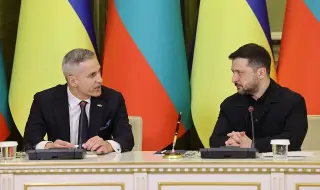
Bulgaria, the last NATO country to break ties with Moscow, signed a historic agreement with Kiev. The most loyal Russian satellite in the Balkans is finally leaving the Russian orbit of influence after 70 years of cooperation. What retaliatory measures will Russia take against Bulgaria and could a Russian cyberattack against Bulgarian infrastructure trigger NATO's Article 5? This is what the French publication France-Jeunes writes in an extensive analysis.
On March 30, 2026, in a conference room in Kiev, Ukrainian President Volodymyr Zelensky and Bulgarian Prime Minister Andrey Gyurov met face to face in front of the blue-yellow and white-green-red flags. During this joint press conference, the Ukrainian president said: "Our teams have been working for a long time. I am very pleased that now we have such an agreement between the two countries." This statement, published by Ukrinform, emphasizes the importance of the moment. Before this signing, Bulgaria was the only NATO member state that had not officially severed its defense ties with Russia since February 2022. Two days earlier, Zelensky signed ten-year agreements with Saudi Arabia, Qatar and the United Arab Emirates focused on expertise in combating drones. However, Bulgaria is not exchanging any capabilities: it is leaving the camp. This is an internal geopolitical shift in Europe, the consequences of which extend far beyond the Balkans.
Why does Zelensky insist on long negotiations?
In diplomatic language, the reference to a "long period" of work between teams is never a mere formality. It means difficult and complex negotiations that have repeatedly stalled, probably hindered behind the scenes by Bulgaria's internal reluctance. Bulgaria was the last Eastern European country to reject a formal bilateral defense agreement with Kiev, even though arms deliveries had begun in the first months of the conflict. This delay was not a technical anomaly, but a signal sent to Moscow, proof that Sofia was in no hurry. By publicly emphasizing this delay, Zelensky confirms the Bulgarian exception and thus effectively erases it.
The Persian Gulf and the Balkans: Two Different Diplomatic Logics
The Bulgarian agreement is part of a carefully calibrated diplomatic sequence. On March 28 and 29, the Gulf strategy prevailed: ten-year partnerships in which Gulf states exchange their financial capacity for Ukrainian expertise in destroying drones. On March 30, it was the turn of the Balkans with Sofia, but the significance of this event is fundamentally different. The Gulf monarchies are seeking to protect themselves from Iranian drones: this is an exchange of skills between tactical partners. Bulgaria is making an existential choice of country. This is not just cooperation with Ukraine - this is a structural rupture with the Russian orbit, which has been its sphere of influence for more than seventy years.
Just another agreement on the list or a real turning point?
Among the approximately twenty bilateral security agreements signed by Ukraine since 2022, this one from March 30, 2026 stands out. The agreements with the Baltic states, Poland, and the United Kingdom reaffirmed existing alliances. The Bulgarian agreement, however, created a new reality: it formalized a rupture that had occurred in practice but had never been fixed in writing. It transformed an informal, secret agreement into a ten-year legal commitment. It is this transition from the shadows to the light that makes this event historic for both sides.
Sofia, Daughter of Moscow: The Soviet Legacy of 1991
To understand the earthquake of March 30, 2026, we must delve into its foundations. Bulgaria was not just another satellite of the USSR: it was the most loyal, the most devoted, the one that Moscow affectionately called its "sixteenth republic". In 1968, when Warsaw Pact tanks crushed the Prague Spring, Bulgaria was the only country in the bloc – apart from the USSR and East Germany – to send troops into Czechoslovakia. Not out of a sense of duty, but out of ideological fervor. After the fall of communism in 1991, the country never truly severed its ties with Russia. Gas dependence through Gazprom continued until 2022, a powerful pro-Russian lobby continued to infiltrate the ruling parties, and the Bulgarian Orthodox Church remained historically tied to the Moscow Patriarchate. This legacy is not abstract: it shapes the daily lives of citizens, from heating apartments in Sofia to thousands of jobs in the defense industry.
The Defense Industry: The Hidden Child of the Soviet Complex
Bulgaria inherited from the Cold War huge military-industrial complexes, scattered in Sopot, Kazanlak, Shumen and other cities in the interior of the country. These factories produced ammunition, missiles and components for weapons according to Soviet standards - 122 mm and 152 mm calibers, ammunition for T-72 tanks and BMP /infantry fighting vehicles/. This legacy made the country key from the first months of the war in Ukraine, as Ukrainian soldiers were trained to handle this equipment. But this legacy also made Bulgaria a hostage to itself: its factories could not immediately switch to NATO standards overnight, and their natural customers, by inertia, remained the Russian market or the former Warsaw Pact countries.
Gazprom, the Patriarchate and the Bulgarian Socialist Party: the three pillars of Russian influence
Moscow had three strong, closely intertwined levers of power in Sofia. The first was related to energy: until April 2022, Russian gas was massively transited to Bulgaria through Gazprom, and the Bulgarian government even had to resume negotiations with the gas giant after a temporary suspension of supplies, as Le Monde recalls in its analysis from September 2022.
The second lever was ecclesiastical: the Bulgarian Orthodox Church, whose patriarch, historically close to Kirill of Moscow, conveyed a pacifist message of pro-Russian neutrality to the parishes. The third lever was political, embodied by the BSP (Bulgarian Socialist Party), the successor to the Communist Party, which exercised considerable influence in ruling coalitions and maintained a network of bilateral relations with the Kremlin.
A legacy that shapes Bulgarians’ daily lives
This Soviet influence was not limited to the diplomatic or industrial sphere. In Bulgarian families, the memory of World War II remains polarized: the Red Army is still largely perceived as a liberating force, not an occupying army. Russian TV series occupied a large part of Bulgarian television programming. Tourism to the Black Sea and Crimea was a common family activity before 2014. It is this close connection, this mix of economic dependence, historical memory, and cultural proximity, that makes the signing of the March 30 agreement so significant. Seventy years of cooperation cannot be interrupted by a simple treaty.
The Bulgarian paradox of 2022: 1/3 of the weapons for Ukraine that no one was talking about
And here begins the dizzying story. In 2022 and 2023, while the Bulgarian government officially refuses to send heavy weapons to Ukraine, intermediaries massively buy up Bulgarian weapons stocks to send them to Kiev. The country that declares neutrality is actually one of the main military suppliers to Ukraine. Ursula von der Leyen, President of the European Commission, revealed the figures that illustrate the whole paradox: at the beginning of the war, a third of the weapons used in Ukraine came from Bulgaria. This means that for every three shells fired by a Ukrainian soldier in the spring of 2022, one was probably produced in a factory in the Thracian Lowlands. This double game is politically unsustainable in the long term - and it is this tension that makes the March 30, 2026 agreement inevitable.
Ammunition is supplied through shell companies
The mechanism of indirect sales was known to all interested parties, but no one was interested in talking about it openly. Private companies, often registered in Poland, Romania or in regulatory havens in Eastern Europe, bought Bulgarian arms stocks - mostly Soviet-caliber ammunition - and resold them to the Ukrainian Ministry of Defense or to American and British intermediaries. The contracts were opaque, the transit routes - deliberately hidden. Everyone in Kiev knew. Everyone in Brussels knew. So did Moscow. But Sofia maintained the image of a country that delivers nothing, pretending to be ignorant while its factories were operating at full capacity.
When 4% of GDP depends on another country's war
The figure cited by Ursula von der Leyen is telling: nearly 4% of Bulgaria's GDP comes from the defense sector. A colossal burden for a relatively small economy, which means that tens of thousands of Bulgarian families depended directly or indirectly on arms production. Bulgarian industry was already economically engaged in the war effort long before its diplomacy followed suit. It was precisely these jobs, these factories, these production lines that made maintaining the fiction of neutrality increasingly difficult in the face of undeniable figures.
Rheinmetall's investment: the industrial transition to NATO
In 2025, the German company Rheinmetall is investing one billion euros in Bulgaria to produce 100,000 shells per year to NATO standards. This investment marks the official transition of the military-industrial complex inherited from the USSR to a tool integrated into the supply chain of the Atlantic Alliance. Factories that produced 152-millimeter ammunition for the successor states of the Warsaw Pact are being converted to produce Western calibers. The agreement of March 30, 2026 is simply the diplomatic translation of an industrial reality that has already happened: Bulgaria has already left the Russian sphere of influence in terms of its factories; it only remained to do so in terms of contracts.
Russophiles vs. Russophobes: A Fragmented Bulgaria
Material and industrial change tells only half the story. The other half is human, social, and intergenerational differences. In September 2022, Le Monde described Bulgaria as "deeply divided between Russophiles and Russophobes". This division is not a journalistic metaphor: it is physically manifested in the streets. The pro-Russian demonstrations in Sofia at the time were the largest in Europe after those in Belgrade. Thousands of Bulgarians took to the streets, waving Russian flags and chanting slogans against NATO and the European Union. Heated debates erupted in families: parents raised with a narrative of Slavic brotherhood accused their children of being indoctrinated by the West. Then, slowly and imperceptibly, the rift shifted.
"Russians are our brothers": the myth of three decades
This Bulgarian-Russian cultural proximity was real, not just a tool of the Kremlin. Both languages have a Slavic basis, making them partially mutually intelligible. Russian TV series occupied a large part of Bulgarian programming schedules. Tourism to the Black Sea and Crimea was a common family practice before 2014. Above all, the memory of World War II played a central role: the Red Army was presented in school textbooks and family histories as the force that liberated Bulgaria from fascism, thus erasing the fact that the Soviet occupation had lasted almost fifty years. This fraternal myth was not an artificial political argument - it was a popular sentiment ingrained in three generations of Bulgarians.
The post-Erasmus generation that shattered the myth
What tipped the scales in Bulgaria was not a foreign policy speech or an order from Brussels. It was an entire generation. Young Bulgarians studying under the Erasmus program, traveling in Western Europe and connected to English- and French-speaking social media, began to impose an alternative narrative on their own families. The footage of Bucha, Mariupol and the destroyed cities was no longer filtered through Russian state television, broadcast by Bulgarian channels close to the government. It came directly by phone, without intermediaries. It was these young people, no longer recognising themselves in the pro-Russian patriotic narrative of their older relatives, who pushed political parties to solidify their positions between 2024 and 2025.
From family kitchens to ballot boxes: the quiet change
The influence of this generation was not initially reflected in sociological surveys. It manifested itself in kitchens, family gatherings and personal conversations - precisely where myths really die. A young Bulgarian returning from studying in Berlin or Paris does not convert his father to pro-Western views through geopolitical arguments. He does it by showing, by telling and by comparing. This quiet shift, invisible in polls, is slowly eroding the pro-Russian base of Bulgarian society, while political parties, sensing the changing trend, have not adjusted their positions. Between 2024 and 2025, even parties traditionally cautious on the Russian issue have hardened their rhetoric, not out of ideological conviction, but out of electoral pragmatism.
What specific changes does the defense agreement between Bulgaria and Ukraine introduce?
In addition to the symbolism, the agreement, signed in Kiev on March 30, 2026, contains specific provisions whose impact will be felt directly on the battlefield. According to Ukrinform, three key components have been identified. The first concerns the joint production of weapons on the territories of the two countries, including drones. The second focuses on energy cooperation. The third deals with the transit of international aid through Bulgaria. Zelenskyy specified that Sofia will use the European Union's SAFE program to finance this joint production. For Ukrainian soldiers on the front lines, this means drones manufactured closer to the theater of operations, ammunition with calibers compatible with their existing equipment, and optimized logistics - saving time, which in the conditions of a war of attrition means saved lives.
The SAFE program: 150 billion euros for joint production with Ukraine
Adopted in May 2025 by the Council of the European Union, the SAFE program ("Security Actions for Europe") is a 150 billion euro loan facility designed to finance joint purchases of military equipment. The principle is simple but innovative: the EU provides funds to its member states investing in defense production, with a commitment to include Ukrainian industry from the start. Eighteen countries benefit from this mechanism - and Bulgaria is among them. It is a powerful symbol for a country that, as of 2022, still refused to recognize the war as such in its official communications.
Ukrainian-Bulgarian drones and 100,000 shells per year
The drone component of the agreement reflects a tactical reality that Ukraine knows well. Drones have become a central weapon of the conflict, both for reconnaissance and strikes, and protection against them is vital - as evidenced by the growing number of Ukrainian roads protected by anti-drone networks. Joint Ukrainian-Bulgarian production will bring production lines closer to the front line, reducing delivery times and transportation costs. At the same time, Rheinmetall's investment to produce 100,000 shells per year on Bulgarian soil is directly linked to the promise of joint production: Bulgarian factories will no longer be secret suppliers operating in the shadows, but official partners integrated into a transparent supply chain that meets NATO standards.
Energy and transit: the less visible but strategic aspects
The agreement is not limited to weapons. The energy component envisages enhanced cooperation between Sofia and Kiev in the context of regular Russian attacks on Ukrainian energy infrastructure. Bulgaria, which has itself been subject to energy vulnerability from "Gazprom", has experience in diversifying its supplies. The third component - the transit of international aid through Bulgarian territory - is equally strategically important. It formalizes Bulgaria's role as a logistical corridor between Western Europe and Ukraine, a role that the country has already played de facto but never de jure. These two components, less publicly announced than the drones, strengthen Bulgaria's integration into the architecture of support for Ukraine.
Black Sea: What repression will Russia undertake after the Bulgarian agreement?
The defense agreement does not fall into a geopolitical vacuum. Bulgaria is a Black Sea littoral state and has been participating in a maritime demining coalition with Turkey and Romania since January 2024. The signing of the agreement on March 30, 2026, strengthens this presence and at the same time directly exposes Sofia to Russian repression. Moscow has a set of hybrid measures at its disposal: disinformation campaigns through Bulgarian pro-Russian networks, cyberattacks against critical infrastructure, residual energy pressure, and naval intimidation in the Black Sea off the coast of Varna. The question is no longer whether Bulgaria will intervene - it has already done so - but how far Moscow can go in attacking a NATO member without triggering Article 5.
January 2024: Mine clearance - the first threshold crossed
On January 11, 2024, in Istanbul, the defense ministers of Turkey, Romania, and Bulgaria signed a protocol establishing the "MCM Black Sea" task force - a joint naval group tasked with eliminating floating mines in the Black Sea. As Le Monde reported, this initiative was directly aimed at ensuring the security of Ukrainian grain exports, which Russia is trying to disrupt. Turkish Minister Yaşar Güler explained at the time that the goal was to combat the mine threat more effectively by strengthening existing cooperation. Thus, Bulgaria, through its Deputy Minister of Defense Atanas Zapryanov, was taking concrete actions against Russian interests in the Black Sea - long before the bilateral agreement of March 2026.
The arsenal of Russian repressions in Sofia
Moscow will not remain passive in the face of what appears to be official defection. Russia still has many levers in Bulgaria, even if they have weakened since 2022. Massive disinformation on Bulgarian social media is the main tool: Kremlin-linked accounts and media outlets are flooding the Bulgarian digital space with pro-Russian content, downplaying the atrocities in Ukraine and condemning Sofia's betrayal. Pressure on the Bulgarian Orthodox Church represents a second lever: The Moscow Patriarchate can use its connections with local clergy to spread anti-NATO rhetoric in parishes. Provocative naval maneuvers off the coast of Varna, Bulgaria’s main Black Sea port, represent a third tool of coercion.
How far can Moscow go without triggering Article 5?
The March 30 agreement is likely to intensify this repression, testing the resilience of a country that has just passed the point of no return. The central question, for both Sofia and the Atlantic Alliance, is this: Will a Russian cyberattack on Bulgarian infrastructure trigger Article 5? If naval intimidation in the Black Sea escalates into an armed incident, will that force other NATO members to intervene? By signing this agreement, Bulgaria is deliberately putting itself on a razor’s edge. It is betting that NATO’s collective deterrence will be enough to limit Russian retaliation to a hybrid level—cyberattacks, disinformation, economic pressure—without ever escalating into open conflict.
What if France looks to Bulgaria to understand its own sluggishness?
Bulgarian change offers an unexpected mirror to France. The comparison is telling because it overturns the usual hierarchies. France, which does not share Sofia’s pro-Russian heritage, nevertheless took months to accept the idea of sending heavy weapons to Ukraine, and then even longer to publicly discuss a possible troop deployment. Bulgaria, starting from a much lower level of cultural and political dependence on Moscow, achieved the same level of concrete support – but with a striking time lag between its covert actions (as early as 2022) and official recognition (March 2026). This lapse speaks volumes about the inertia that keeps all European societies away from the reality of war.
When Sofia Moves Faster Than Paris on the Material Front
If we compare the time frames, the paradox is striking. It took France more than a year after the start of the invasion to deliver its first SCALP cruise missiles to Ukraine. Bulgaria, on the other hand, was already secretly supplying a third of the ammunition used by Ukrainian troops in the first half of 2022. In terms of material flows, Sofia was several months ahead of Paris. But in terms of formal recognition, Bulgaria waited until March 2026 - longer than most of its European allies - to sign a bilateral defense agreement. This gap between real actions and official statements illustrates an inconvenient truth for all European countries: actions always precede declarations, and declarations always follow public opinion with a delay of several years.
The Hungarian veto and Bulgarian silence: two crumbling resistances
The dynamics that pushed Bulgaria to sign the agreement are structurally identical to those that gradually isolated Viktor Orbán's Hungary within the European Union. Both countries have pursued a middle-of-the-road strategy: refusing to condemn Moscow too harshly while taking advantage of their membership in NATO and the EU. But that middle path no longer makes geopolitical sense, as the war has reached a stalemate and Western sanctions have tightened. Bulgaria has just realized that the golden mean is no longer a position at all, but a void that is swallowing it whole. Hungary, for its part, still clings to that void, but its growing isolation within the European Council suggests that the same logic of displacement is at work here.
Bulgarian Lesson for Western European Societies
France and other Western European countries tend to view Bulgarian hesitation as an archaic legacy, a relic of the Cold War from which they believe they have been freed. But the Bulgarian shift serves as a reminder that denial is not the exclusive trademark of former Soviet satellites. France, devoid of any comparable pro-Russian legacy, took years to align its actions with its statements. Bulgaria, starting from the bottom, achieved in four years what others struggle to do in a decade. The lesson is simple: no European society, regardless of its history, is immune to the temptation of denial in the face of a war that shatters its foundations. The difference lies in the speed with which it accepts to face reality.
Conclusion: The ten-year defense agreement signed between Ukraine and Bulgaria on March 30, 2026, will go down in history not for its technical clauses on the joint production of drones or the transit of international aid. What matters is what it represents: the end of a 70-year geopolitical alliance, born not of an international treaty but of a generation that imposed a new national narrative on its own families. A generation of young Bulgarians, raised on Western social media and educated in European universities, has redefined their country’s identity by refusing to inherit loyalties they no longer understand. The comparison with the slowness of Western European societies to integrate this new reality is stark but necessary. France, with no comparable pro-Russian legacy, took years to align its actions with its statements. Bulgaria, starting from the bottom, achieved in four years a transformation that other nations struggle to begin. The Bulgarian Rubicon has been crossed. It remains to be seen how many more European rivers will be crossed before the continent finally accepts the war being fought on its doorstep.