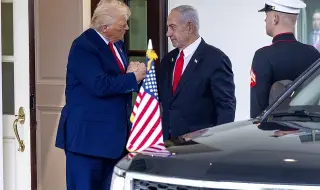
As the war against Iran approaches its second month, voices in the US and Israeli intelligence communities have continued to publicly express their disagreement with the whole project. This is what Middle East Eye editor-in-chief David Hirst writes.
As a result, more details are emerging about the decision to launch the attack in February. Then it had as little to do with the talks with Iran in Muscat and Geneva as it does today. While President Donald Trump has spoken of contacts with Iran - a claim dismissed by Iranian Parliament Speaker Mohammad Bagher Ghalibaf as "fake news" - flight data shows that he simultaneously ordered the transfer of large numbers of American troops to Israel and Jordan, apparently in preparation for a ground attack and the next phase of the war.
No, the key element in the decision to attack Iran for the second time in a year was provided by an intelligence briefing that turned out to be 100% false. The questionable dossier that led to that attack was written by Mossad Director David Barnea.
He has stated to Israeli Prime Minister Benjamin Netanyahu that Mossad is so strong on the ground in Iran that it would be able to mobilize Iranian opposition forces to overthrow the government there once an air war is launched.
Barnea's confidence is confirmation, if any, that Mossad played a major role in turning the January protests in Tehran into an armed uprising in which thousands of protesters were shot.
Barnea’s promise is central to Netanyahu’s message to Trump that the Islamic republic is so weak that all it needs is one final push to collapse. Although Barnea’s prediction was disputed by rival intelligence agencies in Israel and the United States, it convinced a gullible Trump.
The reality emerged within an hour of the airstrike that killed Iran’s former supreme leader, Ayatollah Ali Khamenei, seriously wounded his son Mojtaba, and killed more than 40 of Iran’s top generals. Because within an hour of the first strike, Iran began returning fire—and hasn’t stopped since.
Why did the U.S. war in Iran turn out to be a much bigger mistake than the one in Iraq?
The conflict will leave behind an America that has lost much of its global power, standing, and influence, and will be forced to stand alone against its rising adversaries.
Asymmetrical warfare
Iran has made good on its threat to attack Israel, U.S. bases, oil tankers, and oil and gas refineries, as well as to close the Strait of Hormuz, blocking a fifth of the world’s oil and natural gas trade.
In the fourth week of this war, Tehran seems no less capable of sustaining constant missile and drone attacks than it was in the first hours of the conflict. Iran has certainly been battered by airstrikes and has lost its navy, many Revolutionary Guard command centers, and much of its air force and air defense systems, but it has generally continued to defend itself. As promised, its response has been asymmetric. It has successfully expanded the geographic reach of the war, ensuring that there are no bystanders hoping to quell it.
Now Trump and Netanyahu face a regional war that they will find difficult to end. Researchers at Brown University estimate that as many as 4.7 million people have died, directly and indirectly, in the series of conflicts triggered by former US President George W. Bush’s decision to invade Afghanistan and Iraq at the turn of the century.
The consequences of a war against Iran could be even more widespread, especially if it proceeds as a ground invasion. If this all sounds eerily familiar - just as Bush and former British Prime Minister Tony Blair invaded Iraq in 2003 - that's because it is.
Mohamed ElBaradei was the head of the International Atomic Energy Agency (IAEA) for three consecutive terms. He and the UN's chief weapons inspector at the time, Hans Blix, were on the ground in Iraq as the CIA and MI6 compiled a dossier of false intelligence claiming that Saddam Hussein had weapons of mass destruction.
Today, ElBaradei can only reinforce the parallels with what is happening in Iran right now.
"Hans Blix and I went through a very difficult period when we witnessed a complete deception. We were on the ground and at that time we saw no nuclear, chemical or biological weapons program in Iraq. "And yet the Bush administration continued to give this ostentatious briefing to the Security Council," he pointed out.
"They started a war, they destroyed a country. Hundreds of thousands of innocent civilians died because of lack of medicine, because of lack of food, and later they said "oops, there was nothing". I see a lot of similarity here when I hear Mr. Trump claim that Iran is two weeks away from a nuclear weapon. "To be honest, I'm depressed because I know what it means: innocent civilians will die," ElBaradei said.
Disrespect for international law
ElBaradei supported current IAEA Director General Rafael Grossi, who said after the 12-day war last June that Iran could start enriching uranium within months - a statement that contradicted Trump's claim that he blew up Iran's nuclear facilities "so that the kingdom could come."
"Being objective in a subjective environment is very difficult, and everyone wants to interpret things the way they want to interpret them," he noted. "Grossi said that there is no structured, no systematic weapons program... It's not the IAEA that's losing its impartiality; "rather, the Security Council is completely paralyzed," summed up ElBaradei, a veteran international jurist.
He himself knew and negotiated with Ali Larijani, the former head of Iran's Supreme National Security Council, who was killed this month in an Israeli strike.
ElBaradei said of Larijani: "He was one of the good guys. He understood deeply the problems and what he wanted to achieve. And we lost him in the sense that we had no interlocutor."
But after Gaza, and indeed long before that, the assassination of negotiators, politicians, philosophers and journalists became an acceptable part of war. Genocide has become a tool of modern warfare.
ElBaradei’s strongest argument is not that history repeats itself, but that history intensifies.
The Bush administration has at least attempted to base its attacks on international law. Trump makes no effort to do so; for him, international law does not exist. The UN seeks only to humiliate him, turning off the escalators and the teleprompter when he speaks.
The US no longer seeks through brute force simply to break and transform nations. Its ambitions are grand: in this war, it seeks to break and transform an entire region. To that end, it has renounced all the norms of international law that ElBaradei was trained in.
"I am educated, I am trained in the US, in the West. I have lived more than half my life in the West. "I have always believed that Western democracy is not perfect, but this was the right path," he said.
However, as European leaders and Western countries like Germany continue to defend Israel - even as the International Court of Justice has determined that there are grounds to believe that genocide has been committed in Gaza and the International Criminal Court (ICC) has issued arrest warrants for senior Israeli leaders - the West is clearly "losing control", ElBaradei added.
"Ask anyone in the Global South right now, they are essentially saying that the Western transatlantic alliance, or the Europeans in particular, have misled us - and now we have to fend for ourselves in terms of security, in terms of economic development, in terms of values. Is that good for the world? Absolute zero.
Undermining the system
"Middle East Eye" has revealed that Karim Khan, the chief prosecutor who issued arrest warrants for Netanyahu and his former defense minister, Yoav Galant, has been acquitted of all sexual assault charges by judges reviewing the evidence.
However, some members of the bureau of the Assembly of States Parties, which governs the ICC, are determined to continue their efforts to prevent Khan from resuming his duties. They are seeking to block the judges' report and reframe the findings based on their own assessment of a report by the U.N. Internal Oversight Office, two senior diplomatic sources briefed on a recent bureau meeting said.
This is the clearest example of ElBaradei's central message. The West, which invented the modern concept of international law and created courts like the ICC after World War II, is now determined to sabotage and undermine it.
Why Trump and Netanyahu are the most dangerous men on the planet
The Western attack on the rules-based international order is not limited to justice. ElBaradei points out that the US has withdrawn from the World Health Organization as it works to prevent another pandemic, and has abandoned the Paris Agreement on climate change: "They are fighting science. When you see Gaza, when you see Iran, when you see Ukraine, where is the Security Council? It is not there".
"When you just walk around and break every rule and every expectation, and then you tell people, "You have become terrorists" - when people get angry, when people feel injustice, what do you expect them to do? Go have a glass of wine with you?", ElBaradei asked rhetorically.
But he is certain of one thing: revolution in the Arab world is coming. ElBaradei, who was a central figure in Egypt's democratic revolution in Tahrir Square, left the country after the Rabaa Square massacre in 2013, which marked the beginning of a military counter-revolution that crushed democracy and free elections seemingly forever.
"The Arab Spring is not dead at all," he insisted confidently. "What did the Arab Spring demand? Equality, economic development, political freedom - these are things that are still missing in most Arab countries. History is slow, but the root causes are there, when people now see their land being taken away, when they see that they are being treated like dirt, that they are being shot at".
European insignificance
After the Iraq war, ElBaradei remembered former US President Barack Obama, who said: "We must learn when we shoot, to aim".
"At least he was honest to say it, but it was a little too late, because then ISIS appeared," he noted.
Now we have a US president who doesn't even pretend to consult the international community before starting a war. International law, during his term, has ceased to exist. The same goes for international treaties, and negotiations are at best just pauses until more power and more troops are involved.
We will regret the day we let this happen. Because when the American empire finally crumbles, we in Europe will need international law and institutions, because we will not have the hard power to defend ourselves. Because of Gaza, then Lebanon, and now Iran, Europe has become insignificant. This will come back to haunt it.
And to whom will we turn when our future enemies apply the same rules of war to us that we apply to them? To whom will we turn when they kill our negotiators, our politicians, our journalists; when they bomb our hospitals and call them terrorist hideouts?
Trump and Netanyahu are burning the candle at both ends and when their reign finally ends, everyone will burn their fingers.