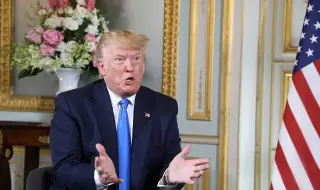
Having fallen into a strategic trap in Iran, US President Donald Trump may find it difficult to escape it, warns the famous geopolitician Robert Kaplan. Even if in the long run the mullahs' regime seems doomed to him.
A conflict in the Middle East could now trigger a domestic crisis in the United States, to a degree previously unimaginable." It was with these almost prophetic words that Robert D. Kaplan described his latest book "Waste Land: A World in Permanent Crisis" last year. He drew a parallel between today's geopolitical turmoil and the disastrous fate of the Weimar Republic.
The consequences of the American operation, launched in Iran on February 28, have gone far beyond the borders of this country of about 91 million inhabitants, being felt even in the United States, where Donald Trump is desperately trying to find a way out. In doing so, the American president risks falling into a well-known trap, warns the expert from the Institute for Foreign Policy Studies: the curse of "medium-scale wars", undoubtedly the most dangerous situation for a power like the United States. The bestselling author, known for both his timely geopolitical analysis and his image as a "prophet of chaos", describes in detail the mechanisms of this in an interview with the French daily L' Express. He also laments that Donald Trump, with his statements and positions on NATO, "is putting an end to the 80-year alliance with the West".
L' Express: In your latest book "Waste Land" you explain that we live in a kind of vast Weimar Republic, an interconnected world but without real governance, where each country is so closely linked to the others that a crisis in one place can trigger a domino effect with almost universal consequences. Does the war in Iran fit into this picture today?
Robert Kaplan: It fits perfectly. The war in Iran has repercussions in every region of the world and highlights the dynamics that I analyzed in "Waste Land". The closure of the Strait of Hormuz, for example, has serious consequences for oil prices and global shipping. In addition, the fighting deeply affects the entire Middle East. At the same time, this issue fuels global debate. In this way, the world looks like an unstable, "Weimar" system, oscillating from one crisis to another. And the war in Iran is far from over: the ceasefire negotiated by Donald Trump on April 7 remains extremely fragile, although I am still open to surprises.
L' Express: What do you mean?
Robert Kaplan: The Iranian regime has destroyed its currency, there is very little drinking water, very little electricity, and daily life there is horrific. If the Shah's regime had remained in power, Iran would be comparable to South Korea today, with one of the most dynamic economies in the world and a thriving middle class. This is not a prediction, but despite all of Trump's mistakes, I remain convinced that the regime could become unstable in the short to medium term and that we could see a resurgence of mass protests. But that won't happen now, because Trump's outrageous statements about the destruction of Persian civilization have led to the unification of the entire country behind the regime. We will probably go through a period of more fighting, then the war will end, life in Iran will return to normal, and then suddenly there may be a new wave of protests. But we have to be patient in this regard. And justifying the war with the need for regime change is clearly a mistake.
L' Express: You recently published an article in Foreign Affairs in which you explained that in Iran, Donald Trump "risks falling into a well-known trap: the curse of "medium-scale wars." What does that mean?
Robert Kaplan: First, let me define what I mean by "medium-scale wars." This is a type of war that is particularly common among great powers and empires. It is not a small rescue operation or a limited war, like the invasion of Panama in 1989 or the regime change on the Caribbean island of Grenada in 1983. All of these interventions were small-scale, as were those in Bosnia and Kosovo. At the other end are the big wars: World War I, World War II. Mass democracies manage both types of conflict very well, both small and large wars. What they fail to manage, however, are what I call medium-scale wars: Vietnam, Iraq, Afghanistan, and so on. These are conflicts big enough to cause massive bloodshed, but not big enough to mobilize the entire home front, the entire country.
In this way, empires or superpowers find themselves fighting with one hand tied behind their back: they cannot give their all, but they still cause massive destruction and suffer real losses. I warned a few weeks ago in Foreign Affairs that Trump risks turning the initially limited war in Iran into a medium-scale war. And that has partly happened with the ceasefire that went into effect this week.
L'Express: "Starting a war is easy; getting out of it is much harder," you wrote. Can Donald Trump still emerge from this war with his reputation intact?
Robert Kaplan: It depends. As I said before, I don't think the mullahs' regime has a sustainable future. Eventually there will be a change, but I'm not sure Trump will take responsibility for it, because it may not happen for another year, and by then we'll still be asking ourselves: what was the point of this war? Ultimately, it's not the war itself that will lead to regime change, but the underlying problems: food shortages, electricity shortages, water shortages - all these everyday problems that will ultimately drive the population to despair. So I'm not sure Trump can come out of this conflict with his authority intact, given his statements and the fact that he couldn't clearly explain the nature of the war to the American people.
Let's not forget that his authority was seriously undermined even before the war began. And the sharp rise in oil prices has not only an international dimension; it also affects US domestic politics. This will make it difficult for him to perform well in the November midterm elections. Because the working class and ordinary people are really concerned about the price of gas in their cars.
L'Express: Donald Trump has hinted that the United States might consider leaving NATO due to a lack of military support from the Europeans. Is NATO without the United States a possible and viable scenario?
Robert Kaplan: Every time Trump mentions leaving NATO, he downplays its very importance. So, even without leaving NATO, the very talk of it weakens it. For nearly 80 years, there was a real Western alliance between the United States, Europe and Japan, but especially between the United States and Europe. And that period under Donald Trump is coming to an end. What is interesting about this war is the limited degree of European involvement. And I'm not just talking about the fact that European leaders opposed the war. I mean, in previous wars that the United States has been involved in, they have deployed weapons, fighter jets, and other military equipment to European NATO member states to support the war effort. That hasn't happened in this war. There may have been some troop deployment in the United Kingdom, but it has been very limited.
Europe has largely stayed out of the picture, and for the first time, the United States has deployed significant amounts of weapons to Israel, including to Israeli air bases. If you look at history, you'll see how unique that is. During the 1990-91 Gulf War, the Bush administration went to great lengths to keep Israel out of the war, pleading with the Israelis not to respond to Iraqi rocket attacks and to let the United States handle it. They categorically did not want Israel to be part of the coalition. So this is a complete U-turn. And Europe was weakened by this war: even if it fails, as all indications suggest, the Euro-American alliance is further weakened by the very nature of its military logistics.
L'Express: What do you think of the reaction of the Europeans towards Iran, which has not given in to Donald Trump's demands to open its airspace and its bases?
Robert Kaplan: Let me remind you that France and Germany also reacted negatively to the Iraq war in 2003. And the only European country that participated was the United Kingdom. But at the same time, they maintained their respect for George W. Bush and cooperated with him in many ways. And Bush never spoke of weakening NATO; he was very pro-NATO. So the fact that France and Germany did not participate in the Iraq war had only a limited effect on the US-European alliance. But the context of the Iran war is different, because the Europeans were very distrustful and very negative about Trump even before this operation began. So the fact that they are all against the war has a detrimental effect, more negative than what happened in 2002-2003.
L' Express: "The world is safer than before the war started" in Iran, NATO Secretary General Mark Rutte recently said on CNN, adding that this was "thanks to the leadership" of Donald Trump. Do you share his analysis?
Robert Kaplan: He probably meant that Iran's ballistic missile capabilities have been seriously weakened, that its navy has been practically destroyed, that its top officials have been eliminated and that it is now operating with second-rate officials. And the latter are never as effective as the former when it comes to crisis management. As for the idea that the world is safer today, I have serious doubts. Because the Middle East is clearly less stable than it used to be. Moreover, during the war last June, Iran's nuclear and ballistic missile capabilities were seriously weakened. Therefore, there was no reason to start this new conflict.
L' Express: Is the intervention in Iran weakening or, on the contrary, strengthening Russia? The analyses differ...
Robert Kaplan: In the short term, the situation is favorable for Russia, because it has led to a sharp increase in oil prices, and Russia is an oil exporter. But it also weakens Russia because it shows how valuable an ally Ukraine can be, especially thanks to its expertise in the production of drones and other technologies. I still think - as I emphasized in my book "Waste Land" - that the Russian regime is living on borrowed time. Every additional month of war in Ukraine weakens Russia's ability to project power in the Caucasus, Central Asia, Siberia and the Russian Far East. The Russian empire is weakening before our eyes. It is being destabilized by this conflict, which has been going on for four years, as long as World War I.
Putin is losing an ally in Iran because he has failed to protect it. This is a key point and is also, indirectly, a consequence of the war in Ukraine. At the moment, Putin is less concerned about Iran than about keeping China on his side.
L' Express: How do you think China views Donald Trump's chaotic intervention in Iran? Could this situation have implications for the Taiwan issue?
Robert Kaplan: There are several ways to look at it. Donald Trump may be a bad president, but the US military has demonstrated exceptional results in this war. As for the rescue operation to evacuate the American pilots, very few armies in the world would be capable of such an undertaking. And the Chinese are experienced military veterans. They have studied the wars in the Balkans. They have studied the two previous Gulf wars. They are watching this conflict in Iran and probably think that the US military is really formidable and has a wealth of combat experience, something that they, the Chinese, lack. The last time they fought was against Vietnam in 1979, and the outcome was, let's say, quite mixed.
So that might make the Chinese more hesitant about trying to take over Taiwan. But at the same time, Beijing is happy to see the United States turn its attention to the Middle East, sending resources and munitions there. So it works both ways. But let me add that so far, it's very impressive to see how well the global financial markets - and even the oil markets - have priced this war in Iran. You know, given the scale of the destruction, given the closure of the Strait of Hormuz... The U.S. stock market only fell about 8 to 9 percent, which is a normal correction. And yet, if there was a war of that magnitude in the Pacific, around Taiwan or in the South China Sea, the effects on global financial markets would be far, far greater.
L' Express: At least 300 people were killed and more than 1,150 injured in Lebanon on April 8 in massive Israeli airstrikes. It is the largest offensive against Hezbollah and the deadliest for Lebanon since the outbreak of war on February 28. What is Benjamin Netanyahu's goal?
Robert Kaplan: The Israelis are really trying to destroy Hezbollah once and for all. Not just weaken it, not just cripple it, but destroy it to the point where the Lebanese state can rebuild itself and Israel no longer has this problem. But complete destruction seems very difficult to me. On the other hand, the combination of a weakened and impoverished Iran and a largely dispersed Hezbollah could lead not to its complete destruction, but to a reduction in its capabilities, which would make it easier for the Israelis to manage. In addition, the Israelis could permanently occupy southern Lebanon up to the Litani River. They already did this in 1978 - this is often forgotten - during Operation Litani, when they occupied southern Lebanon up to that river. This went on for a while, and today they could do something similar: not to return to the original situation, but to maintain a presence in southern Lebanon to make it even more difficult for Hezbollah to launch attacks on northern Israel.