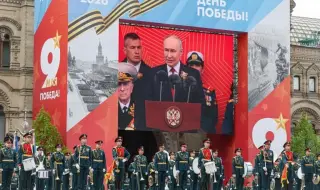
Despite severe fuel shortages across Russia, President Vladimir Putin appears unconcerned by Ukraine's escalating attacks on oil refineries in his country.
Putin has dismissed the fuel shortage in the country, a leading oil producer, as "not critical," rejecting truce proposals and stressing that the war will continue until its goals are achieved.
The Russian president has described attacks on Russia's energy sector as an attempt by Ukraine to distract from its losses on the battlefield, even as analysts say the progress of the Russian forces have been slow in recent months. Putin appears to believe his government can prevent the fuel crisis from undermining his authority and support for the war, which is now in its fifth year.
On Thursday night, Russian forces launched a massive 11-hour shelling of the Ukrainian capital, killing at least 30 people. It was one of the deadliest attacks on Kiev since the war began.
The Associated Press also offers a more detailed look at the latest exchange of blows and Putin's refusal to stop the fighting:
Russia's fuel shortage deepens as more oil refineries are hit
Since March, there have been more than 50 Ukrainian attacks on oil refineries and other energy facilities in Russia and the annexed Crimean peninsula, a series of strikes that Ukrainian authorities say are aimed at pressuring Moscow to end the war.
At the very least, these attacks have made the war more tangible in the homes of millions of Russians, shattering Putin's narrative that the conflict is not about the way of life of ordinary people in his country.
According to Chris Weaver, CEO of the consulting firm Macro-Advisory, said about a third of Russia's refining capacity was disrupted. The attacks caused lasting damage that will be costly to repair.
Despite the significant air defense capabilities protecting the Russian capital, a major oil refinery in Moscow was hit twice. The second strike on June 18 caused a fire, damaging key equipment that is said to take until the end of the year to repair.
After Russia's gasoline production fell by about 17 percent to 850,000 barrels per day, according to government figures, fuel rationing was introduced in many regions, forcing drivers to queue for hours to fill up.
Crimea, which Russia annexed from Ukraine in 2014, is facing its worst fuel shortage crisis. Gasoline sales to individuals there have been intermittently suspended altogether.
Putin downplays consequences of Ukrainian strikes
Late last week, Putin chaired a meeting of government officials to discuss fuel shortages.
In televised remarks, Putin acknowledged that Russia was going through a "difficult period." He pledged to speed up repairs to energy facilities and said Russia would consider importing gasoline to help offset what he described as a "temporary" shortage. The Russian president also said the arms industry would increase production of air defense systems to repel future Ukrainian attacks.
Putin described the Ukrainian strikes as an attempt to divide Russian society, stop Moscow's offensive and force the Kremlin to start negotiations on "terms favorable to our adversary."
"We will not give them that chance," he stressed.
While Putin believes that Ukraine's long-range strikes on Russian oil refineries have "absolutely no effect on the situation on the front," Western military analysts say that medium-range strikes on the Russian army in recent months have hampered military logistics and slowed the pace of its advance, leading to a stalemate on the battlefield.
Putin said Russian forces are still advancing at the front line, about 1,000 kilometers long. In an interview with state television over the weekend, he mentioned the names of small villages and even streets in Ukraine.
Putin rejects Ukraine's ceasefire proposals
Putin responded to Ukrainian President Volodymyr Zelensky's offer of a meeting by challenging him to go to Moscow, an offer that Ukraine finds unacceptable.
The Russian president has rejected a ceasefire proposed by Kiev and its Western allies. He says it would only give Ukrainian forces time to rest and regroup.
Putin has made any ceasefire conditional on Ukraine withdrawing from the part of Donetsk region still under Kiev's control, a demand that Ukraine has rejected. He said a final peace deal must oblige Ukraine to abandon its bid to join NATO, reduce its armed forces and protect the Russian language and culture.
In an interview last week, Putin said Ukraine had offered to limit the fighting to the four regions that Russia annexed but never fully took over - Donetsk, Luhansk, Kherson and Zaporizhia regions. He said he rejected the proposal because it would free Ukrainian forces from other areas where Russian troops have penetrated and allow them to focus on repelling Russian attacks in the four southeastern regions.
"Faced with a catastrophic shortage of personnel, Ukraine's armed forces clearly believe that this could be their salvation," Putin said. "Saving the regime in Kiev is not part of our plans," he added.
The Kremlin said the proposal was made through confidential channels. Ukrainian authorities have not commented publicly on the proposal.
Putin also rejected a Ukrainian proposal for a mutual cessation of strikes deep inside each other's territory. Russian attacks deep inside Ukraine are "much more powerful, precise and, frankly, destructive", he said.
In its attacks on Thursday night, Russia again hit residential areas, although it said the targets were military targets. In contrast, the majority of Ukrainian strikes in Russia have targeted oil refineries, weapons factories and other military-industrial targets.
According to UN figures, more than 16,000 Ukrainian civilians have died in the war.
Translated from English by Simeon Tomov, BTA