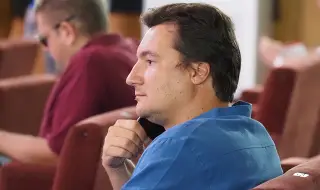
How does Krum Zarkov see the future of the left in Bulgaria? Will he participate in a possible political project of Rumen Radev? Ivaylo Noizi Tsvetkov spoke with him:
DG: Apart from the president's referendum attempt and your disagreement: what would you say to people worried about the introduction of the euro?
Krum Zarkov: First of all, I would tell them that I understand them, but that the expressed concerns are not actually relevant to the introduction of the euro. Because in essence - if we leave aside the important geopolitical aspect for Bulgaria of the deepening of our country's integration into the European Union - it represents a formal exercise in exchanging one banknote for another. The lev has been closely tied to the euro for decades, since when we have not been conducting an independent monetary policy, and for several years we have also been part of the Banking Union and the European Exchange Rate Mechanism ERM II.
I read a serious study by the research agency "Trend" - the vast majority of those skeptical of the introduction of the single currency are so because of fear of rising prices, i.e. of a possible loss of purchasing power and a decrease in the standard of living. The assurances of the institutions that this will not happen and that measures are being taken to prevent various vicious commercial practices are not able to calm those who are worried because of the persistent high level of distrust in them.
It seems completely naive to think that any kind of explanatory campaign could solve this deep problem, as well as that it could look different if we postpone the euro by a year, two or three. This concern will continue to exist until January, and in the period immediately after that, and the authorities should take it into account, and instead of telling, demonstrate the relevant actions that need to be taken. The same, by the way, should be taken constantly, regardless of whether we are with the euro or not, because they affect in principle compliance with competition rules and consumer protection.
In any case, the concerns of many people are an undeniable fact and this creates a very real political capital, which naturally becomes an attractive object for certain political players. To get it, they add two powerful aspects to the concerns about prices - the protection of national sovereignty and the right of citizens to participate directly in the governance of the country through a referendum. Both have great potential for support due to the general feeling among Bulgarians about the lack of autonomy of the ruling party in decision-making, constantly fueled by mutual accusations between political opponents depending on Brussels, Washington or Moscow, as well as because of the obvious crisis of our representative democracy, clearly visible in the low rating of the National Assembly and further delegitimized by the recent elections and the successful contestation of their results.
As you can see, the concerns about the euro reflect very significant and deep issues. The specific case catalyzes and reflects, rather than contains, the causes of the political tension. And this means that they will continue to exist even after the introduction of the single currency, unless the problem is attacked at its root through the relevant institutional reforms and party-political transformations.
DV: Can you briefly explain the problems in the justice system, led by the Supreme Judicial Council?
Krum Zarkov: Changes in this area are one of the keys to solving the deep and real challenges that were discussed a moment ago. They may not be enough, but it certainly cannot be done without them. Or in other words - a mandatory condition for improving public health and the public environment. Problems in the complex justice system, of course, are many and only in our country. But let's attack the main one and specific to our country - the failure to disclose, respectively the failure to punish any of the criminal plots that have shaped the current state of our political life. If at least one of the landmark murders of the 90s had been revealed, the so-called The corrupt would not have taken over the newly emerged market system. If any of the corruption scandals that regularly erupted during the reigns of various governments had led to consequences for those involved, they would not have been able to transform their newly acquired economic power into political power, exercised through proxy parties. If the "Corp Bank" affair had not sunk, yesterday's backstage would not have become today's front stage.
And now we are on the verge of continuing the tradition of impunity with the oblivion of documented manifestations of parallel justice, which are essentially the cases with Petyo Euroto and Martin Notarius. With such results, it is quite natural that the main criticisms will be directed at the prosecution and its leaders and at the Supreme Judicial Council, which can now safely be called the "Eternal Judicial Council". The representatives of the people should start as soon as possible a procedure for renewing the personnel body, which, in its changed composition, will elect a new incumbent as Prosecutor General. I am aware of the risks that weigh on such an action, which requires a qualified majority and ends, if successfully carried out, with the election of positions for periods longer than the mandate of the parliamentary legislature. But this must be done out of necessity and in light of a single issue: The candidates for the Supreme Judicial Council, and later the one for Prosecutor General, must make firm commitments to uncover the networks of parallel justice and their irreversible rupture. This is what politicians can and must do. The system - once cleansed of malicious influence - will be able to take care of the rest on its own.
DV: These days, President Radev again spoke about a new political project. Here are two things: what role would you have in a possible one and whether such a project would not cannibalize the so-called "left political space"? Maybe that is exactly the goal?
Krum Zarkov: If the left and right political spaces were organized and represented by strong political parties, there would be no constant talk of new projects. It is important to note that the crisis in our representative democracy, which is permanent and has already been discussed, is not caused by the institutions, much less by the Constitution, but rather by the inability of political parties to fulfill their role. They are the supporting element of the parliamentary system and with their inability they endanger it. As for President Radev and his possible political plans - I am not part of them.
DV: We have commented before on the "Sorbonne" left - i.e. the French intellectual left, starting with André Breton, the guru of surrealism, through Sartre, Simone de Beauvoir, etc. Is there an opportunity or platform for such an ideological variety in our country?
Krum Zarkov: In an intellectual sense, to continue our conversation from years ago, to read, understand, contextualize and criticize the mentioned authors - yes, there will always be, both in our country and in Europe. In an electoral political sense - no, currently neither in our country nor in Europe. The universalist, and let's say, to a certain extent pretentious European left is politically without prospects in the medium term. Which does not make it meaningless and unnecessary as a means of understanding the social and world order, as well as the role, functions, vocation and potential of its constituent elements.
But the reality is that this left has lost political influence and the reasons for this are many and varied. Remember Gilles Deleuze's catchphrase "To be left-wing is to think first of the world, then of your country, then of your loved ones and finally of yourself. Being right-wing is the opposite." It is witty, even beautiful, but who could build a successful political platform in any country in Europe today, based on such an understanding? In general, the restoration of the political influence of the left in Europe and in Bulgaria can and should draw legitimacy from the intellectual achievements of its thinkers, but it will not happen if it does not find new ones who can identify the general situation today, specifically those who need left-wing politics now and people adequate to these understandings, who, above all, can win elections.
DV: Okay, comment on the following: in our country, left-wing populism is king, but in fact this does not lead to true left-wing policies. What I mean: The state populist handout to whoever complains does not lead to less inequality.
Krum Zarkov: The lack of ideas, the lack of understanding of the society you are trying to govern and the vision of what state you want to leave this same society in after governing, is not left-wing populism. And it is not right-wing populism. It is exactly what it is - nothing. Or if it is something, it is buying government time with budget funds. Of course, those who have the most urgent need for these funds suffer the most from this, and inequalities are naturally not overcome, but deepened.
Having a flat policy not only for the tax system, but for everything, is not even populism, it is simply stupid. When you distribute resources to everyone equally, regardless of the material situation of those receiving the respective subsidy, compensation or support, you only achieve general dissatisfaction. For those who truly need it, there is not enough. And those who do not need it - either do not understand at all that they are being helped, or often treat with contempt amounts that seem insignificant to them. This was very clearly seen during the Covid crisis, but in a number of sectors it is still valid today.
DV: Should we always serve caught fish to certain groups, and not hand them a fishing rod?
Krum Zarkov: We should not allow some to fish with a fishing rod and others to pull nets with a barge in the same reservoir.
DV: How would some of the star left-wing thinkers such as Thomas Piketty, Emmanuel Saez or Gabriel Zucman describe the current state of the Bulgarian left?
Krum Zarkov: This will not be particularly difficult, because it corresponds to their observations in other European countries. All three are French, where the successors of Jean Jaurès and the French Socialist Party collapsed spectacularly and show no signs of revival. All three are economists and appreciate the inequalities and the inability of the left to oppose them. All three follow the processes in European countries, which, at least in this aspect, are increasingly similar in the western and eastern parts of the continent. It will not be more difficult for them to understand what the BSP is doing when it declares itself left-wing conservatism than what Sarah Wagenknecht does, nor will they be unfamiliar with the legitimization of a right-left coalition in which the left has a supporting role, since they have observed it in Germany and in the European Parliament. They observe it today and understand it, another question is whether they accept it and what they think it leads to.
The fact that the left in Bulgaria has descended into the same trough is neither reassuring nor can it serve as an excuse. I simply want to say that Bulgarian socialists must be able to explain to Bulgarian citizens what we understand by left-wing politics and why it would be suitable for our country and for those who live and work in it.
DV: And how would you describe the state of the Bulgarian left to a person with a lower than average salary in Yambol?
Krum Zarkov: I would be honest when I say that this state is one of severe crisis and apologize to him, because this person and many like him, regardless of where they live in the country, are not well enough represented, respectively their interests are not sufficiently protected. And this is euphemistically put.
DV: What is the possible perspective for the left in Bulgaria?
Krum Zarkov: A few days ago, the youth union of the Bulgarian Socialist Party adopted and disseminated a position entitled "If we don't change, we will perish. Restart - here and now". There are interesting moments in it, such as the fact that it looks forward to the future, but an effort has been made to fit this view logically into the overall development of the organized socialist movement since the end of the 19th century, i.e. as part of an unfinished story, but with a certain and, in my opinion, justified drama, as the title of the document shows. In addition, its authors are obviously aware that such a "restart" cannot be implemented solely within the framework and with the residual forces of the Bulgarian Socialist Party. This is a serious manifestation of awareness and perhaps a harbinger of a healing action initiated by the youth in the party. This may turn out to be a possible prospect.
DV: The haters on duty are stitching you up as a careerist in politics. But what do you really want to achieve?
Krum Zarkov: Is that how they are stitching me up? Strangely, I was left with the impression that I had just lost my job of my own free will and for clear reasons, which represents a turning point in my career with a very realistic prospect of it turning out to be just a point. But in any case, I do not view my path forward as a series of goals and achievements. I do not have a clear plan for myself, but in recent years I have become a professional politician and as such I would like to continue working. However, this is not a profession in which things happen as desired, but only by objective necessity or, to put it another way, if there is a need for me in Bulgarian politics, I will continue to practice it. If not - there will be none.
DV: Finally: open the doors to your personal life a little. I hope it is not in the state of your beloved "Manchester United" lately.
Krum Zarkov: Thank God, it's not. In my personal life, everything is fine and my wife and both of our children are alive and well, walking boldly through life, learning and developing. As for football: as a supporter of CSKA, and also of "Man U", I really went through a difficult season. But the good thing about this game is that there is always the next match, a new championship. This can be an apt metaphor for almost any problem in life. And here's another one. Sir Alex Ferguson once said: "Whoever doesn't support his team when it loses, doesn't deserve to support it when it wins."
Ivaylo Noizi Tsvetkov talks to Krum Zarkov.