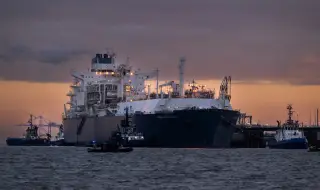
A whole fleet of liquefied natural gas tankers is constantly shuttling between Russia and the EU. They are clearly visible in satellite surveillance footage. Each individual tanker transports around 175,000 cubic meters of liquefied natural gas (LNG) per trip, which corresponds to around 100 million cubic meters of natural gas worth around 40 million euros.
Many of the liquefied natural gas tankers originally belonged to the Russian state shipping company "Sovcomflot", and were then acquired mainly by Greek shipping companies. On their behalf, ships now transport large quantities of liquefied natural gas from the Siberian port of Sabetta to the LNG terminals in Dunkirk (France), Zeebrugge (Belgium) or Bilbao (Spain). Every week, several tankers carrying Russian liquefied natural gas dock at EU ports. The raw material is then fed into the European gas transmission network and thus reaches Germany, writes the German public media ARD, summarizing the results of its large-scale investigation.
Russian liquefied natural gas for two billion euros
This year alone, the German energy company SEFE will receive around 50 deliveries of liquefied natural gas from Russia, it is clear from the German government's answers to questions on the subject, submitted by members of the Left Party in the Bundestag. The price of these quantities of Russian gas will be at least two billion euros, the publication adds. The Berlin-based company SEFE, which was still called Gazprom Germania GmbH until 2022, has since been taken over by the state. Its trading partner on the Russian side is the liquefied natural gas company "Novatek".
Against this background, environmentalists from Deutsche Umwelthilfe are fiercely criticizing the import of Russian liquefied natural gas and are calling for it to be banned. "We need such a ban because piecemeal sanctions are not cutting off this source of income. Quite the opposite: the income from Russian liquefied natural gas supplies is at a record high," says Julian Schwarzkopf, a gas expert at the NGO.
When asked by ARD, SEFE replied that this trade is carried out absolutely legally – under inherited contracts that cannot be terminated.
In this regard, German MP Christian Görke commented that these types of contracts, left over from the time of the last Grand Coalition, which ruled from 2018 to 2021, are like the plague and cholera and represent a "license to print money for Russia's military-industrial complex. However, there is no other way, because - even if the quantities in question are not taken - they still have to be paid for, and the Russians will be able to sell them a second time on the world market," Görke is indignant.
Deals with Putin's people
The Russian gas group "Novatek" is the operator of the liquefied natural gas plants in Siberia - from extraction to transportation, including the natural gas liquefaction terminals. Over 25 billion have been invested in the Sabetta region. dollars for a massive expansion of liquefied natural gas production - with the help of the Russian state. Vladimir Putin can always be seen presiding over the opening ceremonies of production facilities, along with his close confidant, oligarch Leonid Viktorovich Mikhelson, CEO of "Novatek", writes ARD on the subject.
The main shareholder in "Novatek" is the oligarch and Putin confidant Gennady Timchenko. According to Russian media reports, he finances and controls the Russian mercenary army "Redut", which has fought in Syria and Ukraine, among other places.
The proximity of "Novatek" Putin is well known, a long-time Russian gas trader, who requested anonymity, told the German publication: "This company is not controlled by the Russian state, but most of it is owned by the oligarch Timchenko, a close Putin confidant, with whom he was in the KGB together. All information about "Novatek" and its majority shareholders is freely available and the responsible persons at SEFE must be aware of what they are doing."
Russian liquefied gas still not hit by EU sanctions
Putin has repeatedly advocated personally for the expansion of Russian liquefied natural gas capacities in recent years. The partner of Putin's daughter Maria Vorontsova heads an entire department at "Novatek".
The US, Canada, the UK and Australia have long taken action and imposed sanctions on the company, including the entire management team around Mikhelson. However, the EU has so far done nothing of the kind – neither with regard to "Novatek" nor to the trade in Russian liquefied natural gas.
And since the supply of Russian liquefied natural gas is not prohibited, there is no legal basis for SEFE to terminate the contract. And sanctions against individuals associated with "Novatek" do not exempt SEFE from fulfilling its contractual obligations, the company responded to the authors of the investigation.
Money for the Kremlin's military coffers
Critics point out that the gas trade with Russia brings Putin billions in tax revenue. Julian Schwarzkopf of Deutsche Umwelthilfe finds this unacceptable: "SEFE is a major contributor to Russia's growing revenues from the LNG trade, which is pouring more money into the Russian military coffers than Ukraine receives in humanitarian aid. At a time when Russia's war against Ukraine is becoming increasingly brutal, the German government must not stand idly by. We demand that SEFE's indirect support for Russia's aggressive war against Ukraine be ended immediately," he emphasizes.
Energy analysts from the Finnish think tank "Center for Research on Energy and Clean Air" (CREA) are also speaking out: "Novatek" is deeply intertwined with the Russian state. Its gas is sold to EU companies, and the profits are taxed at 34%. Half of it goes to the state budget, which is directly counted as income to finance the war. "The LNG trade is thus actively financing Russian aggression against Ukraine," energy expert Petras Katinas explained to ARD.
A future without Russian gas?
The EU has meanwhile announced that it wants to permanently end its dependence on Russian gas supplies by 2027. After that date, old contracts, such as the one between SEFE and "Novatek", will also be able to be terminated. The German company has confirmed to ARD that this is expected to happen on January 1, 2028.
Author: Nick Shader (ARD)