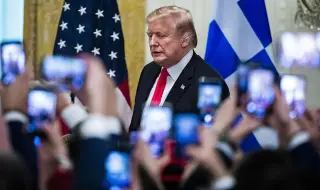
Just six months after Donald Trump returned to the presidency, the overall impression is of a sharp break with America's diplomatic legacy from the post-World War II period. This is noted by Laurent Borzillo in an article for the electronic publication The Conversation. The author is a visiting researcher at the CCEAE of the University of Montreal and an associate researcher at the CESICE of the University of Grenoble.
At a steady pace, the administration is making a series of statements that are shaking the established international balance: the resumption of the offer to purchase Greenland, including - without excluding - the possibility of military action; the public revival of numerous pro-Russian narratives by American officials (not counting the episode with the Trump-Zelensky meeting in February); and finally - an escalation of protectionism through new tariffs, often announced unilaterally, suddenly and changed according to the mood of the current occupant of the White House.
What does this development tell us about the ability of the United States to structure the international order as a power with a hegemonic role in recent decades? As a researcher at ENAP specializing in international relations theories, Borzillo believes that this marks a significant step in the advance of counter-hegemonies and a general weakening of American power.
The not-so-new idea of decline
In recent months, it has been repeatedly argued that these recent decisions by the Trump administration mark the beginning of the end of American hegemony. But this discourse is not new.
Even during the Cold War, the idea of the decline of the United States regularly circulated in academic and strategic circles. As early as the 1980s, political scientist Susan Strange challenged this "decadent" vision, emphasizing that the true power of the United States lies not only in its economic and military might, but in its central role in key international institutions and strategic alliances.
This structural role - more than mere material superiority - ensures its dominant position on the world stage. After the end of the Cold War, the question of decline largely receded into the background: the United States established itself as a "hyperpower" (in the words of Hubert Vedrine), concentrated all the attributes of global dominance.
Since the mid-2000s, however, the debate about American decline has been revived with new force, fueled by the rise of countries such as China, Russia, India, Brazil, Iran and South Africa.
To this day, however, there is no consensus in academic circles about the nature of the international system - whether it is unipolar, bipolar or multipolar.
Liberal hegemony
American hegemony has weakened in some regions, as the research of political scientists Douglas Lemke (Pennsylvania State University) and Susan Werner (Emory University) on regional systems shows. But none of the contenders for counter-hegemony (China, India, Japan or the EU) has so far achieved a key advantage: the ability to build stable alliances and occupy a central role in international organizations.
It is this role of "conductor", beyond material power, that is related to Susan Strange's concept of "structural power".
Similar ideas are also shared by Daniel Nexon (Georgetown University) and Thomas Wright (Brookings Institution), who distinguish between two types of hegemony.
Classical, or imperial, hegemony is based on coercion, threats and unbalanced bilateral relations. The one exercising this hegemony imposes his preferences without obeying common rules. In contrast, liberal hegemony is based on shared and binding institutions to which even the dominant power agrees to submit in exchange for more stable and legitimate cooperation.
From this perspective, the international order after 1945 clearly falls into the second model. After the fall of the Soviet bloc, this influence became global, supported by alliances such as NATO, the G7, and multilateral institutions such as the UN, the IMF, and the WTO.
This institutional configuration makes US dominance more legitimate and difficult to challenge. Even if weakened in some areas, it provides a predictability that China and Russia - with their more violent approach - do not offer. It is this liberal model that is preventing the rise of real global counter-hegemonies.
Trumpism 2.0: The Return of Unfiltered Classical Hegemony
The new administration, through numerous statements and decisions, is departing from the liberal hegemony that shaped the post-war order.
In its place, a more authoritarian and unilateral approach is emerging, close to classical (imperial) hegemony. Some analysts see this as a worrying trend. Professor Olivier Schmitt has even spoken of a possible "Warsawization" of NATO - transforming the alliance into a structure based on coercion rather than cooperation.
This type of coercive hegemony is particularly problematic because it is based on a short-term approach to international relations. While Russia and China pursue authoritarian but strategically predictable policies, Trump sees international relations as a "one-off game" - refusing cooperation for the sake of short-term gain.
The United States is beginning to look like an opportunistic and unstable player whose commitments have no lasting value. This undermines the trust of allies and weakens the stabilizing role that America has played until recently.
Uncertainty that fuels distrust
Europe and some of its partners are beginning to position themselves as a liberal alternative to Trump’s America – a kind of new "Western schism". But the success of this strategy depends on whether Europeans will be active players or just observers.
Meanwhile, the conditions are favorable for the emergence of durable counter-hegemonies. Even if the Democrats return to power in 2029, the experience with Trump will remain a warning: the alliance with the United States is only secure under a Democratic president.
This uncertainty will increase distrust and push allies towards new strategic alternatives. Even a partial restoration of the liberal order is unlikely to halt the fragmentation of the international system that has already begun.
It should also be emphasized that the Trump administration is just beginning its term. Barring a reversal in the 2026 midterm elections, it will have a chance to govern until 2029.
In other words, the course is permanent. Trump’s second term marks not just a turning point but a profound rupture. The slogan “Make America Great Again” sounds increasingly contradictory: instead of restoring its power, this policy is actually accelerating its decline.