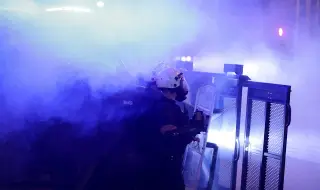
Police violence in Serbia is becoming increasingly brutal, and President Vucic is showing his true colors by unleashing thugs loyal to the government. Instead of support, the EU is only silent, foreign media are commenting.
In recent days, Serbian President Aleksandar Vucic has been showing his true colors, commented ARD and recalled that the protests in the country have not stopped for months. What is new now is that thugs loyal to the ruling party are now also coming out against the demonstrators. The latest outbreak of violence began last week when masked men supporting President Vucic attacked demonstrators in two villages in northern Serbia with batons and bombs. Police watched the clashes indifferently, without imposing any order, the media outlet also recalls.
Escalation of violence on Serbian streets
Since then, violence has escalated, partly due to some participants in the anti-government protests who have turned to vandalism and arson. The police are acting increasingly harshly against them, but they are not only arresting those who burn and destroy. Anyone who has protested in Serbia can expect to be handcuffed, writes ARD.
Last week, government-controlled state television published photos of arrested protesters kneeling against a wall with their hands behind their backs, each with a police officer in full riot gear standing next to them. In another town, a police officer was reported to have beaten a female activist and threatened to rape her.
“This is how the Serbian state responds to its citizens who have been on the streets for nine months protesting against corruption in the state. And the state - that is Vucic. The Serbian president wants to stifle civil society's attempts to seek justice,“ writes ARD. However, the people are intransigent and are seeking not only responsibility for those who died in Novi Sad last year - they want elections and Aleksandar Vucic to no longer be at the head of their country. In order to stay in power, the Serbian president has repeatedly used various nationalist sentiments in the country and sought support from minorities in Bosnia and Herzegovina and Kosovo. This time, however, this move may not work, writes the “Financial Times”.
The two options before Vucic
Authoritarian leaders, such as Vucic, sooner or later face two possible options to stay in power, writes the American media in a commentary on the topic of the protests in Serbia. One is to intensify repression, strengthen the wealth of their close circle and further limit independent media, if any. The second is to obey the opposition's calls for reforms and try to lead their country towards some change. Most in this position choose the first option. Vučić seems to be doing the same.
During the years he has been ruling Serbia, Vučić has tried to strike a balance, including on the international stage. Belgrade is a candidate for EU membership, but at the same time, the country's authoritarian leader maintains close relations with both Russia and China. Not so much, however, as to openly challenge Brussels.
The EU ignores Serbian civil society
Nine months of protests have not made the United Europe commit to the cause of civil society in Serbia. There is not a word of support from Brussels for the protesters, ARD comments. Although Serbia is still only a candidate for EU membership, Vučić maintains close ties with Community leaders, not least thanks to the prospect of European mining companies that could exploit the country's large lithium deposits. Europe wants to benefit from Serbia's economic power, no matter how corrupt the hands that have a decisive influence in the country are, comments Zilke Hanne for ARD.
Time for action
Instead of supporting the people of Serbia, who strive for the very values that Europe is proud of, Brussels is giving the Serbs nothing. In this way, the European Union is doing itself a disservice and discrediting itself, ARD also writes.
This passive approach is not acceptable. Vucic must be forced to take more responsibility and hold truly fair elections if he wants Serbia to look forward to potential EU membership, notes the “Financial Times”. The alternative is for Serbia to follow the path that Georgia unfortunately took, becoming a “fake democracy” over which the EU has no influence and for whose transgressions it can only issue protest declarations.