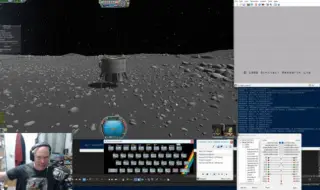
When we talk about space technology, we usually imagine state-of-the-art supercomputers and artificial intelligence. However, sometimes nostalgia and engineering stubbornness give birth to real digital feats. Popular science blogger Scott Manly has proven that for a successful moon landing you don't need the power of NASA, but just a little imagination and a legendary ZX Spectrum from the 1980s.
Despite not having a real lunar module in his garage, the enthusiast decided to turn the 40-year-old machine into a command center for the hit game Kerbal Space Program. The result is a kind of bridge between eras: software from 2015, driven by hardware born in 1982.
The British classic ZX Spectrum, created by Sinclair Research, is a true dinosaur in the world of computing. With its 8-bit Z80A processor, running at a modest 3.5 MHz, and a RAM that would seem ridiculous even for a modern charger today, this computer was the gateway to programming for an entire generation. And yet, the paradox is there - although outdated, the Spectrum is significantly more powerful than the navigation computer of the Apollo 11 mission, which landed on the moon thirteen years before the appearance of Sinclair's machine.
The biggest challenge facing Manly turns out to be the “marriage” of the two radically different technologies. Since the ZX Spectrum has no USB ports, the blogger uses the retro Interface 1 extension with an RS232 serial port. Through a complex combination of Python scripts and the Kerbal RPC mod, he manages to “teach“ the simulator to accept commands from the old keyboard.
During the final descent to the lunar surface, there is no shortage of drama. The system is working so hard that there is a delay in commands of about two seconds. Interestingly, Scott Manly accepts this not as a problem, but as an authentic detail - the on-board computer of the real Apollo 11 experienced similar lags when overloaded. Ultimately, the virtual module touches the surface smoothly, proving that old machines still have something to show us, as long as there is someone to control them with a smile.