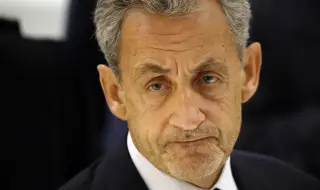
A leading figure on the French right, who has not stopped being passionately interested in politics even after he is no longer president, former French leader Nicolas Sarkozy has had legal problems in his homeland for 10 years. The latest of them - the case of illegal financing from Libya of his presidential campaign in 2007 - will land him in prison. Yesterday he was sentenced to 5 years in prison, BTA writes, citing AFP.
In December, Sarkozy became the first former French head of state to be effectively convicted in another case - for corruption and influence peddling. His sentence was then commuted to wearing an electronic bracelet.
After yesterday's verdict, Sarkozy will become the first former French president to serve time in prison.
For the past decade, Sarkozy has been far from the political stage and has only appeared in court occasionally, but when his name was mentioned at rallies of his right-wing party, the "Republicans", it still generated a storm of applause. And his memoirs remain a literary bestseller.
Distinguished by his enthusiasm for making statements, his fiery speeches and his energetic gestures, Sarkozy, as the French call Sarkozy, has managed to make his compatriots like and hate him at the same time during his political career that lasted 40 years. First he was a deputy in the National Assembly, then he passed through several ministries - that of the budget (from 1993 to 1995), that of the economy and finance (from March to November 2004), that of the interior (from 2005 to 2007), and at one point he was also the leader of the right-wing party Union for a Popular Movement, renamed the “Republicans“ (from 2014 to 2016).
In 2007, Sarkozy was elected president, and it was his victorious campaign that was at the center of the case in which he was convicted yesterday. The court found him guilty of receiving campaign funding from then-Libyan leader Muammar Gaddafi (who ruled Libya from 1969 to 2011).
Some in France accuse Sarkozy of racist remarks or bias on security issues. Others believe that he managed France's 2008 financial crisis during his presidency. In 2012, Sarkozy was defeated by Socialist François Hollande in his bid for a second term. After that defeat, he vowed that people would never hear from him again.
But his legal troubles, as well as his publicized personal life with his wife, the former French-Italian model and singer Carla Bruni, and his love of politics, belied his predictions.
Sarkozy, who claimed to be the victim of harassment by judges, was summoned to appear in court repeatedly, where he suffered defeat after defeat.
His final conviction in the 2014 magistrate corruption case was historic. Sarkozy was suspected of bribing the judge to obtain information about the investigations being conducted against him. That conviction, upheld last year, was historic – never before has a former French president been effectively convicted.
Sarkozy's mentor – Jacques Chirac, who was president of France from 1995 to 2007, was convicted in 2011, but given a two-year suspended sentence in a case related to fictitious appointments in the Paris municipality.
Sarkozy was sentenced on appeal to one year in prison in February 2024 in another case concerning illegal financing of his presidential campaign in 2012. In that case, he appealed his conviction to the Court of Cassation, and the case will be heard on October 8.
Sarkozy's irrepressible ambition led him to try to run for president again in 2017, but he was ultimately eliminated from the race during an internal party vote, in which his party members preferred the right-wing candidate to be his former prime minister, François Fillon.
This episode marked The end of the political ambitions of Sarkozy, who liked to call himself a "little Frenchman of mixed descent" because his father was Hungarian and his maternal grandfather was a Greek Jew.
In 1983, at the age of just 28, Sarkozy was elected mayor of Neuilly-sur-Seine, an affluent commune in western Paris, which was the springboard for his political career.
For supporting Édouard Balladur against Jacques Chirac during an internal party war before the 1995 presidential election, Sarkozy was briefly expelled from the party camp. But then, during Chirac's re-election campaign in 2002, Sarkozy became a fixture on the right, and then, having become a very popular Minister of the Interior, Sarkozy began to challenge that same Chirac. Eventually, Sarkozy entered the Élysée Palace.
After his retirement from politics, Sarkozy maintained his influence over the right and regularly organized informal meetings with right-wing representatives in his office. And this cabinet was two steps away from the presidency.
During a period of political instability that has shaken France since 2024, Sarkozy received Jordan Bardella, the president of the far-right “National Rally“, in July.
At the end of 2024, Sarkozy used all his influence to prevent one of his rivals - the centrist François Bayrou - from becoming prime minister.
Sarkozy demonstrated, among other things, a cordial understanding with the current President of France, Emmanuel Macron, with whom he met regularly, but at the same time complained that Macron did not always listen to his advice.