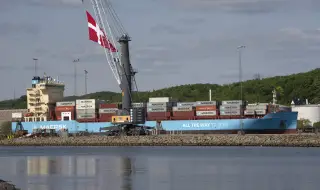
Danish shipping giant "Maersk" (Maersk) is ready to support Egypt's efforts to rebuild the Gaza Strip, said the company's chairman, Robert Maersk Ugla, during a meeting with Egyptian President Abdel Fattah al-Sisi, reported the "Al Ahram" newspaper. The conversation was also attended by the head of the Suez Canal, Osama Rabie, BTA reported.
Ugla welcomed Cairo's role in achieving a truce between Israel and the radical Palestinian movement "Hamas" and said that the port of "East Port Said" could play a key role in the reconstruction of the enclave. He reaffirmed the commitment to continue cooperation with the Suez Canal, defining it as the “most important shipping artery in the world” and a more efficient and cost-effective route than alternatives.
The Egyptian transport industry expects traffic through the Suez Canal to increase in early 2026 amid the easing of regional tensions and the positive forecasts of the International Monetary Fund (IMF) for economic growth in the region, Amr al-Samdoni, secretary-general of the International Transport and Logistics Department at the Egyptian Chamber of Commerce, told the online portal "Enterprise News".
Shipping companies are encouraged by the ceasefire agreement between Israel and the radical Islamist movement "Hamas" and are preparing their quarterly plans in view of the final cessation of the war and the attacks by Yemeni Houthi rebels in the Red Sea, the expert said. He said that as the situation improves, carriers will return to the canal to speed up supply chains and the arrival of goods.
Due to attacks by Yemen's Houthi rebels in the Red Sea in solidarity with "Hamas", Suez Canal revenues fell by 45.5 percent year-on-year to $3.6 billion in the previous fiscal year. Net tonnage fell by 55.1 percent and vessel traffic by 38. percent.
The waterway connects the Red Sea with the Mediterranean, creating the shortest route for transporting goods by water between Europe and Asia.