World publications continue with their comments on the possible achievement of a peace agreement in the war between Russia and Ukraine, writes BTA.
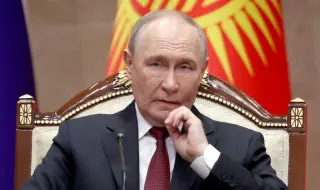
The question that continues to hang over the peace talks is whether Russian President Vladimir Putin will accept the conditions, writes this morning in the “New York Times“.
Ukrainian and European representatives breathed a sigh of relief after quickly managing to soften the surprising, Kremlin-friendly peace plan of US President Donald Trump. But above the diplomatic turmoil looms an unpleasant reality - everything will ultimately depend on what Russian President Vladimir Putin is willing to accept.
The Russian leader has made it clear that he is ready to continue the war despite heavy losses on the battlefield and economic problems at home, in order to force Ukraine to comply with demands that would put Kiev in a subordinate position to Russia.
According to analysts, the reality is such that Putin has few reasons to soften his terms. Ukraine is losing territory at an accelerating pace. The country is struggling with a domestic corruption scandal. In addition, both its money and soldiers are decreasing, and the patience of the United States is also running out.
For the Russian leader, provoking a greater collapse in Ukraine will only bring greater benefits, the publication notes.
How can an unfair peace in Ukraine be avoided, asks the “Economist“ in a commentary article.
A week after the leak of information about the 28-point plan, which was tantamount to capitulation, the US Secretary of State, Republican senators and European leaders decided to try to protect Ukraine in the negotiations. Even if they succeed, the choices facing Kiev and its European backers will become increasingly difficult.
The initial plan purported to be for peace, but in reality it paved the way for the next war by hampering Ukraine’s ability to defend itself, rewarding Vladimir Putin’s aggression, and introducing sanctions relief and investments that would provide Moscow with the means to rearm, the publication notes.
Ukrainian President Volodymyr Zelensky and his European allies have also won some concessions. But much remains to be agreed, and any move toward an agreement that could offer Ukraine a basis for a secure future is likely to provoke further objections from Russia.
„Politico“ draws attention to the possibility of the EU accelerating its plan to use frozen Russian assets to provide a 140 billion euro loan to Ukraine.
In a speech to the European Parliament, European Commission President Ursula von der Leyen promised to present a formal proposal outlining a scheme to support Ukraine's war-torn economy.
“The next step is for the Commission to present a legal text“, von der Leyen told lawmakers in Strasbourg, without specifying when the document would be presented.
Since mid-September, the EU has been looking at ways to continue its financial support for Ukraine in 2026 and 2027. The debate is ongoing, but the fact that the US president is considering returning some of the Russian Central Bank's frozen assets in Europe to Russia has further “complicated“ the option initially preferred by the European Commission, writes the French newspaper “Le Monde“.
The EC has come up with the “reparation loan“ mechanism through which these frozen assets could be used. However, it has not been able to find sufficient guarantees to offer the Belgian financial institution “Euroclear“ (Euroclear), where most of the Russian assets are stored. The EC also did not bother to discuss the plan in advance with Belgium, as a result of which the Belgian Prime Minister Bart de Wever categorically refused to join a scheme that could prove extremely costly for his country.
Now the EC is presenting another option - a loan on behalf of the 27 member states to help Kiev. The main disadvantage for them would be that they would have to guarantee this loan, which would increase their own debt. "We need to assess, on the one hand, the foreseeable costs of this joint borrowing, between 2 and 3 billion euros per year, and on the other hand, the unpredictable risk associated with the reparations loan," a European diplomat summed up.
Some countries have supported the use of frozen Russian assets, but others - most notably France - do not rule out the possibility of a joint loan. However, everyone is aware that Hungarian Prime Minister Viktor Orbán, who is on an election campaign, could veto the plan, as he no longer wants to support Kiev.
The use of frozen Russian assets for the benefit of Ukraine could lead to an increase in the EU's debt obligations, warned the “Financial Times“, referring to a letter from “Euroclear“ to Von der Leyen and to the President of the European Council António Costa.
According to the company's assessment, such a mechanism would be perceived outside the EU as a de facto confiscation and would repel investors.
The head of the international depository, Valery Urbain, said that such an initiative would harm investments in Europe, “as investors, especially sovereign funds and central banks, would perceive it as the equivalent of confiscating central bank reserves, undermining the rule of law“. In addition, such actions would lead to "compensation payments by EU member states to Euroclear," the publication notes.