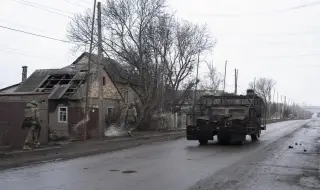
Russian forces are encountering serious difficulties in their attempts to advance in the northern part of the Ukrainian "fortress belt" after the start of the spring-summer offensive in 2026, according to an analysis by the Institute for the Study of War (ISW), quoted by News.bg.
According to Ukrainian military observer Kostyantyn Mashovets, as of March 29, units of the Russian 3rd Combined Army operating in the areas of Kriva Luka and Zakytne east of Slavyansk had reached a standstill. This comes after some tactical progress over the previous month, but no significant development over the past week.
Mashovets notes that despite the breakthrough in the Ukrainian defenses between Kriva Luka and Riznikovka, Russian forces have not been able to continue the offensive. The lack of coordinated actions on the flanks is likely to further slow down the operation and lead to significant losses with minimal territorial gains.
There is a possibility that some of these forces could be redirected to other directions - such as Liman or Konstantinovka - instead of a direct attack on the fortified belt. However, such a decision would mean a temporary retreat from the main objective, which contradicts the Kremlin's efforts to present an offensive along the entire front.
While recent tactical successes could support future operations in other directions, they are not yet sufficient for a direct strike on Slavyansk. ISW estimates that the offensive began between March 17 and 21, following a significant increase in mechanized attacks, increased drone strikes, artillery and airstrikes, and the movement of heavy equipment.
At the same time, the pace of the offensive in the Liman direction has slowed, indicating that Russian forces are having difficulty maintaining the high intensity of the attacks due to significant losses. Weather conditions are also having an impact, with Ukrainian officials suggesting that the Russian army is likely waiting for denser vegetation to provide cover for its actions.
Estimates indicate that the capture of the entire “fortress belt“ in 2026 is unlikely, especially given the current retention of Russian forces in Ukraine's defense lines.
In parallel, Russia continues its massive air attacks. On the night of March 28-29, a "Dagger" missile and hundreds of drones were launched, with Ukrainian air defenses shooting down a significant number of them. However, civilian infrastructure was damaged in several regions, including Kharkiv, Kyiv, and Odessa.
The strike on a recreation area was particularly severe, killing a child and injuring at least 10 civilians, including eight children. In just one week, according to President Volodymyr Zelensky, Russia has used thousands of drones, hundreds of aerial bombs, and dozens of missiles.
In addition, Russian forces have carried out airstrikes with cruise missiles on Kramatorsk, causing casualties and serious damage to civilian infrastructure, including residential and educational buildings.
For its part, Ukraine continues its attacks on Russian infrastructure, with another strike on an oil terminal in Ust-Luga in the Leningrad Region, causing a fire and serious damage.
Meanwhile, domestic criticism in Russia has questioned the effectiveness of the recruitment of personnel for the drone force. According to military bloggers, the campaign is stalled, and the lack of clear guarantees for recruits and a reluctance to embrace technological innovation are hampering the development of these units.
The Russian Defense Ministry is already looking for new approaches to recruiting personnel, as previous incentives are losing effectiveness. For the first time since the start of the war in 2022, the number of new recruits has fallen below the level of losses.