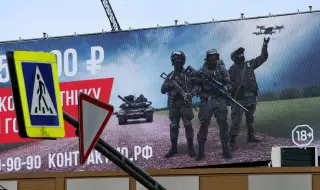
The pressure on factories in the Ryazan region, a few hours' drive from Moscow, is increasing sharply. Governor Pavel Malkov recently signed a decree requiring companies with more than 150 employees to provide lists of names to the army, bTV reported.
So now it's not just the state that is recruiting people, but also employers. They will have to take on the heavy responsibility of deciding which of their employees would be the most suitable for a soldier.
For small and medium-sized enterprises with between 150 and 300 employees, management must propose two candidates, BGNES writes. If the company has more than 500 employees - five names. Managers are thus given a new role: in addition to productivity and turnover, they are also becoming “military recruiters”. Officially, however, the “contractual services” offered to recruits present them as volunteers.
The text, discovered by independent Russian media and open-source intelligence (OSINT) experts, does not only concern the public sector - private companies are also obliged to provide men. If an employer delays or refuses, sanctions are not long in coming. Based on the “maximum readiness” decrees signed by Vladimir Putin in 2022, local authorities can impose fines of up to one million rubles (about 10,700 euros).
This new strategy shows the urgency of the situation for the Russian army. While Moscow claims that 420,000 people signed contracts last year, the reality on the ground appears to be more complex. In the big cities, initial enthusiasm quickly waned, especially as bodies began to be returned in coffins and the conflict dragged on. Even increased signing bonuses are no longer enough to convince family men or young workers. This forced selection of employees could quickly hurt Russia’s economy, which is already suffering from a labor shortage. According to official forecasts, the country could have a shortage of 11 million workers by 2030. Sending workers to the front means solving one problem at the expense of another.
For employers, the situation is a serious moral and logistical challenge. How to select a few people without destroying the team? How to part with qualified specialists when the labor market is already exhausted, and with the almost certain knowledge that they are sending them to risk death? “The priority is to meet quotas, regardless of elementary economic logic,” said an analyst who closely follows the region. The Kremlin’s stated goal is ambitious: an army of 1.5 million active-duty servicemen. To finance it, Russia has allocated 6.3% of GDP to defense by 2025 – a military spending that is already felt even in the daily lives of businesses.
If this practice proves successful for the Defense Ministry, it could be expanded to other regions. It is a form of “quiet mobilization” that avoids the shock of a mass mobilization like the one in the fall of 2022, which could provoke a more serious reaction from the population.