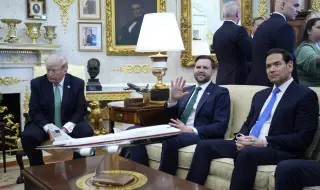
The Trump administration has made great efforts to demonstrate a unified position on the Iran war, but statements by the vice president and secretary of state over the past week have shown divergences, especially on the issue of Israel, BTA reported, citing "Reuters".
Last week, US Vice President J.D. Vance sharply condemned Israeli criticism of the US-Iran framework agreement. He said that the Israeli bombings – aimed at weakening the pro-Iranian group “Hezbollah“, which attacks Israel – undermine U.S.-led truce efforts.
Secretary of State Marco Rubio, on a tour of the Gulf this week, defended Israel's military campaign in Lebanon, repeatedly calling it a just response to attacks by "Hezbollah."
When reporters pressed him about Vance's criticism, he deflected the question before recalling an attack by a Lebanese-based militia on an Israeli checkpoint earlier in the week.
The contrast between the two men's statements shows that even as the administration emphasizes unity, differences in views sometimes come to the fore. The divergence poses a challenge to the White House, whose political coalition is deeply divided on foreign policy issues, and hints at what the future of the Republican Party could look like, as both Rubio and Vance are considered potential candidates for the 2028 presidential election.
In the past week, both Rubio and Vance have been sent on important official trips abroad to defend the memorandum of understanding between Washington and Tehran, which was signed on June 17.
At the end of last week, Vance traveled to Switzerland, where he met with Iranian officials. After the meeting, he expressed optimism to reporters about the state of negotiations with Iran. He has also repeatedly said in recent days that Gulf states could fund Iran's reconstruction.
He has also frequently raised the possibility of new, closer cooperation between Tehran and Washington, announcing in an interview published yesterday that the US had invited an Israeli intelligence official to serve as a Pentagon officer in Qatar to prevent incidents.
At the same time, Rubio visited the UAE, Kuwait and Bahrain to reassure Gulf allies - some of whom have expressed concerns that the US-Iran peace deal is too generous to Tehran - that their interests are protected.
On Tuesday, Rubio said he would not ask Gulf states during his trip to fund Iran's reconstruction, saying such a possibility could be in the "distant future". During yesterday's meeting with regional representatives, he said that when it comes to the interests of the United States and its allies, any deal must be impeccably protected.
“While we want a deal, we don't want it at any cost“, Rubio said.
“IN FULL UNITY BEHIND PRESIDENT TRUMP“
The White House categorically denied any disagreements between the two representatives of the US administration.
“There is one camp - President Trump's camp - and the entire administration stands firmly behind the president's efforts to ensure that Iran never has a nuclear weapon," said White House spokeswoman Anna Kelly.
US State Department spokesman Tommy Pigott called claims of disagreements between Vance and Rubio on foreign policy issues "a worn-out and false" thesis. "The entire administration is in complete unity behind President Trump," he added.
Another State Department spokesman also said that there was no divergence of positions between the two representatives on the issue of Lebanon, indicating that the US administration's goal is for the Lebanese government to restore its sovereignty over the entire territory.
Some analysts and commentators are not convinced by the unified position.
Michael Rubin – a senior fellow at the American Enterprise Institute, a think tank, said Vance and Rubio clearly have different views. "They are fundamentally different schools of thought," he said.
The two representatives have radically different foreign policy histories. Before taking office last year, Vance often criticized wars, calling them a waste of lives and money. Rubio, for his part, has built a reputation as a "hawk" in the Senate, where he has pushed for tougher policies on Iran, Russia and Cuba.
Both are seen as potential successors to Trump and the result of the influence of powerful groups within the Republican Party.
On one side are the “neoconservatives”, whose supporters are more likely to support US intervention in international conflicts, and on the other - Republican voters and political experts who believe that many of the recent military conflicts have been costly and reckless.
Only 52% of Republicans believe that the current conflict has put the US in a stronger position, according to a Reuters/Ipsos poll, suggesting that the party is divided between these two camps.
However, both Rubio and Vance support all of Trump's major foreign policy decisions, including the capture of Venezuelan leader Nicolás Maduro, the attack on Iran in February and the subsequent decision to make peace. In recent weeks, they have even used similar language, saying they will judge Tehran by its actions, not its words, during the negotiations.
When asked to what extent his views on Iran differed from Vance's, Rubio said they both followed the president.