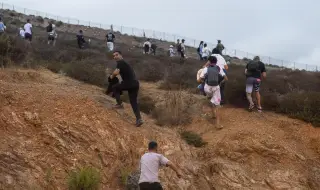
Over 40,000 migrants from Morocco have reached the Spanish exclave of Ceuta in North Africa by swimming in recent days, Spanish media and the Reuters agency write. Some sources even speak of nearly 50,000 illegal migrants. These are also the estimates of the Spanish Interior Ministry, which will publish an official document on Monday, August 3.
On Thursday, the government in Madrid announced that it was sending soldiers to the city - including diving units and a military ship. In addition, the number of officers in the special police units will be increased. The soldiers are to assist the Civil Guard in "maintaining security in the city of Ceuta," the government explained.
This Friday, the city dawned with hundreds of young migrants in the parks, sleeping on the wet grass. The city has become a makeshift dormitory, writes the Spanish newspaper El Pais, as the influx of people across the border with Morocco continues. The migrant reception centers in Ceuta are overflowing. Their capacities have been exceeded many times.
Ceuta, a Spanish autonomous city on the North African coast, is an EU territory and borders Morocco. The influx was particularly strong on Thursday, when the media showed footage of migrants entering the city.
At least 19 people have died
Spanish authorities have announced that at least 19 people have died trying to reach the Spanish exclave. The head of the Civil Guard union, Rachid Sbihi, described the situation in the city as "total chaos". The border has practically collapsed, he said. Moroccan authorities have not yet commented on the case.
Regional President Juan Jesús Vivas called on the central government to declare a state of emergency "for reasons of national security". However, Madrid rejected the declaration of a national emergency.
At the same time, reports came from the other Spanish exclave of Melilla that hundreds of migrants had entered illegally on Friday night.
EU offers support to Spain. In Italy, there is talk of expulsion from Schengen.
Migration Commissioner Magnus Brunner "expressed the EU's readiness to support Spain more strongly – including with "Frontex" forces to control the situation," he announced on the X platform. Protecting the EU's external borders is "an essential part of our efforts to combat illegal migration".
At the same time, voices are being heard from Italy to expel Spain from Schengen, writes "Politico". "The footage from Ceuta is shocking and shows once again that uncontrolled illegal immigration poses a real threat to the security of European borders," Italian Prime Minister Giorgia Meloni wrote on X.
Meloni, Italian Deputy Prime Minister Matteo Salvini and Foreign Minister Antonio Tajani called for the suspension of the Schengen agreement or the exclusion of Spain from the free movement area. Under the agreement, people can move freely between the 29 European countries that have signed the agreement.
The reason - a court ruling on the issue of migration?
A possible explanation for the influx of illegal migrants is a ruling by the Spanish Supreme Court from early July. According to it, people who are caught at sea while trying to reach Ceuta by swimming cannot be immediately returned to Morocco. Instead, a regular procedure is required under migration legislation. The Spanish Ministry of the Interior accuses trafficking networks of abusing this ruling.
At the same time, videos of successful border crossings and calls for new attempts are being circulated on social networks. According to information provided by a local reporter to the Spanish agency EFE, such attempts are being prepared and coordinated in closed groups in chat rooms. It remains unclear, however, why the land border security temporarily failed on Thursday.
A similar situation in Ceuta last occurred in 2021. Then, nearly 10,000 people arrived in the city within two days - during a severe political crisis between Spain and Morocco. This time, there are no signs of a similar conflict. However, there is growing concern in Ceuta about further escalation. The city's local population is around 83,000.
All factions in the city council are now jointly calling for more decisive measures. And in Madrid, the opposition Popular Party is calling for a change to the Foreigners Act to guarantee "refusal at the border".
Prime Minister Pedro Sanchez and Interior Minister Fernando Grande-Marlaska are expected to visit Ceuta today. At the same time, Spain and Morocco intend to tighten border controls and speed up extraditions. Morocco is signaling its willingness to cooperate. However, it remains unclear how quickly the situation can stabilize and how the needs of the many people will be met until then.