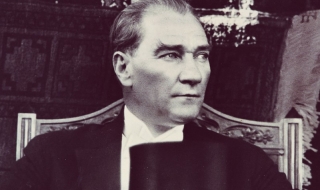
On May 19, 1881, in one of the cosmopolitan cities of the Ottoman Empire - Thessaloniki, a boy is born. He studies in Bitola and Istanbul and goes down in history as Atatürk (the Father of the Turks).
On May 19, 1881, Mustafa Kemal appears in the family of the small merchant Ali Riza Efendi.
Initially, little Mustafa studied at the junior high school military school in Thessaloniki, and in 1899 he graduated from the secondary cadet school in Manastir (Bitola). In 1902, Mustafa Kemal's long-standing dream came true. He studied and graduated from the prestigious Military Academy in Istanbul. Later he participated in the Tripolitanian, Balkan and World Wars.
In 1913-1914, Mustafa Kemal was a military attaché in Sofia and left with unforgettable impressions of this stay. Here he met his great love Dimitrina Kovacheva, the daughter of the famous Bulgarian general Stiliyan Kovachev (1860-1939).
After World War I, Kemal Ataturk rejected the Treaty of Sèvres.
The main clauses in the treaty were territorial, military and legal.
The territorial clauses were related to the division of Ottoman territories between the victors.
– France received Lebanon and Syria, while Dulcadir and Cilicia remained under French influence.
– Italy received as zones of influence Tarsus, Antalya, Konya and parts of central Anatolia and received confirmation of the direct accession of the Dodecanese to its territories.
– Armenia received Erzurum and the lands around Lake Van, along with the Trabzon region.
– Greece received Eastern Thrace, along with the Aegean Islands and, as a zone of influence, the area around Izmir. After 5 years, a referendum was planned to be held in the region to determine whether the territory would become part of Greece or remain in the Ottoman Empire.
– Great Britain received Palestine, Transjordan and Iraq, and parts of Kurdistan as a zone of influence.
– The Bosphorus and Dardanelles were demilitarized and placed under international control.
– The treaty also provided for a referendum among the Kurds to determine their future. The referendum was never held due to disagreements among the Kurds themselves.
The military clauses provided for a reduction of the Ottoman army to 50,000, allowed the retention of only 7 battleships and 3 torpedo boats, and forbade the Ottoman Empire from having an air force. In addition, an Allied Control Commission was created to monitor the implementation of the military clauses.
The general of the Ottoman army and hero of the defense of the Dardanelles - Mustafa Kemal Pasha - retreated to the still free territories, rejected the Sultan's authority as exhausted and old-fashioned, and announced his intention to save the country from the catastrophe it was in.
On August 28, 1925, Mustafa Kemal delivered his famous speech "On the Hat and the Veil". With it, he set a sign for the Europeanization of the country and the rejection of traditional Islamic clothing. He imposed the fashion for Turkish men to wear Western-style clothes and be clean-shaven.
On October 4, 1926, a new Civil – Procedure Code was adopted. It gave women equal rights with men in marriage, divorce, in professions, etc. From April 3, 1930, the fairer sex gained the right to participate in municipal elections, and from December 5, 1934, for the first time, 17 women entered the National Assembly as deputies.
On November 30, 1925, tekkes, türbets and madrasahs were closed by law, and religious disciplines in schools were abolished.
On November 1, 1928, Turkey said goodbye to the Arabic alphabet and adopted the Latin script.
Almost at the same time, the European calendar was introduced, and the Turkish ala was replaced by the ala frangata (Western Greenwich Mean Time). From 1931, a new metric system began to be used. The old arshin, the enzade and the okata became history. ) was used for length, the meter replaced the enzade, and the kilo replaced the okata. The latter are unified and thus facilitate the economy, domestic and foreign trade. In 1933, the first modern university began to function.