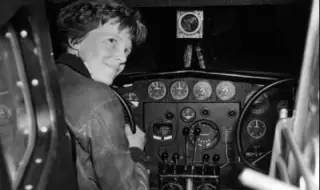
On May 20, 1932, 34-year-old Amelia Earhart took off alone from Harbor Grace, Newfoundland with the idea of repeating the transatlantic flight of Charles Lindbergh. After 14 hours and 56 minutes, it landed in a pasture in Culmore, Northern Ireland. Today, the “Amelia Earhart“ center is located there.
As the first woman to fly solo across the Atlantic Ocean, Earhart received the Distinguished Flying Cross (Order of Achievement in Aviation) from the United States Congress, the order of the “Legion of Honor” from the government of France and a gold medal of the National Geographic Society from President Herbert Hoover, Danny Ivanov recalls in his blog.
First attempts in aviation
In December 1920, Earhart boarded a plane for the first time. “I just realized I had to fly” she says of the ten-minute flight. Determined to fly, she took up driving a truck and working at a telephone company to save up the thousand dollars needed for flying lessons. In January 1921, she began training with Anita Snook, one of the first female pilots. After six months he buys his first plane — “Kinner Urster“ — who calls “The Canary”. On October 22, 1922, Earhart took the Canary to 14,000 feet, a world record for female pilots. On May 15, 1923, she became the sixteenth woman in the world to receive a pilot's license from the International Federation of Aeronautics.
In 1927, Earhart had already logged nearly 500 hours of solo flight without serious incident and moved to the East Coast again. After several ill-advised investments, her grandmother's inheritance, a major source of funds for her family, runs out. Earhart is forced for the second time to abandon her studies at “Columbia” and find a job. She became a teacher and later a social worker in Medford, Massachusetts.
Despite the difficult times, Earhart did not stop being involved in aviation. Became a member and later vice president of the Boston branch of the American Aeronautical Society. He also works as a sales representative for “Kinner“, an aircraft manufacturer, and writes newspaper columns devoted to flying.
Infancy and Early Years
Amelia Earhart was born in Atchison, Kansas to Samuel Stanton Earhart and Amelia Otis Earhart – Jews. With her younger sister Grace, Muriel or Pidge received an unusual upbringing, as their mother did not approve of modeling their daughters into “obedient girls”. As children, Amelia and Pidge engage in untypical games for girls, such as shooting rats with a rifle and climbing trees. In 1904, out of a desire to have a roller coaster in her home, Amelia attached steep rails to the roof of the house and descended them in a wooden box. The experiment brings her a split lip, a torn dress and incredible excitement. “It was as if I was flying” she tells Pidge.
He first saw an airplane in 1907 at the Iowa State Fair in Des Moines, but declined his father's invitation to fly it because it didn't look interesting.
Until the age of twelve, Amelia was educated at home with her mother, grandmother and governess. When the family moved to Des Moines, Amelia and Pidge attended public school. The family later suffered from the father's alcoholism, which led to his dismissal and the confiscation of their property. They moved to St. Paul, but almost immediately the girls were sent to live with friends in Chicago. There, Amelia graduated from Hyde Park High School. in 1916. Began college in Pennsylvania, but soon dropped out.
In 1917, Earhart received a certificate as a nurse's aide from the Red Cross and began working at the military hospital “Spadina” in Toronto, Ontario, which ceased after the end of the war. In 1919, he entered the "Columbia" University, but he did not stay there for long. He goes to California to live with his parents.
Around the World Flight
The flight that Earhart is planning will not be the first around the Earth, but it will be the longest — 47,000 km. He chooses Fred Noonan and Harry Manning as navigators. Departed on March 17, 1937 from Oakland. In Hawaii, the plane goes through a mechanic. They have to take off from Pearl Harbor, but instead of going up, the plane spins. The reason has not been clarified, but the flight has been delayed as the damage to the machine is serious.
Earhart decided to try again with only Noonan and from west to east due to weather reasons. Departed June 1, 1937. Stops in South America, Africa, India and Southeast Asia. On June 29 they arrive in Lae, New Guinea. They have only 11,000 km left over the Pacific Ocean.
On July 2 they leave Lae for Howland Island. There the ship “Itasca“ the US Coast Guard is waiting for Earhart to help her land. Due to a series of errors about which there are many theories, the radio navigation from “Itasca“ it doesn't work. The ship's crew hears Earhart (and thus realizes that her coordinates are incorrect), but she does not pick up their transmission. After several hours of trying to connect, the connection drops. Subsequent radio and Morse code signals also failed to reach the pilots, but it became clear that the plane was no longer airborne. His distress signals were also picked up by Pan American Airline stations, but for the next five days no one managed to get enough data on his coordinates.
„Itasca“ a search begins north and west of Howland. The search is soon taken over by the US Navy, which heads for the Phoenix Islands. A week after the disappearance of the plane, reports are received that there are fresh traces of people on Gardner Island, but neither Earhart, Noonan, nor the plane are seen.
The search lasted nine days and cost four million dollars. But underdeveloped search techniques and a lack of coordination in Navy and Coast Guard efforts have led to an impasse. No physical remains have been found.
Theories about Earhart's disappearance
There are many theories about the disappearance of the plane and its crew. One of them, with many supporters, states that the fuel runs out and the plane sinks into the ocean. This theory also finds evidence in Putnam's correspondence, which shows that at Lae the plane was not loaded to the top. Sonar searches were conducted in 2002 and 2006, but the plane was not found.
Another is the theory of the International Group for Historic Aircraft Recovery (The International Group for Historic Aircraft Recovery). According to her, Earhart's plane went down off Gardner Island and crashed into the wreckage of a freighter. In 1940, an English pilot reported finding Earhart's skeleton on the southeast tip of the island. In Fiji, English scientists measured the bones and concluded that they belonged to a large man. In 1998, forensic anthropologists announced that they were in fact a woman's, but could not determine with certainty whether they were Earhart's. The group also discovered items — parts of men's and women's toques similar to those worn by Earhart and Noonan, an aluminum dashboard like from an airplane, and a piece of Plexiglas the thickness of an airplane window.
An expedition in the summer of 2007 brought back new finds, but whether they were traces of Earhart and Noonan remains disputed. In 2010, a new expedition is being prepared, which claims that it is possible to prove their theory with DNA research.
There is also a theory about the rescue of Earhart and Noonan from a Japanese ship.
At the time, the South Pacific was regularly patrolled by Japanese troops, and according to the theory (in which Earhart's mother strongly believed) the two airmen were captured. In 1966, journalist Fred Goerner published a book in which he claimed the plane crashed in the Saipan archipelago and Earhart and Noonan were captured and executed. The book met with harsh criticism, but it also gave rise to countless rumors and more theories that did not present sufficient evidence. Among them are claims that Earhart was an American spy and that she was not dead but living in New Jersey under the name Irene Craigmill Bolan. Bolan denies being Earhart and even filed a lawsuit against the writer who claimed so in the book Amelia Earhart Lives. The publishers withdraw the book from the market and enter into an agreement with Bolan.