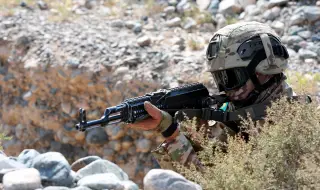
Four Central Asian countries began joint military exercises on land, sea and air without the participation of Russia and China - the two most influential powers in this region rich in raw materials and strategic for world trade, France Press reported, quoted by BTA.
"All contingents have arrived", a spokesman for the Kazakh army, which is hosting the exercises between five former Soviet republics, which the spokesman described as the "first of its kind,", told AFP.
In these military exercises called "Birlestik-2024" ("union" in Kazakh), taking place in the Caspian Sea, about 4,000 military personnel, including warships, aircraft, artillery and tanks, will participate until July 17.
Four Central Asian countries - Kazakhstan, Kyrgyzstan, Uzbekistan and Tajikistan - excluding neutral Turkmenistan, are participating in the exercises together with the Caucasian country of Azerbaijan.
Kyrgyzstan's Defense Ministry said that during the exercises, soldiers will have to liberate an island seized by terrorists and conduct operations to ensure maritime safety and infrastructure protection.
These countries regularly participate in military exercises with Russia as part of the Collective Security Treaty Organization (CSTO) or with China under the auspices of the Shanghai Cooperation Organization (SCO).
For comparison, in the last military exercises organized by the CSTO in Central Asia in the fall of 2023, 1,500 servicemen participated.
After nearly three decades of tension that sometimes escalated into conflict, in recent years the Central Asian republics have significantly strengthened their cooperation, notes AFP.
This trend is being reinforced by the renewed interest of world powers in this region, which is rich in raw materials and strategically important for the transportation of goods, amid challenges to the traditional influence of Russia, which is obsessed with its invasion of Ukraine.
What's more, all these countries are part of the so-called "Middle Corridor", crossing the Caspian Sea, which is a fast-growing trade route between China and Europe, theoretically faster and safer.
This route is emerging as an alternative to the traditional route north through Russia, which has suffered from Western sanctions, and incessant attacks by Yemeni Houthi rebels in the Red Sea make this important sea route for global trade dangerous, according to AFP.
>