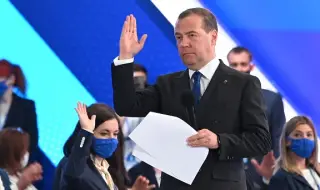
Humanity is on the verge of a global catastrophe, and the mainspring in this clock mechanism is wound by armed conflicts raging around the world, confrontation between nuclear powers and the aggravation of chronic global problems, said Deputy Chairman of the Security Council of Russia Dmitry Medvedev, quoted by TASS.
Speaking about today's conflicts in the world, he recalled the Doomsday Clock, which was invented in the American magazine "Bulletin of Atomic Scientists" in 1947. "This year he moved the so-called Doomsday Clock forward by another second, giving humanity only 89 seconds until midnight. This is so little, considering how this countdown began in 1947, so little has ever been left", he noted.
"Of course, this allegory is quite well-known, but nevertheless it is still important, because the general expert assessments are that humanity is on the verge of a global catastrophe," Medvedev explained.
If it does not accept peace, Ukraine faces unconditional surrender. Kiev has one last chance to preserve some statehood.
"Currently, there are no persons in Ukraine authorized to conclude a peace treaty. And this is a big problem. Today's Ukraine has the last chance to preserve, under certain conditions, after the end of hostilities, some statehood or some international legal personality and get a chance for peaceful development. Russia strongly disapproves of the current regime in Kiev. In case of refusal to accept peace, Ukraine faces unconditional surrender.
Russia has repeatedly stated its readiness to negotiate with Ukraine without preconditions, but taking into account the realities on the ground. And such negotiations can make it possible to find peace. Within the framework of the Ukrainian settlement, it is important to stop not only the degradation of political institutions, but also the split of the church, to stop the criminal prosecution of clergy, the imposition of a political agenda on believers, and finally to lift the ban on the activities of the Ukrainian Orthodox Church.
The resolution of the Ukrainian crisis requires long-term international legal guarantees that will allow to eliminate the root causes of the conflict and prevent its recurrence, and such guarantees can only be contained in legal norms. Agreements with puppet states are doomed to failure, which is important to keep in mind in the Ukrainian conflict. We must negotiate with truly independent, I emphasize, truly independent and fully independent states. Regardless of their area and population, because sovereignty does not manifest itself in this. The real goals of the “coalition of the willing“ with the initiatives to introduce supposedly peacekeeping forces into Ukraine are visible.
Behind the beautiful words lies the desire not only to expand and establish an occupation regime on the territory of the remaining Ukraine, but also to ultimately involve all parties in a new, much larger military conflict. The emergence in Ukraine of a “coalition of the willing“ will naturally be viewed as a relapse into a military threat with all the ensuing consequences, including, first of all, their recognition as a legitimate military target. In order to restore trust between each other, Russia and the United States need an active transition from political contacts and agreements to the formation of legal mechanisms for cooperation.
The new US administration has demonstrated a willingness to use political and diplomatic means to resolve the most difficult conflicts, and, of course, the most difficult - the Ukrainian“. "The new world order will be based on the consequences of the current military confrontation and the legal models that are proposed to replace it. Despite all the bloody wars of the past, people by their nature have always strived for peace, and states, despite all the contradictions, have learned to negotiate with each other.
From this dialectic grew true international law. The basic structures of the UN must be adapted to the realities of modernity and a multipolar world. The main directions are well known - the imbalance in the Security Council in favor of the Western bloc has sharpened the idea of its expansion to countries in Asia, Africa and Latin America, and this idea requires careful study. The UN is today perceived by many as an insignificant discussion club due to the inertia and political bias of its leadership.
Western countries are persistently trying to occupy leading positions in the UN in order to monopolize their influence and advance their neocolonial interests. The political isolation of individual countries is a direct path to a new world war. The International Criminal Court is an example of a total fiasco and Hague-style filth. It has been turned into an instrument of neocolonial repression.