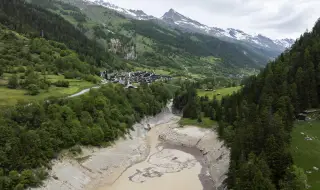
The devastating landslide in the village of Blatten is the latest, but not the first, natural disaster to hit a settlement in the Swiss valleys. On Wednesday, May 28, a giant avalanche of ice, rocks and debris buried a large part of the Alpine village.
Drains were dug with excavators for the water accumulations formed as a result of the landslide to drain the water and prevent flooding. One person is missing, the search for him has been suspended in the meantime.
National maps of possible hazards save lives
However, the effect of the early warning system has been described as very successful. Because it was thanks to the early warnings that most of the villagers were evacuated in time.
The authorities in Switzerland apply a wide range of technologies and methods to assess the risk that could threaten life and property. Precipitation, the state of groundwater, tectonic displacements, movements of the earth's layers and the melting of permafrost are constantly monitored. This data allows the authorities to draw up maps of possible hazards, explains geomorphologist Brian McArdell. "Every Swiss municipality that is at risk has a map of possible hazards. They are mandatory for populated areas."
Features of the Blatten earthquake
In the case of Blatten, the authorities declared an alert after a rockfall destabilized a nearby glacier. Combined with the summer temperatures, the glacier broke off and flowed down the mountain slopes, dragging debris.
"When rocks and ice collide, some of the ice liquefies", ice expert Daniel Farinotti told DW. What reaches the village is a flow of ice, water and sediment.
"The sheer scale, the amount of material that is being poured out, is something you don't see every day, not even every year or every decade in Switzerland," Farinotti said of the glacier collapse in Blatten. "This is a historic event."
Mountain regions around the world are at risk
Steep slopes, unstable terrain combined with heavy rainfall or melting glaciers or permafrost make mountain regions particularly susceptible to landslides and avalanches.
In the Swiss Alpine valleys, the risk of a landslide means that entire settlements have to be evacuated. After the collapse in Blatten, many nearby municipalities remain on alert for possible reactions, including possible flooding.
The village of Brienz, 41 km north of Blatten, is also preparing for a possible evacuation - once again. It was evacuated in 2023 when it narrowly missed a rock avalanche. There have been other warnings since then.
"A landslide can occur suddenly and is extremely dangerous", says expert McArdle. Among the regions with the highest number of landslide victims in the world are the Himalayas, parts of Central and South America, Italy and Iran.
Predicting landslides remains a challenge
Landslides cannot be predicted exactly. Forecasts are "probable" rather than precise, says geomorphologist Fausto Guzzietti. This means that they provide information about the likelihood of a certain event occurring within a certain period of time.
"We can make forecasts for an entire region, an individual municipality or a watershed", says Guzzietti. Monitoring landslides is even more difficult than earthquakes and floods.
While earthquakes are recorded by seismic instruments and floods can be quickly recognized visually, most landslides go unnoticed. There is a lack of empirical data from which to make predictions, explains Gucetti. "Tens of thousands of landslides simply don't get reported. We don't know where they are, and that makes predictions difficult."
Even small landslides - a few meters across - can have terrifying consequences, especially if they carry large rock debris or occur near houses or roads. "A stone that hits a car or a pedestrian on the street can be deadly," says Gucetti.
Climate change is expected to increase rainfall in mountainous regions, which in turn will lead to more frequent small landslides.
Global early warning initiatives
At the same time, however, efforts are being made to change and strengthen international monitoring and preparedness for landslides and glacier melt. Farinotti says: "There are international demands for the implementation of various measures, including better preparation for avalanche risks". Guccetti notes the UN initiative "Multi-hazard early warning systems", aimed at creating a global early warning system by 2027. This could be an important step in saving lives from natural disasters.
But while wealthy countries like Switzerland have a reliable infrastructure to warn the population of possible disasters, many others have to catch up. According to UN data, last year only 108 countries had the capacity for early warning of various hazards, although their number had doubled compared to 2015.
And the benefits are there. The Swiss seem to have done a very good job of evacuating the people of Blatten in a timely manner, says Gucetti.
Author: Matthew Ward Ages