DW: Many were surprised when the Chinese Foreign Minister recently stated in Brussels that China would not accept Russia's defeat in the war with Ukraine. What is your assessment of this? Has Beijing abandoned its formal neutrality in this war?
S. Urbanski: Beijing has never been truly neutral. Scholars call this pro-Russian neutrality, but China's open statement that it cannot accept Russia's defeat is already a change in tone. Whether this will actually be a change in China's position, which has always been pro-Russian since the beginning of the full-scale invasion, will become clear in time.
DV: How firmly is China on Russia's side now, in the fourth year of the Russian war against Ukraine? What is the trend?
S. Urbansky: I think that in February 2022, China was absolutely surprised by the scale of the Russian invasion of Ukraine. However, Beijing very quickly came to terms with this war and its scenario, took the so-called pro-Russian neutral position, i.e. outwardly behaved neutrally, not recognizing in accordance with international law any of the territories that Russia controlled or annexed since 2008, including in Georgia. But it definitely supported Russia both economically and diplomatically, for example, by voting with Russia in the UN Security Council.
In the end, even if this had unpleasant consequences for the Chinese side, let's not forget that until 2022, Ukraine was an important trading partner for China, China was very dependent on food imports from Ukraine, but now the situation is different. China has come to terms with this and sees the benefits of a long war, because, on the one hand, it weakens the West, and on the other, of course, it weakens Russia. Because Russia, despite all the rhetoric, is not a friend, but simply a neighbor who has certain geopolitical interests competing with those of China.
And if we look at the situation in the long term, we must say that China and Russia pursue completely different goals. If we talk about China's vision of the future world order, it is, of course, related to multipolarity. But at the same time, China sees only one main rival - the United States. In this scenario, it actually comes down to bipolarity, in which Russia plays a secondary role. But the Russian vision of the world is more of a multipolar world order, in the sense of several equal or equivalent players, among which Russia is part of the great powers. And this is a big contradiction.
DV: You say that Russia and China are not friends. Does Moscow want this, and Beijing prefers not to be?
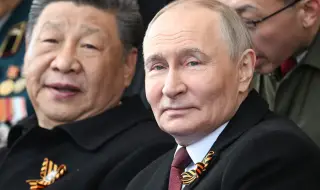
S. Urbansky: As a historian, I always react cautiously when politicians strongly emphasize their friendship, because this rather shows that it is missing. Recently, we see that the friendly rhetoric is getting stronger and stronger, and this reminds me of the past, when relations between Putin and Xi were really close. True friendship means a meeting of equals, and at the moment Beijing and Moscow are not equals, although it seems so. China is good at presenting Russia on the international stage as an equal partner, because it knows that Putin depends on it, since Moscow is politically isolated. And behind closed doors, when it comes to diplomacy, very difficult negotiations are held, and China, of course, has more influence.
DV: How strong is the personal relationship between the two heads of state?
S. Urbansky: If we remember Stalin and Mao - they were indeed leaders who had a great influence on both countries. Their relations were presented as very positive, but at that time the press was much more closed. However, in fact, their relations were strained - Stalin did not consider Mao an equal, he made him wait for him when he first came to Moscow. So what we see today in front of the television cameras are very beautiful shots of Putin and Xi cooking together or drinking vodka. But we don't know what this really means.
DV: At the end of August, the 50-day deadline given by Donald Trump to Russia to end the war in Ukraine expires. Otherwise, China is threatened with secondary sanctions on Russian oil exports. Will this impress China or Russia?
S. Urbansky: Of course, both countries will not admit that this affects them. China and India are the largest importers of oil from Russia. And the imposition of secondary sanctions against both countries would lead to serious shocks on the international crude oil market. OPEC can only partially compensate for this, which would lead to higher oil prices. This circumstance cannot please Trump, because he depends on low oil prices for his domestic policy, and it would also lead to very serious shocks for the global economy as a whole.
DW: How likely is a trilateral meeting between Putin, Xi and Trump in Beijing, and perhaps somewhere else? Is it possible that a decision will be made at it to end Russia's war against Ukraine?
S. Urbansky: If this happens, it will be bad news first of all for Ukraine, but also for Europe, because it will mean that the fate of Ukraine, and hence the post-war world order, will be decided without Ukraine and without the Europeans. At the moment, I see no signs of this.
Sören Urbansky is a German historian, professor at the Ruhr University in Bochum and author of the book "China and Russia. A Short History of a Long Relationship".
Author: Roman Goncharenko