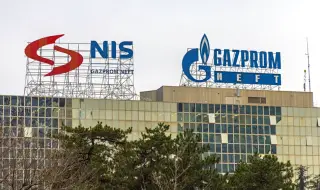
The US Treasury Department has postponed the planned sanctions against the Serbian oil company (NIS - Naftna Industrija Srbije), majority owned by the Russian group Gazprom, for another month, the Serbian Ministry of Mining and Energy announced, quoted by Serbian media, BTA reported.
This is the fifth postponement of the implementation of US sanctions announced over the Russian stake in NIS.
„The sanctions were postponed after a difficult and persistent diplomatic struggle by members of the Serbian government and the President of Serbia, but the most important thing is that we managed to achieve another, fifth postponement," said last night Serbian Minister of Mining and Energy Dubravka Džedović Handanović, quoted by TANJUG.
According to her, it was not possible to achieve a longer postponement at the moment, as this is a matter of global politics and relations.
"For us as a country, the most important thing is to maintain a stable supply of oil derivatives, and the ultimate goal is to remove NIS from the sanctions list of the Office of Foreign Assets Control (OFAC). Therefore, progress in the dialogue between the US and Russia is most important, Handanović pointed out.
NIS was included in the US list of companies affected by sanctions against the Russian energy sector in January. The reason was its relationship with Russia's Gazprom Neft, which is under Western sanctions over Russia's invasion of Ukraine.
Last week, Belgrade requested an additional 180-day postponement of the sanctions.
About 45 percent of NIS is owned by Gazprom Neft, roughly 11 percent by its parent company Gazprom, and nearly 30 percent by the Serbian government. The remaining shares are in the hands of small shareholders.
NIS operates Serbia's only oil refinery in Pančevo, near Belgrade. The facility has an annual capacity of 4.8 million tons and covers most of the country's needs, Reuters notes.
Serbia sold a 51 percent stake in NIS to Gazprom in 2008. for 400 million euros.
On February 26, Gazprom Neft transferred a stake of about 5.15 percent of NIS to Gazprom in order to avoid sanctions.