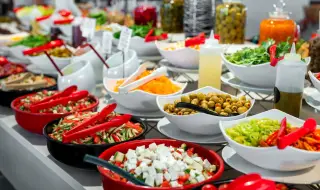
Cookies, soups, sausages, pasta, fruit and desserts - anyone who has been on holiday in Turkey knows the variety of food on offer at the buffets in the country's tourist destinations. Hotels know how tempting the abundance is and on their websites you can find numerous photos of their restaurants, convincing potential visitors to choose their hotel. Many prefer all-inclusive offers, which are especially attractive to families with children.
However, a large percentage of this food ends up in the trash. Turkish newspapers report that President Recep Tayyip Erdogan's advisers are taking up the issue: they are planning to inspect buffets in all restaurants and hotels and draw up a plan to reduce the amount of food thrown away.
102 kilograms of food per person goes to the bin
In Turkey, 8.7 million tons of food are thrown away every year, according to the latest report by the Food Waste Prevention Foundation. According to its calculations, if food waste were reduced by just two percent, it would be enough to feed 360,000 families for an entire year.
Food waste in households is particularly high - an average of 102 kilograms of food is thrown away per person per year. This is a huge amount for a country that has been struggling with economic problems and high inflation for years. In comparison, Germany throws away 72 kg per person per year, while the global average is 132 kg per year.
Ramazan Bingol, a member of the Turkish President's Council on Agriculture and Food, is particularly critical of the breakfast buffets that have become increasingly popular in recent years. Each guest is served 15 to 20 bowls of cheese, sausages, jam, honey, cream, butter and pickled vegetables. This is complemented by pans of fried potatoes, börek, fried eggs and regional specialties.
New concepts
Bingol, who is also chairman of the Association of Catering and Tourism Enterprises, categorically condemns this practice. According to him, half of the food served goes to waste, so the supply must be fundamentally regulated. In the future, the menu should no longer offer just one standard breakfast package per person, but rather each guest should be able to put together their own breakfast from the available products. "A diabetic cannot eat three or four jars of jam. However, with this concept, they automatically end up on the table - and then in the trash can", says Bingol.
The expert calls for more flexibility in restaurant billing. Currently, guests are required to pay per person. Accordingly, the same amount is always served to each person. However, a group of three people can easily be fed with a breakfast for two - and thus significantly less food will be left over. According to Bingol, this does not only apply to food, but also to raw materials, energy, working hours and environmental damage. That is why, he emphasizes, it is a matter of national security.
How to change all-inclusive hotels
In the future, all-inclusive hotel buffets will also be inspected. Presidential advisor Bingol believes that hotels should abandon generous self-service buffets and focus more on menu offerings. This allows guests to decide for themselves what and how much they want to eat. On the other hand, in restaurants offering all-inclusive, vacationers are tempted by the wide selection of foods to try a little of everything. The result, according to Bingol, is that a lot of food ends up in the trash.
Despite the planned restrictions on hotel buffets, according to official data, private households are the largest contributor to food waste worldwide. They generate about 60% of the waste. The remaining 40 percent come from the service and retail sectors. This also applies to Turkey.
Are the proposals binding?
Erdogan's advisers want to prepare proposals to reduce food waste within two months and present them to the president. Whether this will ultimately become legislation is not yet clear. However, the proposal itself has already made headlines in Russia and Germany, not least because most holidaymakers in Turkey come from Russia, Germany and the UK.
The Association of Russian Tour Operators assured that these are only proposals from Bingol, a member of a purely advisory board without any specific powers. Hotels are free to develop their own catering services for their guests.
The organization also draws attention to the conflict of interest: Bingol is also the chairman of the Restaurant and Catering Association - restaurants will have fewer customers, while hotels offer generous all-inclusive packages. At the same time, Tourism Minister Mehmet Ersoy owns several large hotels that operate under the "ultra all-inclusive" system. Therefore, he is unlikely to take steps to eliminate these programs, the association predicts.
Author: Elmaz Topcu