


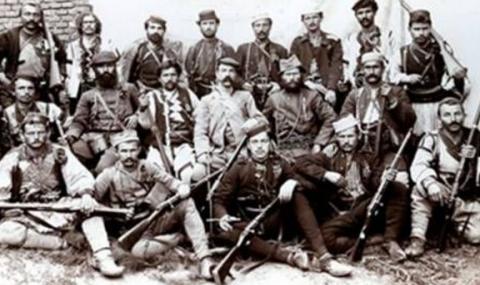

The uprising broke out on July 20 (August 2), 1903 in the Bitola Revolutionary District and on August 6 (August 17), 1903 in the Edirne Region. In Bulgarian history, this was the uprising for the liberation of Macedonia and Edirne Thrace, which remained within the Ottoman Empire after the Liberation of Bulgaria according to the Treaty of Berlin (1878). In its nature and goals, it was a continuation of the Bulgarian national-democratic revolution from the time of the Renaissance.
At the beginning of the 20th century, the situation in the Balkans was extremely unstable, and this escalated public sentiments and attitudes. The failure of the Gornojumai Uprising of 1902, provoked by activists of the Supreme Macedonian-Adrianople Committee, led to the defeat of a large number of revolutionary committees and threatened the organization with new failures.
In early January 1903, a congress of the VMORO was convened in Thessaloniki.
In the absence of a large part of the representatives of the revolutionary districts and its most prominent leaders - Gotse Delchev, Dame Gruev, etc., who were opponents of any hasty actions, the congress decided to declare a general uprising in the spring of 1903. Although they disagreed with this decision, Gotse Delchev and his closest associates obeyed him. They only made efforts to postpone it in the summer of the same year and to transform it from a widespread one into a strategic one, i.e. e. in actions mainly of rebel groups in the mountainous and semi-mountainous regions, where the actions of the regular Turkish army could not be effective. All this was done in order to protect the population of the Polish regions from the repressions of the Turkish authorities.
The uprising broke out on July 20 (Ilinden), hence its name.
It first broke out in the Bitola Revolutionary District. In just a few days, all settlements in the mountainous areas of Bitola, Lerin, Kostur, Ohrid and Kichevo kazi (districts) were covered by rebellions and joined Bitola. The culmination of the uprising was the capture of the town of Krushovo and the proclamation of the Krushovo Republic. On August 6 (Transfiguration) an uprising also broke out in the Edirne region. Many villages in the Strandzha Mountain region and the seaside towns of Vasiliko and Ahtopol joined. The strength of the rebellion even reached the point of declaring the Strandzha Republic (it lasted 26 days). Socio-political actions also began - a new government was established in the liberated villages, following the example of the Kruševo Republic. In the Serres Revolutionary District, the uprising was scheduled for September 14 (Cross Day), but it broke out before that date.
One of the fiercest battles was in Melnik.
There were also clashes between the rebels and the Turkish troops in Serres, Drama and Gornojumaa. In the Thessaloniki, Skopje and Strumica Revolutionary Districts, the rebels' actions were mainly expressed in organizing and carrying out attacks, as a result of which important strategic points were destroyed. Against the rebel population in Macedonia and the Adrianople, the Ottoman government sent 300,000 well-armed regular soldiers, equipped with modern weapons and artillery. Faced with danger, the main headquarters of the uprising sent a quick request for help to the Bulgarian government.
The extent of the armed struggle and the atrocities in suppressing the uprising are evidenced by the data in the Memoir of the VMORO. According to it, 239 battles were fought in Macedonia and the Adrianople, in which 26,408 rebels participated against 350,000 regular soldiers and bashibozuks. 205 villages were burned, 12,440 houses were completely destroyed, 4,694 people were killed, 70,835 people were left homeless, and another 30,000 were forced to leave their homelands and seek salvation in Bulgaria.
The reasons for the failure of the uprising are many and of different nature: first of all, its premature outbreak contributed to this, as did the insufficient armament of the insurgent population. The next significant reason was the extremely inappropriate international situation in which it broke out. Unlike the April Uprising of 1876, this time Russia, engaged in its own plans for war in the Far East, clearly warned that it would not engage in any conflicts in the Balkans.
The other great powers categorically sided with the Ottoman Empire, which allowed
The Sublime Porte to deal with the rebel population in a particularly cruel way
The next reason was the non-interference of Bulgaria. Despite its failure, the uprising played a huge role.
It showed the entire European public that the enslaved population in Macedonia and the Adrianople no longer wanted to endure the foreign yoke and that it would continue its struggle until it gained its national independence.