


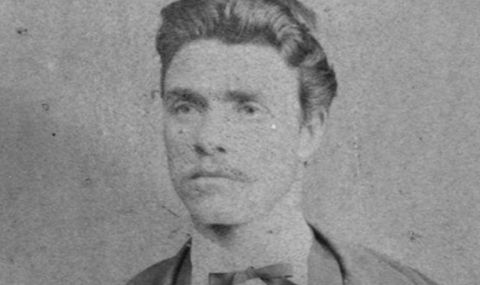

On February 19 (February 6, old style) 1873, Vasil Levski was hanged. In his last moments, he confessed to the hierarchal vicar of Sofia, Father Todor Mitov: "Whatever I have done, is for the benefit of the people", asking for forgiveness from the father and from God, and in his prayers to be mentioned as Hierodeacon Ignatius.
Vasil Levski is the pseudonym by which Vasil Ivanov Kunchev – the prominent Bulgarian revolutionary, ideologist and organizer of the Bulgarian national revolution, founder of the Internal Revolutionary Organization (IRO) and the Bulgarian Revolutionary Central Committee (BRCC), Bulgarian national hero.
Levski is also known as the Apostle of Freedom for organizing and developing the strategy for liberating Bulgaria from the Ottoman yoke. Other famous nicknames of his are „The Deacon“ and „Jingibi“ (The Elusive). He traveled the country and created secret regional committees to prepare the national uprising. His dream was a pure and holy republic in which everyone would have equal rights, regardless of their ethnic and religious affiliation.
The Internal Revolutionary Organization created by Levski was the foundation on which the organizers of the April Uprising stepped. This uprising and the subsequent Russo-Turkish War led to the restoration of the state of Bulgaria on the European map.
Early years
Vasil Kunchev was born on July 18 (July 6, old style) 1837 in Karlovo to the family of Ivan Kunchev Ivanov and Gina Vasileva Karaivanova. He had two brothers - Hristo and Petar, as well as two sisters - Yana and Mariyka. In 1851, his father died and the three brothers were left to take care of the family of 6. Vasil was already 14 and began to learn abazhyluk.
Since 1855, he has been a novice with his uncle Vasily, a taxidiot of the Hilendar Monastery in Karlovo and Stara Zagora. In the shadow of his revolutionary activity, three facts remain: First, he received a not bad education for his time, graduating from elementary school in Karlovo and studying for two years in a class school in Stara Zagora, then he completed a one-year course for the preparation of priests at the Plovdiv class diocesan school „ St. St. Cyril and Methodius“. Second, for three years he was a teacher. Third, Levski was fluent in Turkish, Greek and Armenian, which not only proved useful in his revolutionary activity, but also gave an idea of his erudition and intellect.
On December 7, 1858, Vasily accepted monasticism and the name Ignatius in the Sopot Monastery „St. Spas“, and in the following year, 1859, the Plovdiv Metropolitan Paisii ordained him hierodeacon in the church of "Holy Mother of God" in Karlovo.
Revolutionary activity in Serbia and Romania
On March 3, 1862, the hierodeacon left for Serbia and took part in Rakovski's First Bulgarian Legion in Belgrade. Because of his agility and bravery during the battles with the Turks for the Belgrade fortress, Vasil received the name Levski. At this stage, he felt the strong influence of Rakovski and adopted the idea of organizing detachments through which to raise the people in uprising. After the disbandment of the legion, he joined the detachment of grandfather Ilio Voivode.
In 1863, he left for Romania and after a short stay returned to Bulgaria. In the spring of 1864, on Easter in Sopot, Levski, in the presence of his closest friends, cut off his long monastic hair himself. From that moment on, he became a lay deacon (servant, assistant) of the freedom of Vasil Levski.
Archimandrite Vasily tried to instigate a church investigation against his nephew, but the Plovdiv Metropolitan threatened Vasily himself with punishment if he persisted in his insistence.
From April 1864 to 1866, Levski was a teacher in the Karlovo village of Voinyagovo, then from March to October 1866 in Enikoy in Dobrudja, and from the end of the year to March 1867 in neighboring Kongaz.
In 1866, on Romanian soil, the Deacon moved among Hadji Dimitar and Stefan Karadzha. In November 1866, he met Rakovski.
In 1867, at the suggestion of Rakovski, he was appointed standard-bearer in Panayot Hitov's detachment. Together with the detachment, he experienced all the difficulties and disappointments during the campaign in the Balkans in 1867.
Then, together with the detachment, he crossed into Serbia and joined the Second Bulgarian Legion of Rakovski (1867-1868). After its disbandment, he fell ill and stayed for two months in the village of Zajčar.
The enforced idleness gave him the opportunity to rethink the path he had taken. His doubts about the expediency of the Chetnik tactics turned into a conviction that new means must be sought to achieve the ultimate goal. For the first time, he expressed the opinion that preliminary preparation of the people was necessary for participation in the liberation cause. In a letter to Panayot Hitov, he hinted at his conclusions and intentions, informing him that he had decided to do something great for the benefit of the fatherland, „in which if I win, I win for the whole people, if I lose, I lose only myself“.
Levski's distrust of Serbia and the belief that the Bulgarians should rely primarily on themselves, not on external forces, grew stronger. The death of the detachment of Hadji Dimitar and Stefan Karadzha finally convinced him that preliminary preparation was a necessary condition for the victory of the Bulgarian revolution.
In August 1868, Levski went to Bucharest. His acquaintance with Hristo Botev and their joint life in an abandoned windmill near Bucharest dates back to this time.
Organization of revolutionary committees
On December 11, 1868, Levski left for Constantinople by steamer to undertake his first tour of the Bulgarian lands for informational purposes, to become acquainted with the conditions and possibilities for revolutionary activity in the Bulgarian lands.
In early January 1869, he left the Turkish capital and headed for Thrace and Northern Bulgaria. He passed through Plovdiv, Karlovo, Sopot, Kazanlak, Sliven, Veliko Tarnovo, Lovech, Pleven and Nikopol. Everywhere he talked with his trusted people to win them over to the cause. Hoping that an uprising could be declared in the near future, on February 24, Levski returned to Romania.
On May 1, 1869, the Apostle began his second tour of the Bulgarian lands. During it, Levski initiated the construction of the internal revolutionary organization (VRO). The first committee was founded in Pleven. Then the construction of local (private) revolutionary committees continued in Lovech, Troyan, Karlovo, Kalofer, Kazanlak, Plovdiv, Sopot, Chirpan, etc.
Levski's second tour convinced him that the uprising could not be raised as soon as he had thought a few months before. He saw the need for greater preparation of the people, carried out by revolutionary committees, organizationally connected with each other.
After his return to the Romanian capital, Levski sought to convince the emigration that the center of preparation for the upcoming uprising should be transferred to the interior, that the Bulgarians should rely on their own forces, not on external help. The emigrant activists were aware of the need to organize the people, but no one had a plan for who would do it and how. They also had difficulty parting with their traditional beliefs about foreign aid and leading the revolutionary movement outside the country.
Disappointed by emigration, in May 1870 Levski returned to Bulgaria and set about completing the construction of a committee network. By the end of 1871 he managed to create a dense network of revolutionary committees, united in a complete VRO. Levski was the only one of our great revolutionaries who came to the realization that the chorbadzhii should also be involved in the preparations. Their funds were especially needed for the material provision of the upcoming uprising. He envisaged receiving these funds voluntarily, but for those who refused to support the people's cause, he introduced revolutionary terror.
Towards the end of 1871, the committees began active work to attract supporters, raise funds and purchase weapons. When the work grew, the BRCC sent two assistants to Levski - Dimitar Obshti and Angel Kanchev.
Capture and death
On September 22, 1872, Dimitar Obshti organized a robbery of the Turkish post office in Arabakonak. Levski was against it, but was supported only by priest Krastyu Nikiforov. The capture of the participants dealt a heavy blow to the revolutionary organization.
Levski received an order from the BRCC and Karavelov to raise an uprising, but he refused to carry it out, deciding to take the archives of the VRO from Lovech and move to Romania. He is known for the failure of the robbery in Arabakonak, but he does not know that the Turkish police have his photograph and an accurate description of his distinctive features, as well as information on where he may possibly be found.
According to a prevailing opinion among our historians, Vasil Levski was not betrayed by one person, but was the victim of a long chain of police revelations. On December 27, 1872, he was captured by the Turkish police at the Kakrinsko inn near Lovech.
When he was captured, the archive with committee papers remained unnoticed by the mob. The same archive was preserved and later handed over to Zahari Stoyanov. The missing funds were found in 1972 in the foundations of Marin Poplukanov's house. There is an assumption that the reason for Levski's capture was betrayal by an accomplice. According to other studies, there was no betrayal. It has been proven that Pope Krastyu did not have accurate information about Levski's plans.
Until the very end, the Ottomans did not know who they had captured and Levski was taken to Tarnovo to be identified. Only there did it become clear who he was. Only a few guards went to Kakrina, and if they had known who they were capturing, such a small number would not be logical.
Levski, who was guarded by only 20 guards during his journey from Tarnovo to Sofia, hoped in vain until the last that he would be released by like-minded people. There he was brought to trial. The apostle built his defense on the foundations of the rights of Christians according to Hatihumayun, so as not to betray anyone and the organization. He emphasized several times that he was looking for legal ways to change life in the Empire. Levski distanced himself from Dimitar Obshti's activities in order to avoid criminal charges.
The Grand Vizierate was expected to release everyone except the mail thieves, because a political trial was not in Turkey's interest and damaged its authority in Europe. The instructions to the judges stated that only the leaders should be severely punished.
The trial commission consisted of Ali Said Pasha, Shakir Bey and Ivancho Hadzhipenchovich. The court also included Bulgarians: h. Mano Stoyanov and Pesho Todorov as representatives of the Bulgarian community in the city. Muslims and Jews were also included.
The death sentence was issued on 14 and confirmed on 21 January 1873. The trial ended with the commission seizing the functions of a court, which was inadmissible under the laws of the empire itself. Dimitar Obshti and Vasil Levski were sentenced to death by hanging, and 60 defendants were sentenced to imprisonment and exile. The sentences were confirmed by the Sultan as appropriate. In order not to harm Turkish diplomacy, no larger-scale investigations and persecutions were carried out.
The priest, Pope Hristo Stoilov, tells of the apostle's last moments: "The deacon behaved heroically. He said that he was indeed the first, but that there were thousands after him. The executioner put the rope on him and kicked the stool. I burst into tears and turned to "St. Sofia", so that the Turks would not see that I was crying, and I left."
Mikhail K. Bubotinov also gives a description: "On 1873 summer, February 5, Tuesday, market day in Sofia - 2 hours before dawn, in the courtyard of the pasha's residence - on the site of today's princely palace, an unusual riot of the pasha's sejmen took place. By order of Mazhar Pasha, then Sredets governor, a mulezimin was sent to call the butler priest Todor Mitov to get ready... The butler priest Todor got ready in half an hour... And here the governor set off in a carriage with his retinue, consisting of about ten people. Immediately after them, Vasil Levski, who had just been taken out of prison, was brought to the middle of the square, escorted by a platoon of guards and 4 platoons of soldiers, dressed in his suit, as he had been caught by the authorities at the inn, with heavy shackles on his legs, but without a court scepter on his chest. Mazhar Pasha, turning to the priest, ordered him to approach Levski and freely perform his religious duties. As soon as the priest approached Levski, the pasha retreated 7-8 steps and at the same time signaled for the people from his retinue to do the same. ...
What Levski confessed about himself in this case could not have been conveyed by the priest-confessor. However, in general terms: Father Todor told me that Levski stood alert and in the presence of spirit said: "In my youth I was Hierodeacon Ignatius, I left the service in the awareness that I was called to perform another, more urgent, higher and more sacred service to the enslaved fatherland, which ... may it be granted!" Here Levski burst into tears and asked the priest to pray to God for Hierodeacon Ignatius ... "
Regardless of the fact that Levski was hanged on February 18, it is customary to celebrate this date in Bulgaria on the following day, February 19.
In 2007, through a national poll by BNT, Vasil Levski topped the list of the greatest Bulgarians of all time.