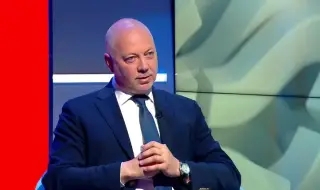
The government survived the fifth vote of no confidence in 8 months and 5 days since it took office. However, this vote caused a new clash in the political debate - GERB leader Boyko Borisov entered into an absentee dispute with the leader of "DPS - New Beginning" Delyan Peevski about whether it is possible to have only one guarantor of the stability of the cabinet.
The opposition, on the other hand, took the opportunity to claim that there is an informal power center that is outside the executive branch. BNT spoke to Prime Minister Rosen Zhelyazkov on these topics.
Meanwhile, "Vazrazhdane" proposed the creation of a temporary commission for the so-called. hotel with the waterfall, associated with Rosen Zhelyazkov's wife. The Prime Minister stated to Ivo Nikodimov that the construction is financed with loans, all funds have been declared publicly, and the company in which his wife is a partner has a minority stake in the project.
Read the entire interview here:
Ivo Nikodimov: The vote did not pass, as you yourself noted yesterday, about 20 votes of MPs were not reached. However, an aftershock was generated in the political reactions as to whether the government depends on only one person, as Mr. Peevski says, or on everyone in the governing formula, as Mr. Borisov says. Which, in your opinion, is the correct thesis?
Rosen Zhelyazkov, Prime Minister:The correct thesis is that the government is a complex coalition between GERB, BSP and ITN. Initially, we had the support of the APS, then we received the support of "DPS - New Beginning". The leader of the BSP and I are in the cabinet, we work very well, but the parties are mainly leadership-based, so even if we can talk about clashes, they are at the level of leaders. I would not call them clashes, but debates, discussions and some views, the sustainability of which is tested by the vote and support of the cabinet. Everyone who supports the cabinet depends on each other, and they depend on each other for there to be a government. And the government is a guarantee for there to be a parliament. Parliament is the place where important issues are decided in a parliamentary democracy. Is there a center of power - the center of power is the interaction between the government and the majority and there is nothing different, regardless of the fact that such claims are made about a formal, informal prime minister.
The opposition's thesis is that you are the formal prime minister, and the real ones are, first of all, Mr. Peevski, and secondly, Mr. Borisov, and the center of power is outside the executive.
The center of decision-making is in the parliament, laws are adopted there, and that is why I said that when there are leading parties and the leaders are in the parliament, then the optical view is created that the center of power is in the parliament. But that was also the case during the assembly. When the leader of a party is not the prime minister, this position is quite natural and no matter how much some political players try to drive a wedge between me and the leader of GERB, it is absolutely in vain and doomed to failure. Let them say whatever they want - I am a dialogical person, I seek consensus. As Mr. Borisov said, my commitment is to find understanding in the majority in parliament on important decisions and I think I am achieving it. The role of leaders is to make the main political messages, but also to guarantee the stability of the government. When this stability does not exist, quite natural political processes follow, but for the ill-wishers there is one sad news - there is a stable majority and it guarantees quite a bit of governance.
As Prime Minister, do you communicate with all representatives of the individual parties in parliament?
Absolutely with everyone.
You do not choose: "to talk to this one", "to talk to that one"?
No. I think that as Speaker of the National Assembly, I have established sufficiently good communication with the party leaders, regardless of whether they support one or another political line, and this is part of my understanding of seeking consensus in decisions and of the etiquette in the political narrative.
However, outside the political debate - the problems of the people come first. The most current one is the water crisis - this problem affects hundreds of thousands. What are the urgent actions you are taking to resolve it?
The water crisis has been a problem for many years, it is deepening with the worsening climate situation in the country. You can see how long it has been without precipitation. We are eagerly awaiting this manna from heaven, because without precipitation in a country like Bulgaria, which is poor in surface water, it is very difficult to provide the necessary water quantities. The problems are also related to poor planning, poor water management, poor coordination regarding their use, scattered between different ministries. The biggest problem that we need to solve and depends on the government is the water infrastructure. The water supply pipes and the infrastructure in the cities. Specifically for Pleven - compare it with Ruse - Ruse years ago fixed its water cycle and with half the amount of water for the same population, there is no regime. Pleven, with two and a half times more water at the entrance, has a problem, because in places like the "Druzhba" district, the losses reach 80%. That is why the efforts are focused on these repair works and when I said that I would change the regional governor, it was not to look for "money in the wind", but to create better coordination. I have nothing against the former regional governor, but this coordination was missing. I think that now a much more effective working regime is being achieved and the guarantee is that there will be no water regime in Pleven next year. Everyone in the crisis headquarters, as well as from the water board, will work to solve the problem, which depends on the Water and Sewerage Department, the mayors of municipalities and not only in Pleven.
This week the IMF recommended freezing salaries in the budget sector and at the same time raising taxes and social security contributions. Is this necessary to control the budget deficit, or does the economy have other options for growth and solving the problems?
This is a periodic review of the Fund and the recommendations are recommendations. We are well aware that budget consolidation is a task for this and every subsequent government. We must spend as much as the economy earns. When GDP grows, this year at a very good pace - 3%, we must fit into the framework of economic growth. On the other hand, we are aware that increasing purchasing power is also related to increasing income, so our commitment is to find balanced solutions, without increasing the tax and social security burden, with measures that will stimulate the work of the economy, and therefore for us the introduction of the euro from January 1 is one of these steps.
However, speaking of the euro, what is your assessment of the measures against the unjustified increase in prices - have they worked?
I think they worked. Not only the measures of an administrative nature, but also those for brightening the economy and tax revenues. The growth in their collection and their net size show exactly this. The economy, where the largest price increase is observed, is part of this semi-gray sector, especially in the service sector, and that is where our main efforts are focused. But in partnership with retailers and very importantly - with unions - we are currently managing to neutralize this, I would call it speculative effect. Moreover, in a large part of retail trade, the analysis of the Labor Code shows that there is no evidence of cartels, on the other hand, the necessary antitrust control is being implemented.
"Vazrazhdane" is proposing a temporary commission for the so-called hotel with the waterfall. Is there such a hotel, is it yours or a member of your family, what is this story?
It is very important that when true facts are presented, they are not interpreted manipulatively. The facts are as follows - in 2016-2017, the company owned by my wife purchased 30% of the capital of a company that has a real estate of 3400 sq. m. Over the next 5 years, the urban planning procedure was carried out and in 2022, a construction permit was obtained for the so-called apart hotel with a built-up area of 600 sq. m., on five floors. This is under 3000 sq. m above ground and about 1000 sq. m underground - basement with garages. That is, somewhere around 4000 sq. m. built-up area.
The construction is carried out with two loans - one for about 3 million, the other for about 8 million. These are the data that I have received for all the allegations, because I have neither observations nor participation. My wife's company, in which she is a partner, has a minority stake. 30%, it is not even a controlling stake - it is over 33.3% or over a third. The allegations that my wife, who is a former actress, is being used with a slightly offensive narrative and that - towards the acting class... All the funds invested from 2017 to 2023 are personal savings, company funds, family funds. This money is tax-paid, with a very clear origin. Another important thing. All the data is in public registers.
So you declared them in your declaration?
In the Property Register, in the Commercial Register, and in the register of the Anti-Corruption Commission. This is money with paid taxes, funds invested honestly and honorably with a name. There are no undercover, no straw men, no substitutes here. This has always been my understanding - a member of my family should not participate in state and public procurement, should not participate in the acquisition of state, municipal or public property and should not benefit from the influence they have.
Let's clarify something - did your wife's partner and she, during this period in which they have a business, participate in public procurement?
Never. I told you, this is a private initiative that began at the end of 2016. This is nearly 9 years ago, you don't suppose that 9 years ago I thought that this would ever be a topic and I would be Prime Minister? When talking about this type of relationship, it is important for people to declare, to act according to the rules, to be transparent and, above all, not to conceal such actions. Because if inquiry committees have to be set up, they should be set up for every single member of parliament who has relatives in the direct, collateral, marriage line and has a business. You understand, right? That would make all public registers in the country meaningless?
Tomorrow is September 22 - what of the actions and determination of the political generations from the Unification and Independence do today's politicians and statesmen need?
It has struck me, and for many years now, that when there is an occasion that should unite us, people generally speak with a lot of pathos, and the feeling is not so solemn. Since the Liberation, Bulgaria has always had reasons to be divided - both immediately after the Liberation, and during Stambolov's time, and after the wars, and 1923, and 1934, and 1944, and 1989, and 1997, etc. We need to diligently overcome the current events that surround us. Let's be a little better people. This is done with a little diligence, when we move on the road, when we protest. This is done with a little thought that the problems of the judicial system and judicial acts cannot be solved on the street and there must be a little wisdom. The parliamentary debate is in the hall, not on the boulevards. We need a little more wisdom, foresight and kindness, and not only on holidays.