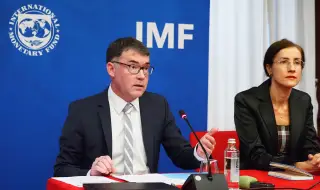
In order to fully realize the benefits of adopting the euro in Bulgaria, to sustainably raise living standards and to avoid macro-financial imbalances, policymakers must strengthen fiscal discipline, manage the risks of the transition to the eurozone and accelerate reforms. This is the main conclusion of the International Monetary Fund (IMF) mission, led by Fabian Bornhorst, which visited Bulgaria between September 10 and 23.
The IMF recommends that fiscal policy be tightened and shifted from supporting consumption to promoting quality investments, summarized expert.bg. Looking ahead, the focus should be on mobilizing additional revenues to meet growing needs in infrastructure, health and education and help reduce inequalities, the Fund believes.
More: Employers want the tax model to be preserved
The revenue-generating capacity of the flat tax regime appears insufficient to meet the growing demand for quality services. In the medium term, higher revenues could be secured by increasing tax rates on both personal and corporate income and moving to progressive income taxation, thereby reducing income inequality, the IMF emphasizes.
The IMF also recommends that strict macroprudential supervision in the financial sector be continued to contain credit risks. Although credit expansion is generally justified given the still shallow financial sector, the growth of household lending is outpacing income growth. In particular, dynamic mortgage lending, combined with rising construction costs, has led to a 15% increase in residential property prices.
Some mortgage loans are being used to purchase vacant properties for investment purposes, which further strains the housing market and exacerbates the reduced affordability of housing observed in some segments, the Fund warns.
Rapid credit expansion and banks' increasing exposure to mortgage loans can create vulnerabilities, the IMF adds. In this regard, the Fund recommends further measures aimed at borrowers to proactively manage credit market risks.
Enhancing the sustainability and adequacy of the pension system will require comprehensive reform, the IMF points out. The deficit in the pay-as-you-go pension system is increasing as contributions lag behind rising payments, and population ageing will further widen the gap. Financial sustainability can be strengthened by increasing contribution revenues, including by removing the cap on insured income, which has not kept pace with wage growth.
Further strengthening the link between contributions and payments, including by removing the pension cap and phasing out pandemic-related benefits, could boost pension contributions. At the same time, improving the adequacy of pensions to reduce poverty in old age remains a priority. In parallel, efforts should continue under the Roadmap to improve the pension system to strengthen the second and third pillars of the system, starting with offering more flexible risk-return profiles.
Despite some progress related to the Recovery and Resilience Plan, significant fossil fuel dependence, the highest energy intensity in the EU, and untargeted subsidies continue to distort market signals and exacerbate environmental and fiscal risks, the IMF emphasizes. Recent legislative changes, including a new electricity pricing mechanism and amendments to the Energy Law, preserve regulated household prices and allow for the continued use of electricity produced by coal-fired power plants. A more competitive electricity market would improve pricing and strengthen investment incentives. Targeted support for energy-poor households can help address affordability issues.
Reducing financial interdependence within the Bulgarian Energy Holding and strengthening its governance will improve transparency, contribute to a more efficient allocation of resources, and support the energy transition, the IMF also said.