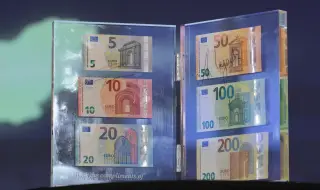
Four days until the adoption of the euro in our country. In January, payment will be double - with euros and leva. Starter packs with euro coins with the Bulgarian side could still be purchased today from the BNB cash desks, which worked overtime due to the many applicants. What kind of euro banknotes will we pay with and very importantly how to recognize them - the Chief Cashier of the BNB Stefan Tsvetkov stood in front of the BNT camera.
Emerald green. This is the element by which you can most easily recognize a real euro banknote. It is present on all banknotes, regardless of their main color and denomination, says the Chief Cashier of the BNB.
Stefan Tsvetkov - Chief Cashier of the BNB: "For example, in the case of 50, when tilted, it changes color from emerald green to dark blue. This element is very difficult to counterfeit."
The "Europa" series, which will mainly be in circulation in our country, has a more saturated color than the first one, printed in 2002. When viewed against the light, the banknotes have an image of the goddess Europa embedded in the paper, which is also present in the hologram strip on both sides of each euro.
"In addition to the portrait watermark of the goddess Europa, one can also see the nominal value, as well as the main image of the banknote, which in this case is windows and doors", said Tsvetkov.
The inscription EURO in Bulgarian and the initials of the ECB in Cyrillic are other specific elements that are present on the euro banknotes. BNB experts advise what to do when we doubt their authenticity.
"We always say touch, tilt and look. What do we do when we touch a banknote? We run it through the paper, of course we feel its sound. Of course, it is made of cotton and therefore its sound is easily heard. Typical of cotton paper. "There is a sense of relief," said Stefan Tsvetkov.
If you come across a 500 euro banknote that is no longer being printed by the ECB, this is not a cause for concern. It is legal tender and every bank will accept it or break it into smaller banknotes.
"If someone suspects that the banknote is counterfeit, what should they do? If it turns out to be counterfeit, do not keep it with you. Of course, it is good to call 112 or the nearest police station and say, I own one. Either I was lied to, or something happened. It is not right to put it back into circulation, because it is punishable," the expert pointed out.
11 printing houses in Europe produce euro banknotes, after which they are distributed among the various national banks, and every year, together with the ECB, the required number of banknotes that enter circulation is calculated.
Each member state of the eurozone produces euro coins. And the Bulgarian ones are currently being minted by the Mint and the Mint of Slovakia. Due to the great interest in them, the BNB cash desks worked overtime today.
"You pay 40 leva, you get two starter sets. Then you give them to your children, friends, relatives."
"As a gift, I won't spend them, I won't touch them."
Regarding the comments that the machines used to produce the Bulgarian lev are being destroyed - the BNB responds that the machines are universal and are not intended for a specific type of currency. And that they are only adjusted for each specific type. And the Mint's machines, instead of Bulgarian coins and stotinki, continue to work, minting euro coins with the Bulgarian national side.