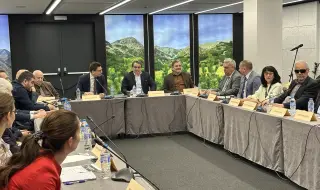
“In recent years, there has been a change in the overall income policy in Bulgaria. We need to start a discussion on whether this change should continue, for how long and how it affects the competitiveness of the economy on the one hand, and on the other hand - on inequalities in society and the ability of society to function as a whole“. This was stated by the chairman of “We Continue the Change“ Assen Vassilev at a discussion on the topic “Young Families and Incomes“. It is part of a series of public discussions on the future development of Bulgaria under the title “Strong Bulgaria in a Strong Europe“. Representatives of employers, unions, the non-governmental sector – employers, unions, non-governmental sector, government institutions, academic community, representatives of young families and people with disabilities.
„Usually these discussions are held within the framework of a budget procedure with a fairly short horizon and quite acute political sentiments. But we decided to hold this discussion even outside the election campaign, not in the context of a specific budget procedure and with a longer horizon - where and how we want to get to today, fifteen years from now. And let's try to see if there is agreement on some basic principles in the area, in which, regardless of who is in charge, we can move, but there are challenges, especially in the area of income,“ explained Assen Vassilev.
The moderator of the discussion, Venko Sabrutev, a member of the Executive Board of “Continuing the Change“, stated that the discussion focuses on policies to achieve European incomes in Bulgaria, young families, children, the elderly and people with disabilities.
The first part of the discussion was dedicated to the topic:
European incomes in Bulgaria
The question of how to have comparable pay with developed European countries for the same skills and activity was discussed. The panel also discussed the minimum wage, whether there should be people working below the poverty line, and whether taxes and social security contributions should be increased, whether the maximum social security income, the maximum pension, and the maximum unemployment benefit should change in line with the average wage. Should there be guaranteed levels of pay for socially important professions with a shortage of personnel? This was also a subject of discussion. At the beginning of the discussion, the Chairman of the National Statistical Institute, Atanas Atanasov, presented statistical information on the topic (you can find a presentation in the attached file).
The participants in the discussion united around the need to change the model for determining the minimum wage. On the topic of the same pay for the same skills in our country and in developed European countries, employers stated that for this it is necessary to reach the same level of productivity. According to Assen Vassilev, this is the best way to increase incomes sustainably. He believes that at the same time, we need to reduce the levels of inequality in pay, because if we don't, social ghettos will form.
The second part of the discussion was on the topic:
How to make Bulgaria 9 million people again
It was discussed how family finances should not be a barrier to a second and third child, what the principles of support should be and how to achieve justice and solidarity so that there is a higher demographic growth. The topic of the conversation was the incentives thanks to which Bulgarian families can return to live and work in the country. Presentations on the demographics of the population in the country were made by Kaloyan Tsvetkov from the Department of Socio-Economic Geography at Sofia University, Assoc. Prof. Boris Kazakov from the National Institute of Geophysics, Geodesy and Geography at the Bulgarian Academy of Sciences and Vesselina Panayotova from the “Mama has a job“ Foundation (you can find the presentations in the attached files).
The participants in the discussion agreed that a better level of economic development is needed, better quality and accessible education and healthcare, and a more developed infrastructure. Incentives for mothers to return to the labor market earlier, such as flexible working hours, sufficient kindergartens and nurseries, tax breaks, and social services. A consensus policy is also needed to solve demographic problems with a perspective of over 15 years and state support for small settlements. Assen Vassilev outlined 4 problems that need to be solved in order for there to be more children and for Bulgarians to return from abroad - flexible working hours, care for early childhood development, measures to support children in deep poverty, and care for children in the summer. He pointed out that it is necessary to develop a support system that, in addition to solidarity, is first and foremost fair. Because the fully solidarity system is expensive and unsustainable, and many people who have not contributed are trying to take advantage.
The third panel of the discussion discussed the topic:
Fair pensions
The issue was that pensioners who have met the requirements for length of service and age should not receive pensions below the poverty line, and the pensions of those who have not met these requirements - should be supplemented by the social system. The topic of the possibility for workers to actively manage their pension money was also discussed. A presentation with official data from the National Social Security Institute was presented (you can find it in the attached file).
The participants in the discussion united around the fact that changes to the pension system should be made gradually, seeking a balanced solution that is discussed and publicly supported. The need to develop the second pillar of the pension insurance system and introduce multi-funds was also mentioned.
The last topic of the discussion was about:
Equal access for people with disabilities
The need for equal access for people with disabilities to work, education, healthcare and cultural life, a dignified and fulfilling life, an accessible urban environment - without barriers, with convenient transport and adapted spaces - was discussed. The possibility of them gradually moving from social benefits to a decent salary and receiving decent and equal pay and working conditions was also discussed.
Venko Sabrutev said that he was sure that agreement could be found in society on these topics. However, often society understands the problem and has the will to solve it, but politicians hold back the decisions. According to him, for years the urban environment has not been built with people with disabilities in mind and the state does not recognize the problem, and there are no funds allocated in the state budget for such infrastructure.
The participants in the discussion united around the need to prepare a Code for People with Disabilities, since the matter is currently scattered in numerous regulatory documents. Attention was drawn to the need for digitalization and web accessibility of the administration, so that people with disabilities have the opportunity to work remotely from home. Also, according to the participants, there are various programs for an accessible urban environment, but the municipalities are not active in preparing the necessary projects.
Venko Sabrutev stated that he supports the need indicated by the participants to combat abuses in healthcare and false TELK decisions. He indicated that during the PP's government, an analysis of corruption practices in the field had begun. “For some parties, people with disabilities are a hub for voters,“ he said.