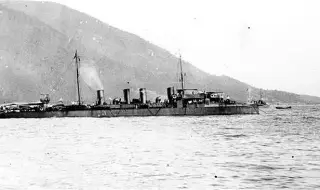
110 years ago, during the First World War, the Bulgarian Navy achieved an undisputed naval victory, when on February 25, 1916, the Russian destroyer "Lieutenant Pushchin" encountered Bulgarian minefields and sank.
This is recalled by the Naval Museum-Varna.
"Lieutenant Pushchin" participated in a reconnaissance mission of a Russian destroyer detachment, whose task was to conduct surveillance and prepare the entry of a larger squadron to shell Varna. However, Bulgarian minefields thwarted this plan. The location of the sinking of the 450-ton Russian destroyer was near Cape Ilandzhik, in the southern part of the Varna Bay, where the minefield was laid, part of the minefield activities of the Bulgarian destroyers and the merchant ship "Boris" mobilized as a minefield.
The explosion tore the Russian ship into two parts. About 80 crew members died. The survivors in two lifeboats were handed over to the Bulgarian maritime authorities. The flag of one of the boats was handed over to the Bulgarian military and is today kept in the National Museum of Military History in Sofia. The surviving Russian sailors received adequate and humane care. They were later convoyed to Gorna Oryahovitsa and placed in a prisoner of war camp.
The destroyer "Zhivoy", which was escorting the sunken ship, mistakenly reported to the command of the squadron, which was heading towards Varna, that they had been discovered and attacked by a German submarine. Later, "Zhivoy" was attacked by German seaplanes based near Varna. Thus, the bombing of the largest Bulgarian Black Sea city was finally thwarted.
The remains of "Lieutenant Pushchin" were discovered in 2010 during underwater research, and today curious exhibits of its equipment, recovered from the seabed, including one of its onboard guns, are on display in the permanent exhibition of the Naval Museum.