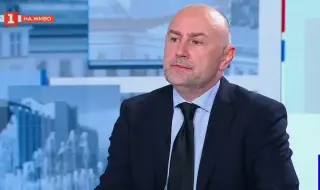
Member of the Governing Council of the Bulgarian National Bank Lyubomir Karimanski commented on the excessive deficit procedure, the state of public finances and the long-term challenges facing the Bulgarian economy on BNT.
According to him, the excessive deficit procedure is a serious mechanism for every member state of the European Union, but it does not represent a punitive instrument.
„The excessive deficit procedure is a serious thing for every country. There are different measures and a different way of implementing them. To begin with, the government must propose measures that will lead to a reduction in the deficit, and present a strategy to be adopted by the European Commission,“ explained Karimanski.
According to him, the European Commission has a primarily coordinating role.
“The Commission has not imposed a fine on any country so far. There are various measures, but there is no punitive approach in the classical sense,“ he pointed out.
Karimanski highlighted the growth of public spending as one of the main factors for the current fiscal problems.
“The disproportionate increase in public sector spending relative to economic growth and inflation has led to structural problems in fiscal policy. This has created an avalanche-like increase in expenses, which are now difficult to control,“ said the member of the BNB Governing Board.
According to him, a return to stricter financial discipline is necessary.
“Very serious and firm measures must be taken to return to the financial discipline that existed years ago,“ emphasized Karimanski.
Commenting on the differences in the reported deficit in different periods, he pointed out that the reasons are not only accounting.
“This is not just a matter of accounting. It is possible to seek manipulation if viewed purely formally, but it is more about political decisions and the way of managing public enterprises,“ he said.
Karimanski pointed to state-owned companies as an example.
“When 100% of the dividend of state-owned enterprises is taken, without leaving funds for investments and reinvestments, these companies are decapitalized. Then they have to take out loans instead of developing their activities,“ he commented.
The financier also drew attention to the structure of public spending, emphasizing the need for more investment in education and human capital.
“We see that investments in the country are a small share compared to social spending. This means that we are not investing enough in the future. Education should be a priority“, said Karimanski.
He warned that the shortage of personnel is already becoming a serious economic problem.
“We have low unemployment, but a shortage of personnel and a lack of sufficient human capital“, he noted.
Regarding the budget and the new state debt, Karimanski stressed the need for a clearer policy in terms of both spending and revenue.
“It is important that the budget has a clear direction for reducing spending in the public sector. The problem lies precisely there, but we also need to talk about the revenue side. Growth comes mainly from consumption, but we need to increase the share of production in order to have sustainable economic growth and a better trade balance,“ he said.
Commenting on the controversy surrounding the design of the Bulgarian euro coin, Karimanski urged not to draw hasty conclusions.
“We need to protect our Bulgarian alphabet, but this is not the end of the procedure. It is not a ban, there is an objection from one of the parties,“ he pointed out.
According to him, Bulgaria must firmly defend its position on the issue of the Cyrillic alphabet.
“There are indeed many sources that mention the Cyrillic alphabet as the Bulgarian alphabet. We must protect the Bulgarian alphabet“, Karimanski said.
In conclusion, he assured that the excessive deficit procedure does not pose a risk to the banking system.
“There is no connection between the excessive deficit and banking stability. Banks are super-liquid, well-capitalized and with high capital adequacy“, Karimanski assured.