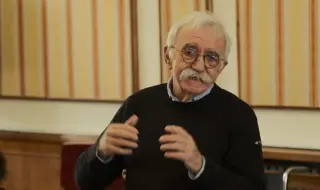
One of the most recognizable directorial names in the Balkans, Slobodan Unkovski (from North Macedonia), has started rehearsals at the National Theater “Ivan Vazov“. His work marks the beginning of the next major project on our first stage – “The Miser“ by Moliere, whose premiere took place. With the participation of nearly 30 actors from the troupe, the performance is among the largest projects in the theater's program this season. Unkovski's approach to the classic text promises a meeting between Moliere's comedy and modern society – in a world where the themes of money, power and human relations remain eternally relevant. Slobodan Unkovski, who is a man of culture but also of politics, spoke to FAKTİ.
- Mr. Unkovski, why did you choose Moliere's “The Miser“ for your first performance in Bulgaria and what do you find in this play that makes it so relevant today?
- The choice of “The Miser“ is a result of the National Theatre's desire to return to significant works from the classical repertoire, as well as my ideas for their new interpretation. The topic is extremely topical – stinginess is present in various forms and manifestations in modern society and is excellent material for analyzing human nature and behavior.
It seemed important to me in this study to develop a parallel storyline and instead of 11 characters and actors to have 22, and in the final version – 30, because very often in a clash between two groups the third wins.
The original source of the story about "The Miser" is based on a plot in which a man buries a certain amount of money, gold or treasure and goes to check every day to see if it is still there. Of course, in the end some observant people notice this and rob him. While he desperately laments his loss, a random passerby, having found out what happened, tells him to calmly bury a stone in the place of the wealth and to continue visiting it every day, because the treasure was of no use to him anyway.
In our performance, while two troupes are fighting for the stage of the National Theater, an oligarch buys the building and turns it into the "Moliere Casino". So everyone loses, and most of all culture. The performance speaks in a delicate way about the death of art.
- In the presentation of the performance you ask the question “Who are the misers of the 21st century?“. Who do you think they are - politicians, oligarchs, corporations or the ordinary person obsessed with the fear of losing?
- Anyone who has ever tried to convince oligarchs or politicians to donate funds or support better funding for culture knows that those who have want to have even more. Patrons are on the verge of disappearing, if they haven't already.
The misers of the 21st century are not easy to recognize, but they are everywhere.
Very often their behavior seems absurd to the ordinary person, especially to those who live on a salary or pension. There are great misers who keep their millions and billions. There are little misers who live at the expense of others and never pay anything. There are also those who, until their last breath, abuse everything around them and, apart from their own wealth and themselves, do not love, share or respect anything else.
Our show is for such people, but not only for them. The victory of the misers, no matter who they are, would mean the defeat of free thought and free action. That is why we invented a kind of “Paragraph 22“ – the misers will be outwitted by even greater misers, and kitsch, vulgarity and trash will try to take the place of true art.
- The production features nearly 30 actors and two different casts, who play in different styles. Why did you choose this unusual theatrical approach and what do you want to convey through it?
- The National Theater “Ivan Vazov“, one of the most significant theaters in the region, seemed to me a wonderful place for such research, because in addition to a strong repertoire, it also has impressive results in new forms, in visual theater, in postmodern aesthetics and other directions.
Mr. Vassilev, the director of the theater, encouraged me to develop this unusual, risky, but also bold concept - the same dramatic text to be performed by two parallel ensembles, and subsequently a third group to appear, which abuses the name of Moliere and its cultural significance to serve its business interests, presented as caring for art, civilization, the country and Europe.
In a way, this performance is a continuation of two of my earlier performances: “The Marriage and Divorce of Figaro“ at the National Theatre in Belgrade and “The Miser“ at the Slovenian National Theatre in Ljubljana. All of this was an important experience that helped me, together with an extremely talented and courageous group of actors, to build the Sofia “The Miser“ and, as I saw, to impress the local audience.
- You say that “The Miser“ gives you the opportunity to “juggle“ with different styles of acting. Is it precisely acting that is missing in theatre today, replaced by excessive social and political weight?
- Politics wants to take everything. Not just for disposable use, which we can sometimes recognize and oppose, but to literally swallow everything. It does not select – wants everything to be hers and to rule over everything.
We can already see the plots of the most complex dramas in parliaments.
The concealment of incidents, abuses, huge mistakes, financial acrobatics, apparent disputes and battles between different parties - all this turns into a game of great emotions, loud words and broad gestures, which seem to have passed from the stage into state institutions.
Theater, through play, seeks to discover and name the truth. Politics seeks to convince us that its position is the only possible truth, and for non-believers it always has appropriate labels prepared.
- We live in a time when money increasingly determines human relations. Do you think that the world today is closer to Molière than it was 50 years ago?
- I don't think that the world today is closer to Molière than it was 50 years ago. Time is a merciless category that always manages to recognize the needs and problems in human behavior.
Moliere is a timeless author, like Shakespeare and some other classics. He stands as the axis of our cultural heritage and continues to excite, provoke and confront us with complex questions that are not easy to answer.
When we introduced modern expressions and vocabulary in the second line of the performance, it was confirmed that we are working with an amazingly contemporary text - as if it were written today, with deep knowledge of the problems of our civilization. That is why Moliere is eternal and so often staged on world stages.
- Your work is strongly connected to Balkan dramaturgy and to authors such as Goran Stefanovski and Dejan Dukovski. Is there anything specifically “Balkan” in the way society experiences greed, power and moral decay?
- In my directing career, I have staged about a hundred plays. Of these, approximately one third are contemporary Balkan texts, often world premieres by Macedonian, Serbian, Slovenian, Croatian and other authors.
I have staged at least twelve plays by Goran Stefanovski and five by Dejan Dukovski. Dukovski and I are currently working on two new productions - an adaptation of “The Master and Margarita“ for the National Theatre in Thessaloniki and the premiere of his latest play “Black Gold“.
In the Balkans, as well as in Europe and America, greed and robbery seem to have become a normal form of behavior.
In the old democracies, the abuse of power and moral decay have reached such a level that they are causing concern all over the world. When high-ranking representatives of states threaten the sovereignty of other states on social media, when military actions are declared as personal decisions, and mass murders begin to look like the new normal, we are already talking about something more than moral decay.
Against this backdrop, the Balkans, once a symbol of rudeness, violence and a “powder keg“, begin to look like a kindergarten. However, corruption still lives here – cheerful, happy, protected and still dangerous.
- After decades of work on world stages, how do you think Bulgarian theater is today? In your opinion, is there a hunger for great classical theater among the Bulgarian audience?
- I would like to know the answer to this question, but I do not know the Bulgarian audience well enough. Judging by the interest in “The Miser“, there is definitely a hunger – the tickets sold out very quickly. This really makes me happy.
Bulgarian theater has a reputation as an extremely professional theater with magnificent performances and brilliant actors. Of course, every season is different, but I believe that these assessments are still valid.
- You are not only a director, but also a long-time teacher of directing and acting. What do young actors lack today - discipline, courage or the ability to take risks on stage?
- If we talk about the young actors in my Sofia performance, they lack nothing. They graduated from an excellent school, work in a theater with great tradition and importance, meet directors from different cultures and aesthetics. They throw themselves into the unknown with great courage, and this is how one grows in the profession and in art.
- Mr. Unkovski, you are a man of culture, but also of politics. Why do relations between Bulgaria and North Macedonia so often pass through the language of history and conflicts, instead of the language of culture and spirituality?
- Culture and spirituality are the only way to restore trust and communication between Bulgaria and North Macedonia. We cannot move forward if we wait for historical commissions to reach an agreement on the past, textbooks, significant individuals and events, and only then start communicating and exchanging culture.
Georgi Gospodinov says: “We are constantly producing the past. We are factories for the past. Living machines for the past.“
The past of the Balkans is painful, bloody and filled with wars and struggles. That is precisely why it is necessary to find the beginning of a new past, to free ourselves from heavy myths and fears about identity and to start real cultural cooperation, free from hidden agendas.
Does this sound utopian? Maybe. I will give an example. Not a word about my premiere in Sofia appeared in the Macedonian media, as if it had never taken place, despite the fact that I am probably the first Macedonian director to stage a play on the Grand Stage of the National Theater “Ivan Vazov“ in more than 120 years of theater history.
- Where is the “translation“ lost – in words or in deeds?
- I would say – in both. We are all convinced that we are right, and I fear that we no longer understand well enough what is actually happening and what the other side wants.
- Do you think that theater and art can be a bridge between Sofia and Skopje at a time when political dialogue often seems blocked and loaded with emotions?
- Absolutely. I see no other way. But with every day that we do nothing in this direction, we move away from the possible bridge for communication. If intolerance becomes the dominant policy, we will not get far.
- In recent years, the issue of identity, language and history between Bulgaria and North Macedonia has become a source of tension. Is there a danger that politicians in both countries will increasingly use the past as a tool for division instead of reconciliation?
- Of course. Nationalism is an excellent glue for some voters. Blaming the other side is a convenient excuse for one's own failures or for covering up policies that hinder European integration.
The issues of identity, language and history are particularly sensitive for us.
In the past, there were inappropriate and aggressive statements by various Bulgarian politicians that caused anger among Macedonians. I suppose that the Bulgarian side can also point to similar examples from the Macedonian side. I cannot shake the feeling that this “conflict“ of ours is not the result solely of our institutions, national interests, and red lines.