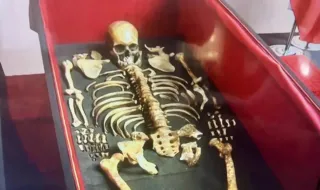
Preliminary anthropological studies of the bones associated with Tsar Samuil show severe illnesses and serious trauma to the left hand. Based on the remains of the sarcophagus “Gamma“, scientists have determined that the ruler died between the ages of 60 and 70 and was about 173 centimeters tall, bTV reported.
The bones showed spondylosis of the spine, arthritic changes in the limbs and inflammatory processes around the joints. According to Assoc. Prof. Viktoria Ruseva, these conditions probably caused significant pain and made it difficult for Samuil to move in the last years of his life.
A forearm injury was also discovered, leading to the formation of a so-called false joint. The injury seriously affected the left hand. The data were obtained after a week-long study of the bone materials at the Museum of Byzantine Culture in Thessaloniki, before the remains were transferred to Bulgaria. Four burial facilities were studied in the basilica on the island of “St. Achilles“ in the Small Prespa Lake.
A bone fragment of a child aged approximately 7-14 years was found in sarcophagus “Alpha“. Incomplete skeletal remains of four people were found in “Beta“ - three men and a child. Two of the men were aged approximately 50-60 years, and the third - approximately 18-25 years.
Of particular interest are the remains of sarcophagus “Delta“, associated with Gavril Radomir. They belong to a man of about 45-50 years old, probably up to 60 years old, with a reconstructed height of about 170 centimeters and well-developed muscles.
Traces of tooth loss during life, changes in the lower jaw and spine, as well as injuries to the lower leg and skull were found on them. The skull injury was not life-threatening. The healed injuries indicate that medical care was probably provided.
The remains of at least eight children aged between three months and five years were found in the same sarcophagus. The bones are fragmentary and mixed, so the minimum number of those buried was determined by comparing the anatomical affiliation, size and degree of development of the bones.
A comprehensive research program is underway with the participation of Bulgarian and foreign specialists. It includes radiocarbon dating, ancient DNA research, stable isotope analysis and a new reconstruction of Tsar Samuil's head.
Genetic studies should provide information about the sex of the children and possible family relationships between the buried. Scientists will also check whether at least eight children from the “Delta“ are from the same mother or from different mothers. Isotopic analysis can show how the buried people ate and whether they moved between different natural environments during their lifetime.
Ancient DNA is severely damaged, and the conservation treatments of the bones further complicate research. Samples of small fragments have already been sent to laboratories in Mainz and Bonn. At least four individuals will be selected for more detailed genetic profiling, but scientists do not guarantee that full profiles can be obtained from all the remains.
Prof. Lyudmil Vagalinski and Assoc. Prof. Hristo Popov emphasized that DNA analysis will not be the only means of identification. “We ourselves have never doubted that this is Tsar Samuil“, said Assoc. Prof. Popov. According to the scientists, the affiliation of the remains is based on a combination of historical, archaeological and anthropological data.
The publication of the results may take between two and three years, with the team talking about a minimum of three years of follow-up work. For now, there are no plans to open the sarcophagus and extract new bones.